
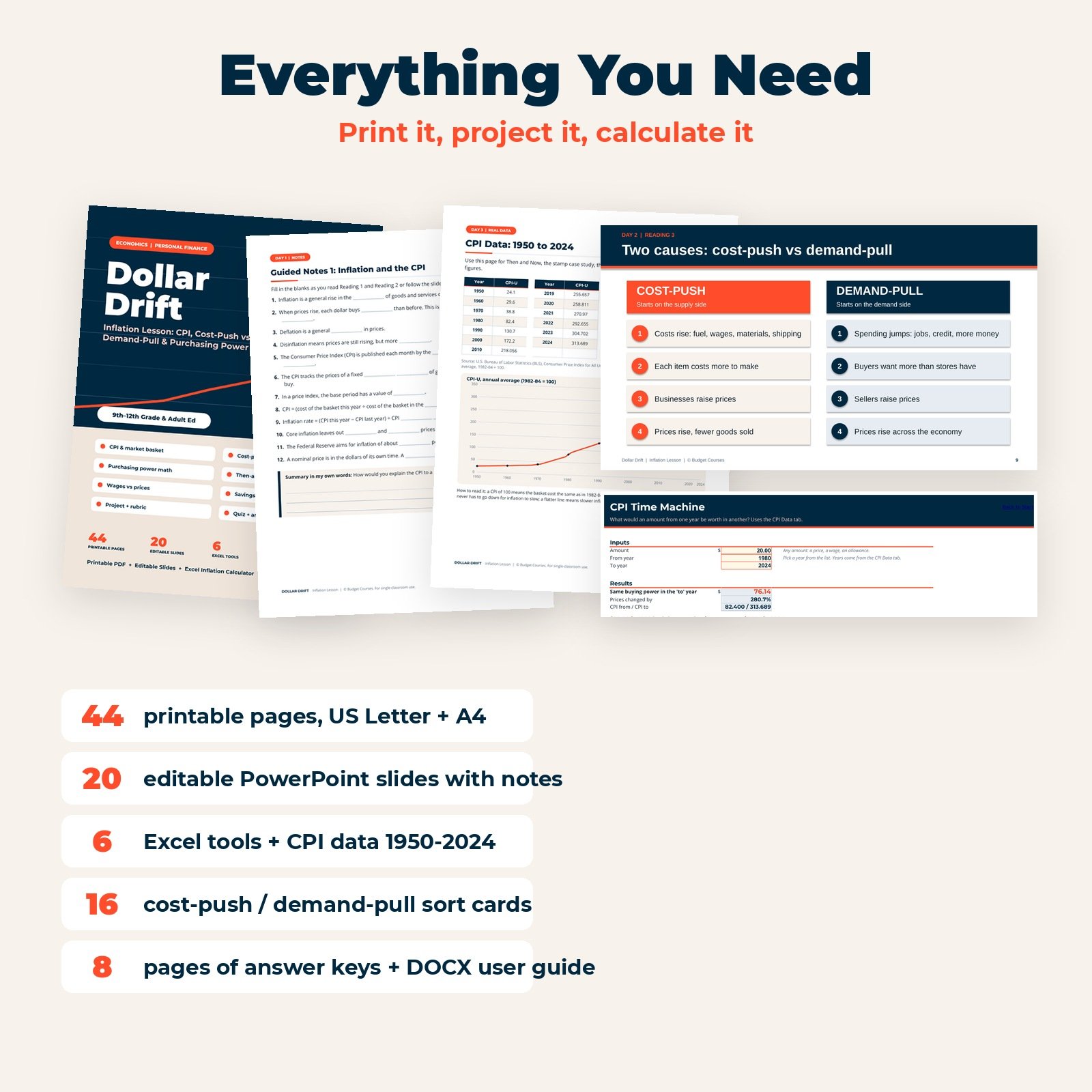


Dollar Drift is a complete inflation lesson for high school economics, personal finance and Adult Education. Learners find out what the Consumer Price Index measures, sort 16 real-world cost-push and demand-pull scenarios, convert prices across 74 years with official CPI data, and decide whether a raise really kept up with prices. It runs for five class periods, with a two-day project option, and you can also teach a one-day, no-prep version.
What this inflation lesson covers
Most inflation worksheets stop at a definition and a cartoon. This one puts real numbers in front of learners and asks them to use them. A $20 bill from 1980 had the buying power of $76.14 in 2024. A first-class stamp cost 8 cents in 1971, which is about 62 cents in 2024 dollars, so it really did get pricier. The federal minimum wage of $1.60 in 1968 is worth $14.42 today. Learners work all of this out themselves.
- What inflation is, plus deflation, disinflation and hyperinflation, and why the Federal Reserve aims for about 2%
- What the CPI measures: the market basket, the eight major groups, base years and the two core formulas
- Cost-push vs demand-pull inflation, the wage-price spiral and why higher interest rates cool demand
- Purchasing power math: moving prices between years, future prices, today’s value of future money and the Rule of 70
- Wages vs prices: nominal vs real wages and the minimum wage in 2024 dollars
- Savings and loans: real interest rates, who wins and who loses, and ways to protect buying power
- Shrinkflation and a personal inflation rate built from each learner’s own spending
What is included
44-page printable lesson (PDF, US Letter and A4)
- Teacher guide with objectives, standards connections, a 5-day pacing guide, teaching tips and background notes with sources
- 4 one-page readings with Quick Check questions and 2 guided notes pages
- Warm-up with a K-W-L chart and a Build a Basket CPI activity
- 16 cut-apart Cost-Push or Demand-Pull sort cards with a recording sheet
- Purchasing Power Toolkit, 8 practice problems and a CPI Data page (CPI-U, 1950 to 2024)
- Then and Now: CPI Time Machine, The Price of a Stamp case study and Wages vs Prices: The Minimum Wage, each with a graph to complete
- Real Raise or Pay Cut?, Winners and Losers, Savings and Loans Math, Shrinkflation Lab and My Personal Inflation Rate
- Vocabulary word wall (18 terms) and a 12-item vocabulary check
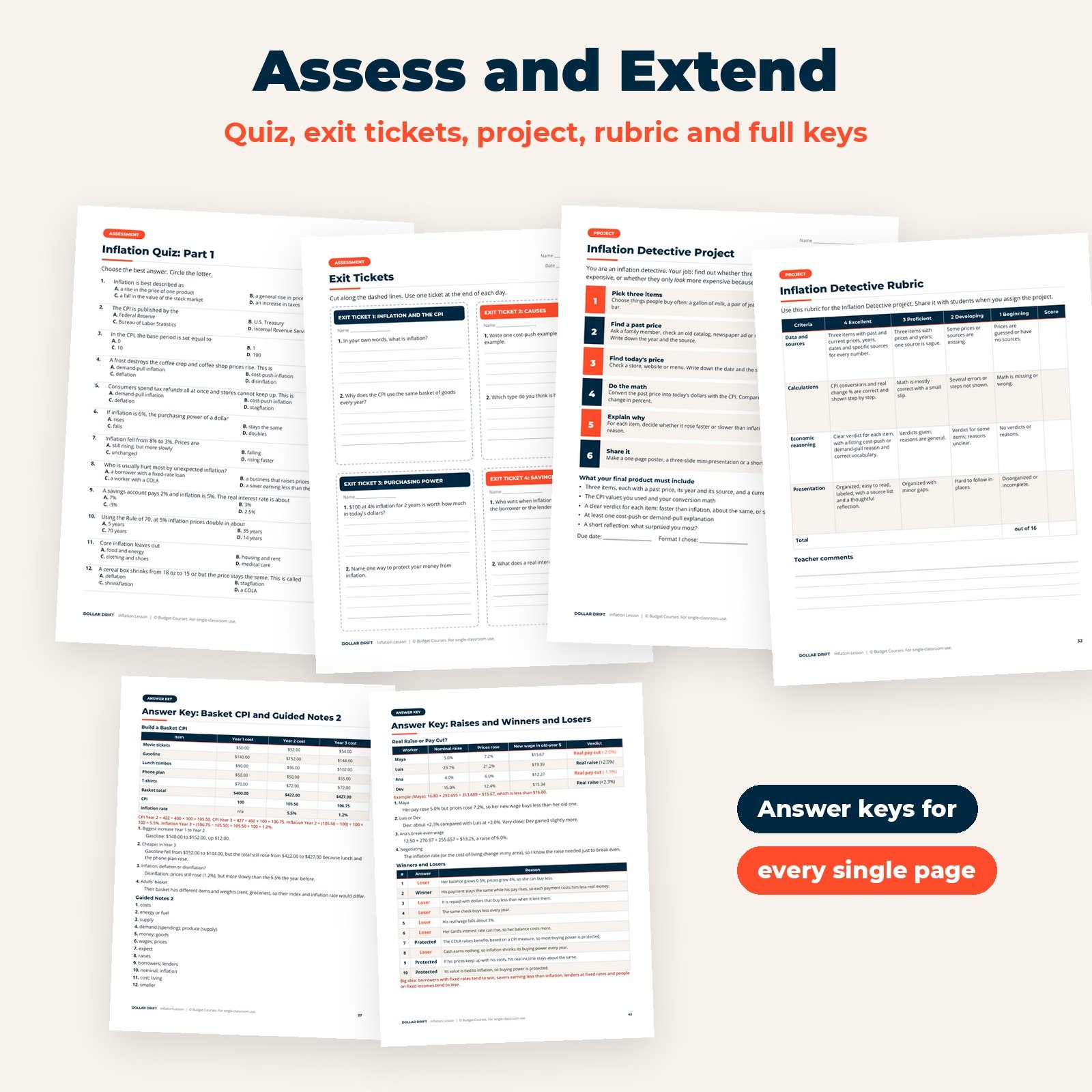
- Inflation Detective project with a price hunt sheet and a 4-level rubric
- 16-question inflation quiz, 4 exit tickets and 8 pages of answer keys
20 editable teaching slides (PowerPoint)
The deck follows the lesson in order, with speaker notes on every slide. The CPI, stamp and minimum wage charts are real, editable charts, and the slides use Arial so they look the same on any computer.
Excel inflation calculator
Six tools for live demos and student practice: CPI Time Machine, Purchasing Power, Savings Check, Raise Check, Basket CPI and Personal Rate. The CPI Data tab holds the official CPI-U annual averages from 1950 to 2024, with blank rows for new years. One currency setting controls every money value. Formulas are locked without a password, and inputs are checked so a typo cannot break a result.
User guide (DOCX)
A 10-page guide with a page map, setup steps, tips, troubleshooting and FAQ.
Why teachers choose this CPI and inflation activity set
- Real data, clearly labeled. Every real figure names its source and year: BLS CPI-U, the U.S. Department of Labor and the U.S. Postal Service. Practice prices are marked as example prices, so answer keys never change.
- Math that matters. Learners calculate a price index, an inflation rate, a real wage and a real interest rate, not just vocabulary.
- Works for teens and adults. Examples use paychecks, rent, car payments and savings accounts, written in plain language.
- Low prep. Print in black and white, cut one set of cards and teach from the slides.
How it works
Day 1: What inflation is and how the CPI works, ending with Build a Basket CPI. Day 2: Cost-push vs demand-pull inflation and the card sort. Day 3: Purchasing power math with real CPI data. Day 4: Wages, savings and loans. Day 5: Shrinkflation, personal inflation, vocabulary and the quiz. Exit tickets close each day, and the optional Inflation Detective project takes two more periods.
File formats and software
- PDF lesson in US Letter and A4, fonts embedded, with a clickable contents page and bookmarks
- PPTX slides: tested in PowerPoint-compatible software (LibreOffice Impress)
- XLSX calculator: built for Microsoft Excel and tested in LibreOffice Calc
- DOCX user guide: opens in Word or LibreOffice Writer
This is a digital download. Nothing ships. After checkout you can download all five files right away, as many times as you need.
Customizing
Edit any slide text, color or chart. In the calculator, choose your currency symbol, type in your own market basket, or add next year’s CPI value and every tool updates. The printable PDF keeps a fixed layout for clean printing.
Great for
- High school economics units on inflation, unemployment and the Federal Reserve
- Personal finance and consumer math classes covering saving, borrowing and paychecks
- Adult Education, GED and HSE social studies prep, and transition programs
- Homeschool economics, substitute plans and test review on purchasing power
FAQ
What grade level is this inflation lesson for?
Grades 9 to 12 and Adult Education. Strong 8th graders can handle the readings and card sort with support.
Is the data in the lesson real?
Yes where it says so. CPI-U values come from the U.S. Bureau of Labor Statistics, minimum wage rates from the Department of Labor and stamp prices from the Postal Service, each with its year. Store prices and named workers are marked as examples.
Does it explain cost-push and demand-pull inflation?
Yes. Reading 3 explains both with a step-by-step diagram, and learners apply it with 16 scenario cards and a recording sheet.
Do I need Excel?
No. The printable lesson stands on its own. The calculator is a bonus for demos and practice, and it also works in free LibreOffice Calc.
How long does it take?
Five periods of 45 to 55 minutes, plus an optional two-day project. A one-day version is described in the teacher guide.
Are answer keys included?
Yes, for every reading, activity, the quiz and the exit tickets.
Can I share it with my department?
One purchase covers one teacher and their own students. Colleagues are welcome to buy their own copy.


Reviews
There are no reviews yet.