

A Friendly, Complete DSST Criminal Justice Study Guide
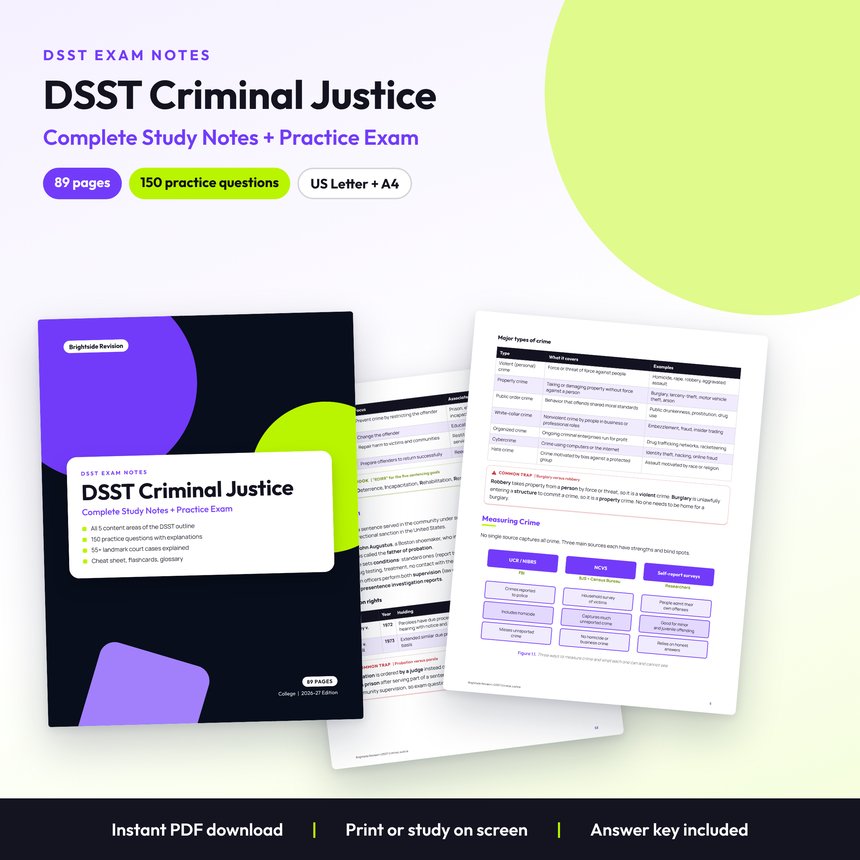
Bright Docket is a full DSST Criminal Justice study guide built to help you earn college credit with confidence. The DSST exam has 100 multiple-choice questions in two hours, covering criminal behavior, the criminal justice system, law enforcement, the courts and corrections. These notes walk you through every one of those areas in plain, encouraging language, with tables, flow charts and memory aids that make the names, dates and cases stick.
DSST lists 400 as the passing score, and the American Council on Education recommends 3 semester hours of credit. Each college decides how it awards that credit, so check your school’s policy.
Who It Is For
- Adult learners and college students earning credit by exam
- Military service members using DSST for college credit
- Students in an introductory criminal justice course
- Anyone considering a career in law enforcement, courts or corrections who wants a solid foundation
What Is Covered
Criminal behavior (15 percent)
- Defining and Measuring Crime: felonies and misdemeanors, types of crime, the UCR, NIBRS and NCVS, the dark figure of crime, juvenile delinquency.
- Theories of Crime: classical and rational choice, routine activities, positivism, social disorganization, strain, differential association, social bond, labeling and conflict theories.
The criminal justice system (25 percent)
- Legal Foundations: common law, substantive and procedural law, elements of a crime, defenses, and the Bill of Rights.
- Models, Agencies and Case Flow: Packer’s crime control and due process models, the funnel, the wedding cake model, discretion and agencies at every level.
Law enforcement (20 percent)
- Policing: History and Organization: Sir Robert Peel, the three eras of American policing, Vollmer, Wilson’s styles, patrol research.
- Police Discretion and Legal Limits: the Fourth and Fifth Amendments, Mapp, Terry, Miranda, Garner, Graham, corruption, community and problem-oriented policing.
The court system (20 percent)
- Courts and the Courtroom Work Group: the dual court system, judges, prosecutors, defense counsel, Gideon, juvenile courts.
- Pretrial, Trial and Sentencing: bail, grand juries, pleas and plea bargaining, jury selection, trial steps, sentencing goals and structures.
Corrections (20 percent)
- Corrections History, Probation and Parole: Walnut Street Jail, Pennsylvania and Auburn systems, punishment philosophies, intermediate sanctions.
- Jails, Prisons and Juvenile Corrections: security levels, inmate rights, capital punishment cases, privatization, wrongful convictions, juvenile justice cases.
Features
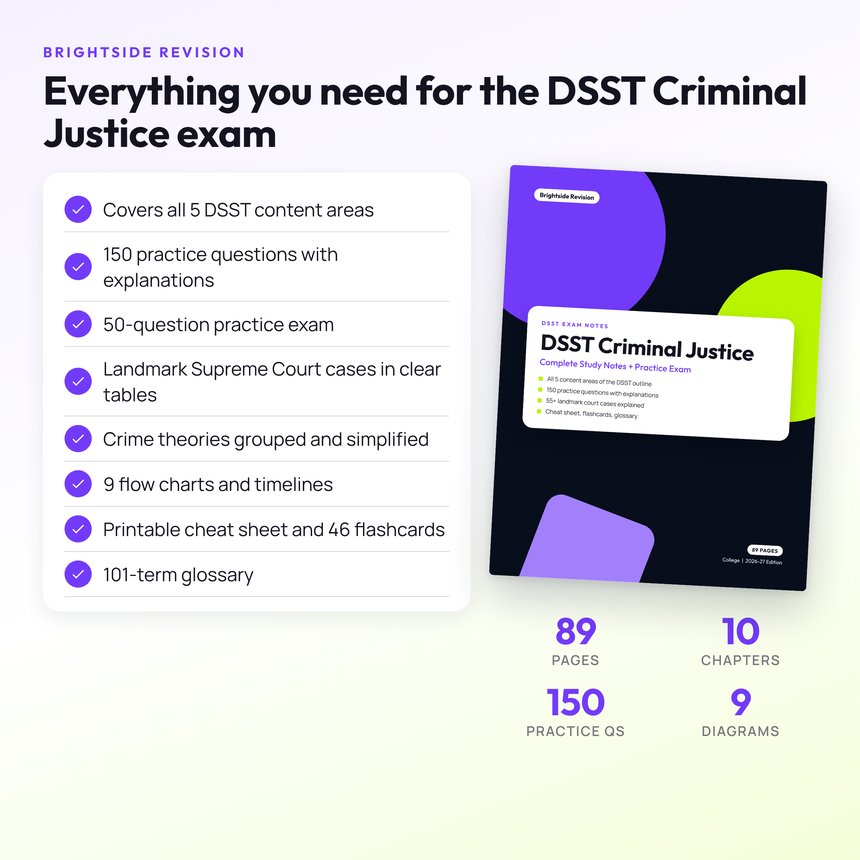
- 55+ landmark court cases in tables with the year and holding, from Marbury v. Madison to Miller v. Alabama
- 9 diagrams: crime measurement, theory map, case flow, policing eras, the dual court system, trial steps, sentencing goals and two timelines
- Mnemonics for Hirschi’s social bonds, Wilson’s policing styles, the five sentencing goals and juvenile rights cases
- Trap boxes for classic mix-ups: robbery versus burglary, probation versus parole, Furman versus Gregg
DSST Criminal Justice Practice Questions
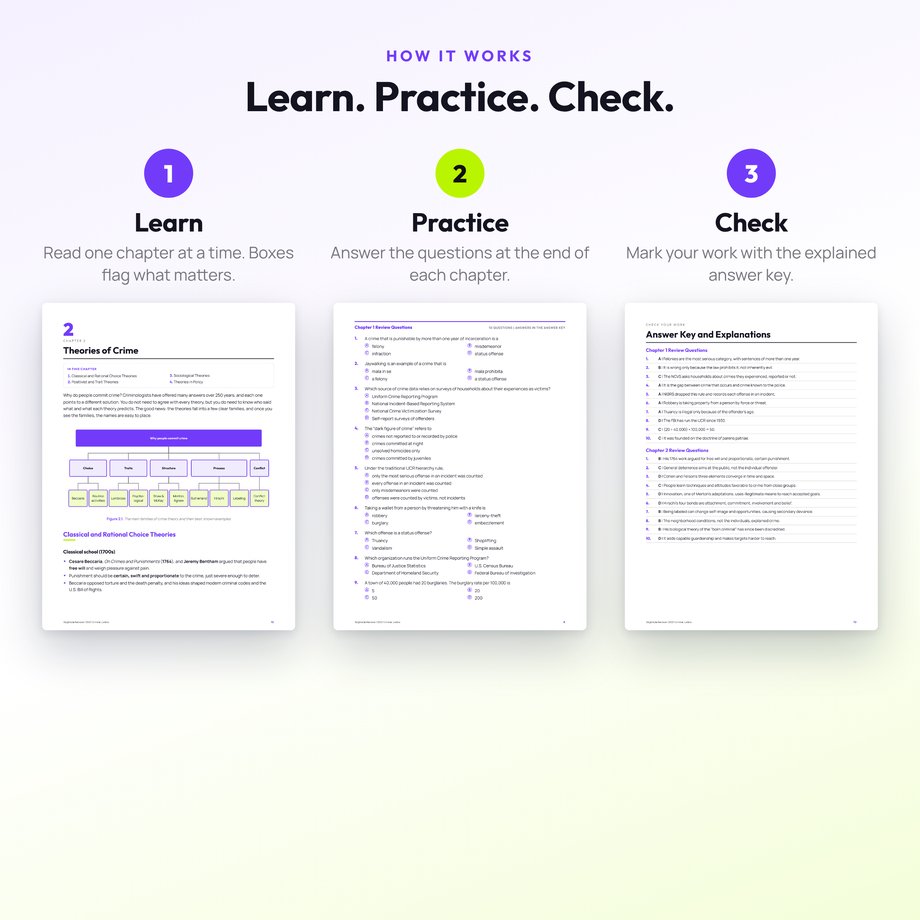
- A 10-question review at the end of every chapter (100 questions)
- A 50-question practice exam weighted like the real test
- Every answer explained in the Answer Key
Review Tools
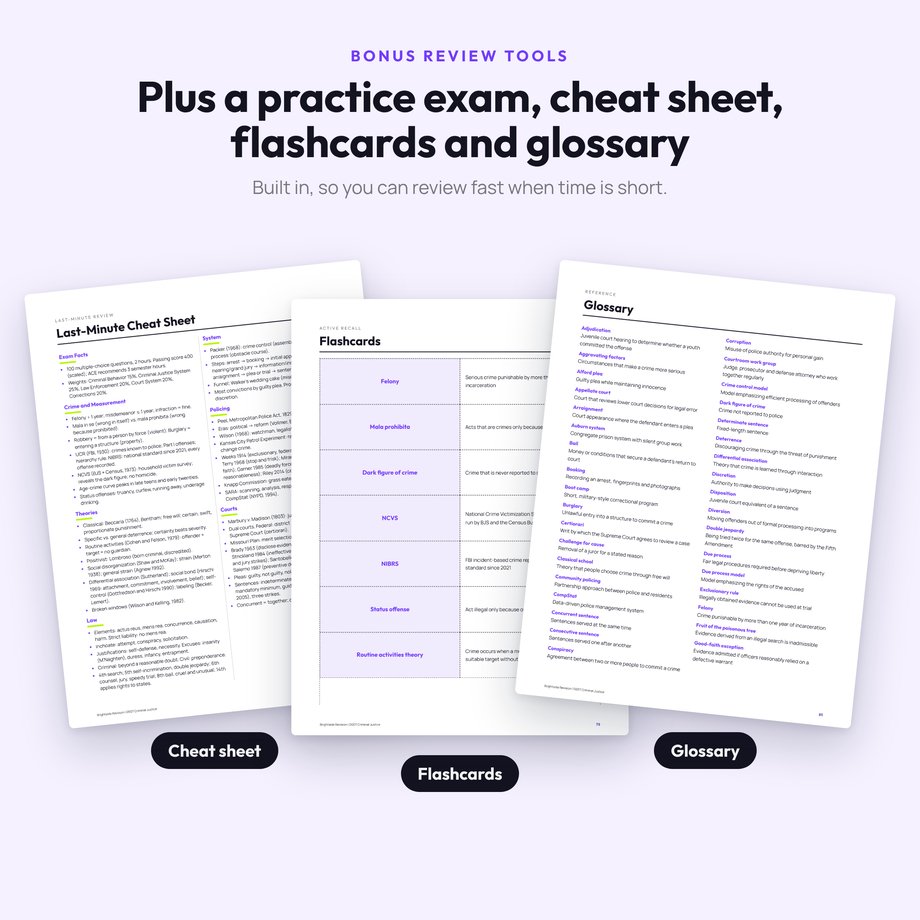
- A last-minute DSST Criminal Justice cheat sheet
- 46 cut-out flashcards
- A 101-term glossary
How It Works
- Read one chapter at a time; start with Chapter 1 and work in order.
- Answer the chapter review without looking back, then read every explanation.
- Build your own case list from the tables and quiz yourself daily.
- Take the practice exam in about an hour, then focus on weak areas.
- In the final days, use the cheat sheet and flashcards.
Files Included
- Full study guide PDF, US Letter size
- Full study guide PDF, A4 size
- Separate cheat sheet PDF
- User guide (DOCX) with study tips and a suggested schedule
Formats and Software
The PDFs open in any PDF reader on a computer, tablet or phone. The user guide is a DOCX file that opens in Microsoft Word, Google Docs, Pages or LibreOffice.
Printing and Customizing
Print everything or choose a page range for the chapters you need. Highlight and take notes on a tablet in apps such as GoodNotes, Notability, Xodo or Adobe Acrobat. Print the flashcards on card stock for quick review.
Digital Download
This is a digital product, and nothing is shipped. You can download your files right after checkout and download them again from your account whenever you need them.
Use Cases
- Self-study for the DSST Criminal Justice exam
- Review for an introductory criminal justice course
- Preparation for a criminal justice degree program
- A quick refresher on landmark cases and terms
FAQ
Does this follow the official DSST outline?
Yes. The ten chapters cover all five content areas, and the practice exam is weighted to match them.
How many practice questions are there?
150: 100 chapter review questions and a 50-question practice exam.
Do I need any background in criminal justice or law?
No. Every term is explained when it first appears, starting from the basics.
Are the Supreme Court cases up to date?
Yes. The case tables include recent decisions such as Riley v. California (2014) and Ramos v. Louisiana (2020).
What score do I need?
DSST lists 400 as passing; your college sets its own credit policy.
Is this an official DSST product?
No. DSST is a registered trademark of Prometric, which is not affiliated with and does not endorse this product.
Try a Free Sample First
Not sure yet? Download a free chapter of these DSST Criminal Justice notes and see the layout, the diagrams and the practice questions for yourself.
DSST is a registered trademark of Prometric, which is not affiliated with and does not endorse this product.


Reviews
There are no reviews yet.