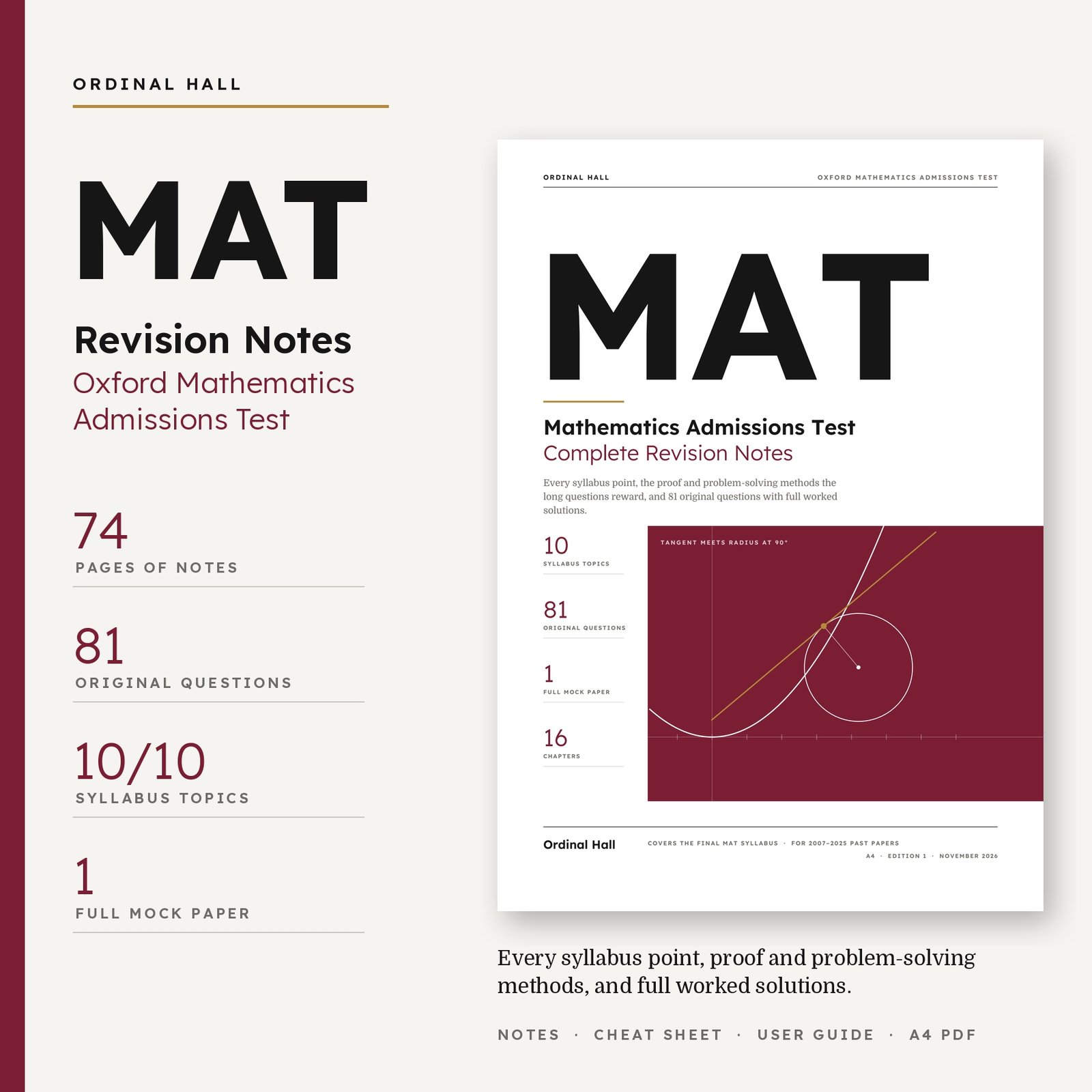




MAT revision notes that teach the whole syllabus and the thinking behind it
The Oxford Mathematics Admissions Test (MAT) was famous for asking hard questions about easy-looking mathematics. Its syllabus was small, roughly the pure mathematics of the first year of A-level plus a few extra topics, but the questions demanded fluent algebra, quick sketches and clear logical arguments. These Ordinal Hall MAT Revision Notes teach every point of the final MAT syllabus in its official order, then show you how to use that knowledge on the multiple-choice and long questions that made the MAT distinctive.
Please read before buying: the University of Oxford used the MAT from 2007 to 2025. Oxford has announced that from 2026 the MAT does not take place and that applicants for Mathematics, Computer Science and joint honours courses take the TMUA instead. These notes are designed for working through the nineteen years of free MAT past papers and for Oxford-style problem-solving practice. If your required test is the TMUA, use them alongside the official TMUA materials, not instead of them.
What’s covered
The ten syllabus headings (Chapters 1 to 10)
- Polynomials: completing the square, the quadratic formula, the discriminant, factorisation, the Factor Theorem, counting real roots.
- Algebra: simultaneous equations, inequalities, AM-GM, counting and combinations, the Binomial Theorem, binomial probabilities.
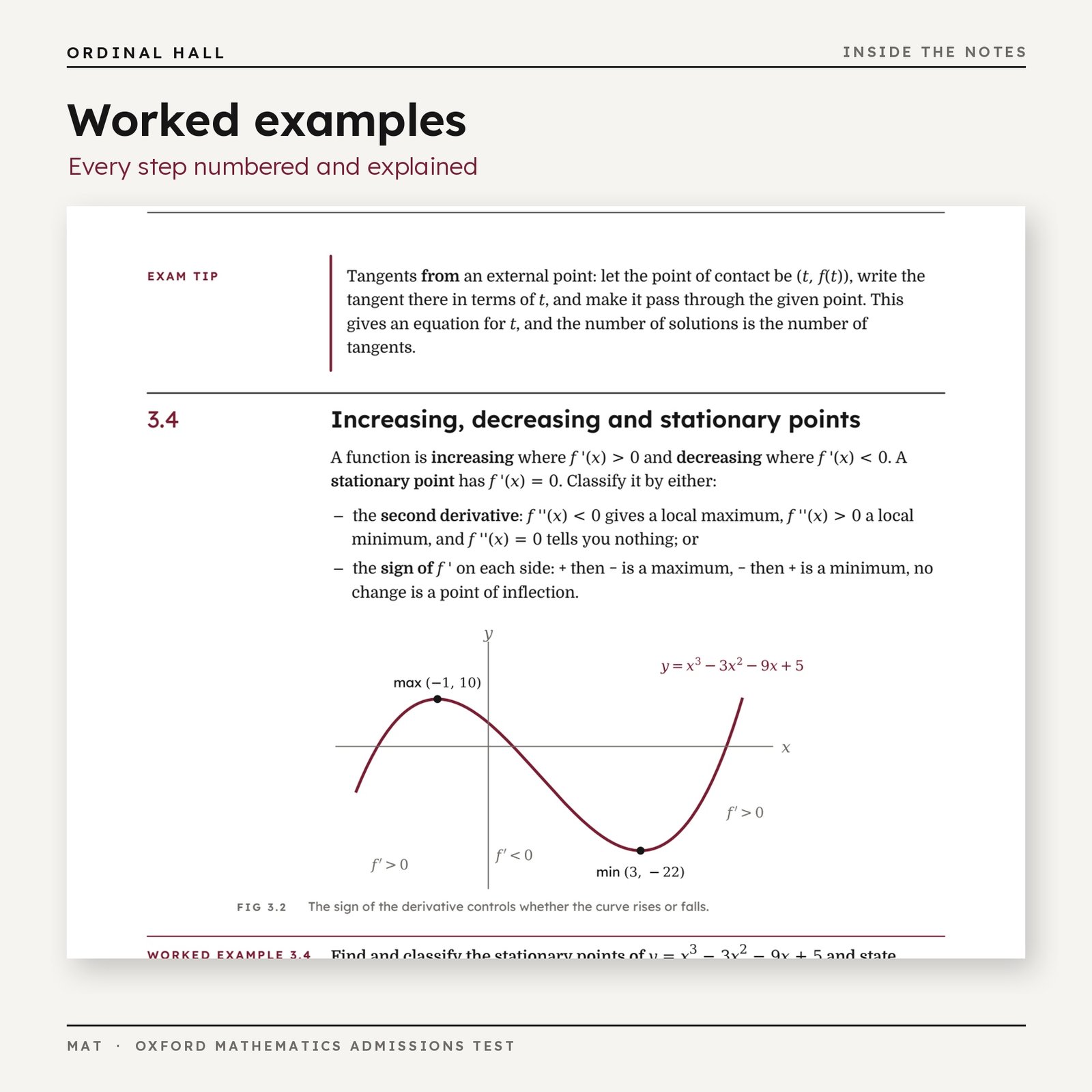
- Differentiation: first principles, powers and exponentials, tangents and normals, stationary points, maxima and minima.
- Integration: reverse differentiation, definite integrals as signed areas, reasoning about integrals of unknown functions.
- Graphs: quadratics, cubics, trigonometric, root, exponential and logarithmic graphs; solving equations by sketching.
- Logarithms and powers, Transformations, Geometry (lines, circles, circle properties, arcs, vectors), Trigonometry and Sequences and series.
Problem solving and technique (Chapters 11 and 12)
A full chapter on logic, proof methods (contradiction, contrapositive, induction, construction), parity and remainders, invariants, the pigeonhole principle and recursive counting: the tools the long questions reward. A technique chapter explains how the 2024 and 2025 tests and the earlier paper-based tests were structured and marked, with a timing plan, multiple-choice strategies, command words and a model structure for proof answers.
What’s included
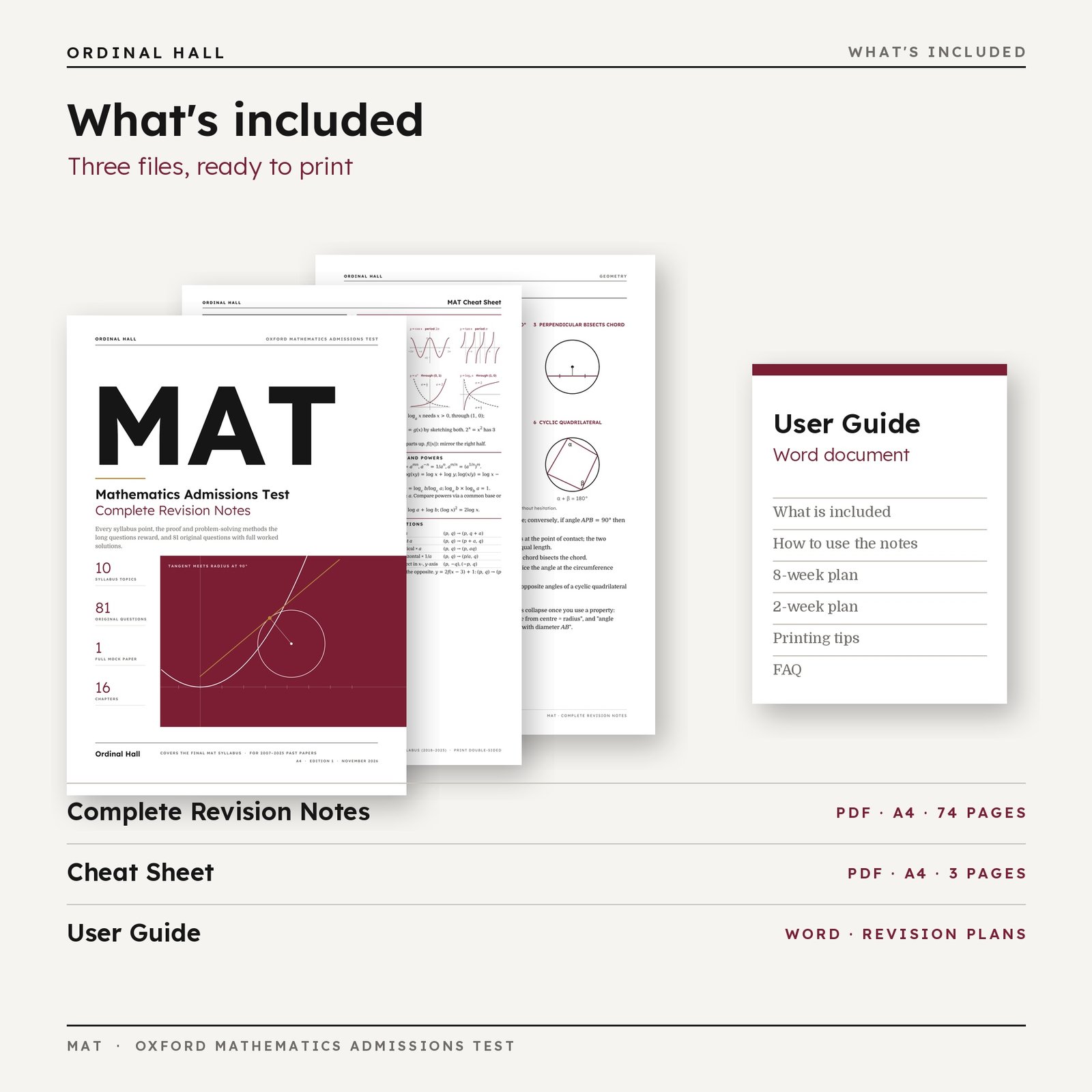
- Complete Revision Notes (PDF, A4, 74 pages): ten syllabus chapters, proof and problem solving, exam technique, 81 original practice questions with full worked solutions, a glossary and a syllabus checklist with page references.
- Cheat Sheet (PDF, A4, 3 pages): dense, printable summaries of formulae, graph shapes, transformations, circle properties, exact trigonometric values, series results, patterns to recognise and proof templates.
- User Guide (Word document): how to use the pack, 8-week and 2-week revision plans, printing tips, how to use the checklist and an FAQ.
Practice questions
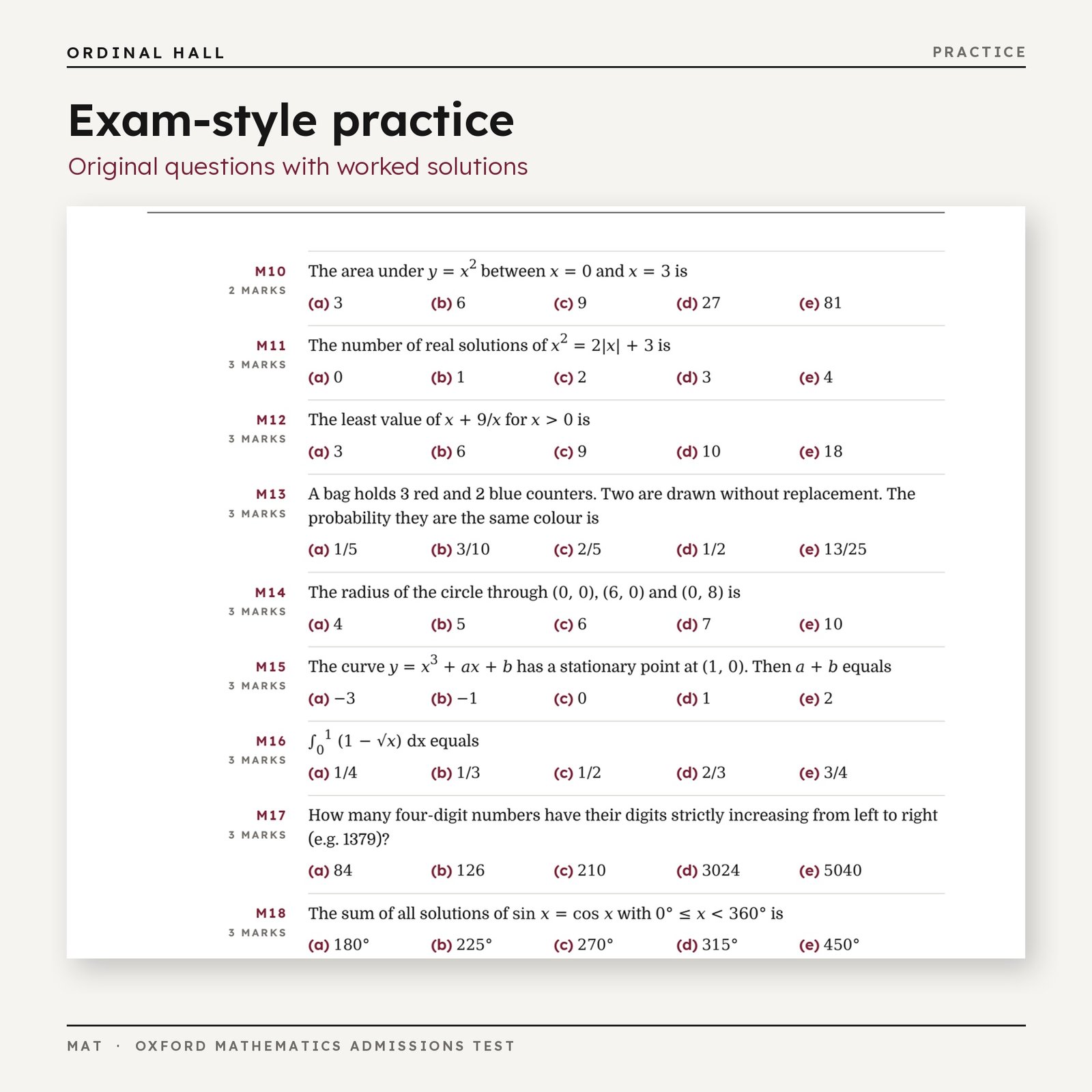
All 81 questions are original and written in the MAT style: ten topic sets of five multiple-choice questions, a full mock in the 2024 to 2025 format (25 multiple-choice questions plus two 15-mark long questions) and four further long questions. Every question has a worked solution, and every numerical answer has been checked by computer.
Design and features
- A clean Swiss-style layout on a strict two-column grid: labels on the left, teaching on the right, so you can find any worked example, tip or definition at a glance.
- Over twenty diagrams drawn precisely in code: graphs, circle properties, transformations, cobweb diagrams and more.
- Numbered worked examples with boxed answers, plus Exam tip, Common mistake, Key fact and Links callouts.
- Prints well in black and white; correct mathematical symbols throughout.
How to use it
Start with a topic set to find your weak areas, then work through the matching chapter, covering each worked example and trying it yourself first. Do the topic set again, then move on to official MAT past papers on the same topic. When you have finished Chapters 1 to 12, sit the mock under timed conditions and mark it with the full solutions. Use the checklist to make sure every syllabus point is learnt, practised and secure.
Who it’s for
Year 12 and Year 13 students who want to work through MAT past papers with confidence; applicants for Oxford Mathematics, Computer Science or joint honours who want serious problem-solving practice; and teachers running enrichment or Oxbridge preparation sessions.
FAQ
Is the MAT still running?
No. Oxford used the MAT from 2007 to 2025 and uses the TMUA from 2026. These notes cover the final MAT syllabus for past-paper work and problem-solving practice.
Will this help with the TMUA?
Oxford says the TMUA topics are very similar to the MAT’s and that the tests share a problem-solving spirit, so this practice is relevant. It is not a complete TMUA course; use the official TMUA specification and papers as well.
Are these real MAT questions?
No. Every question is original. Real past papers and official solutions are free from the University of Oxford website, and the notes show you how to use them.
Do I need a calculator?
No. Like the MAT, everything is designed to be done without one.
What do I need to know first?
GCSE Higher maths and some Year 12 A-level Maths. The notes teach everything else on the syllabus.
Disclaimer
This product is independent and is not affiliated with, endorsed by or produced by the University of Oxford, UAT-UK or any test provider. It covers the final MAT syllabus (issued January 2018 and used up to the October 2025 test). University of Oxford and Oxford are trade marks of the Chancellor, Masters and Scholars of the University of Oxford. This product is independent and is not endorsed by the University of Oxford.



Reviews
There are no reviews yet.