
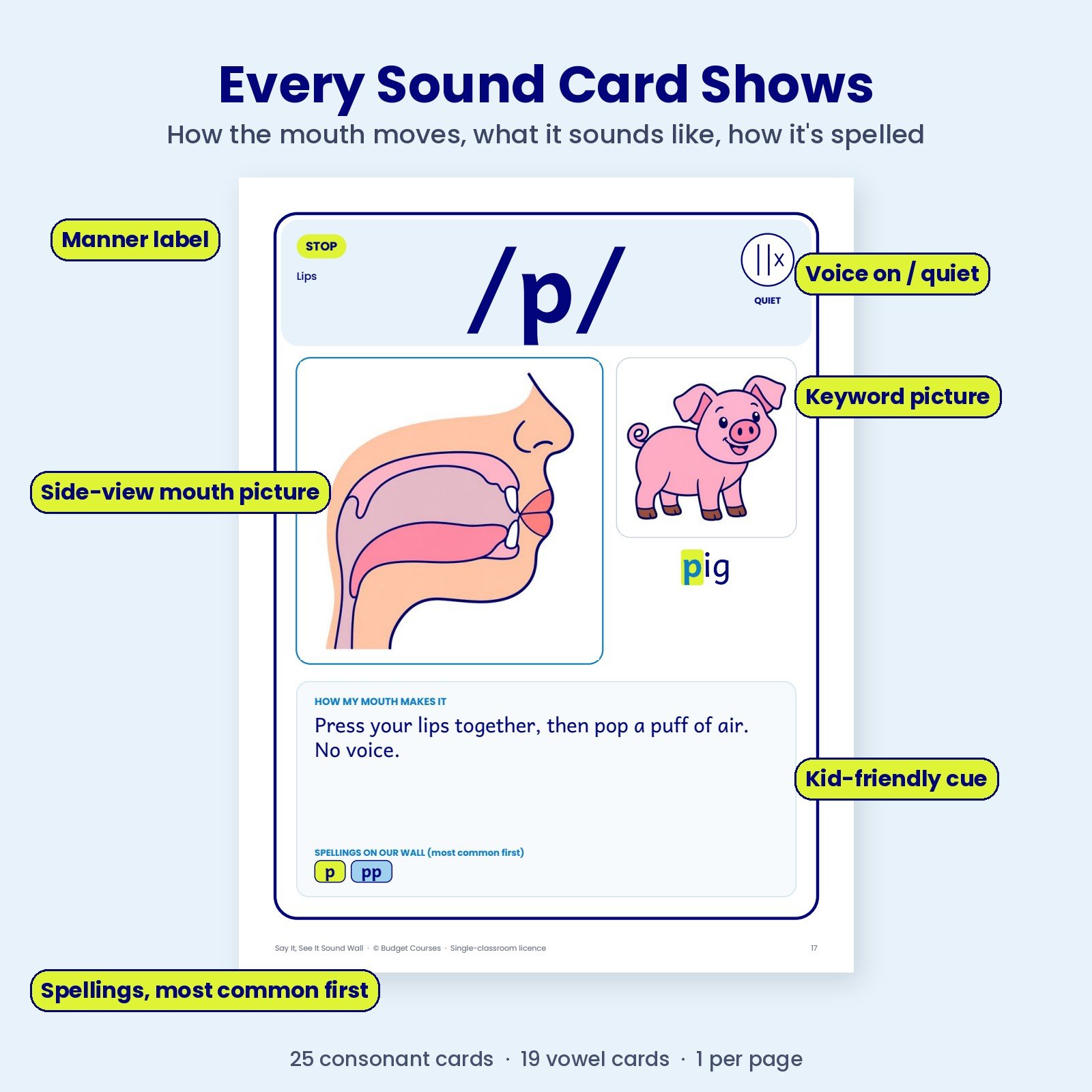
The Say It, See It Sound Wall is a printable sound wall with mouth pictures for kindergarten, 1st grade and 2nd grade. All 44 sounds get their own card. Each one has a side-view mouth picture, a keyword picture, the sound in slashes, a manner label and a voice icon. Then 160 grapheme cards go underneath, so kids can see every common way to spell what they just said.
It’s built for teachers who are swapping a word wall for a Science of Reading sound wall and don’t want to spend three weekends making cards. Print, laminate, hang. The teacher guide tells you where every card goes.
Why a sound wall with mouth pictures works
Kids can say /k/ long before they know it might be spelled c, k, ck or ch. A word wall makes them start with letters they don’t know yet. A sound wall flips that. They start with the sound, feel where their mouth makes it, find the card, then look down for the spelling.
The mouth pictures carry most of the load here. Lips pressed together for /p/ /b/ /m/. Top teeth on the bottom lip for /f/ /v/. Tongue peeking out for /th/. Back of the tongue up for /k/ /g/ /ng/. Every picture uses the same side view, the same colors and the same line weight, so children learn to read them fast. Pull out a mirror and they can copy the shape themselves.
What’s inside the sound wall printables
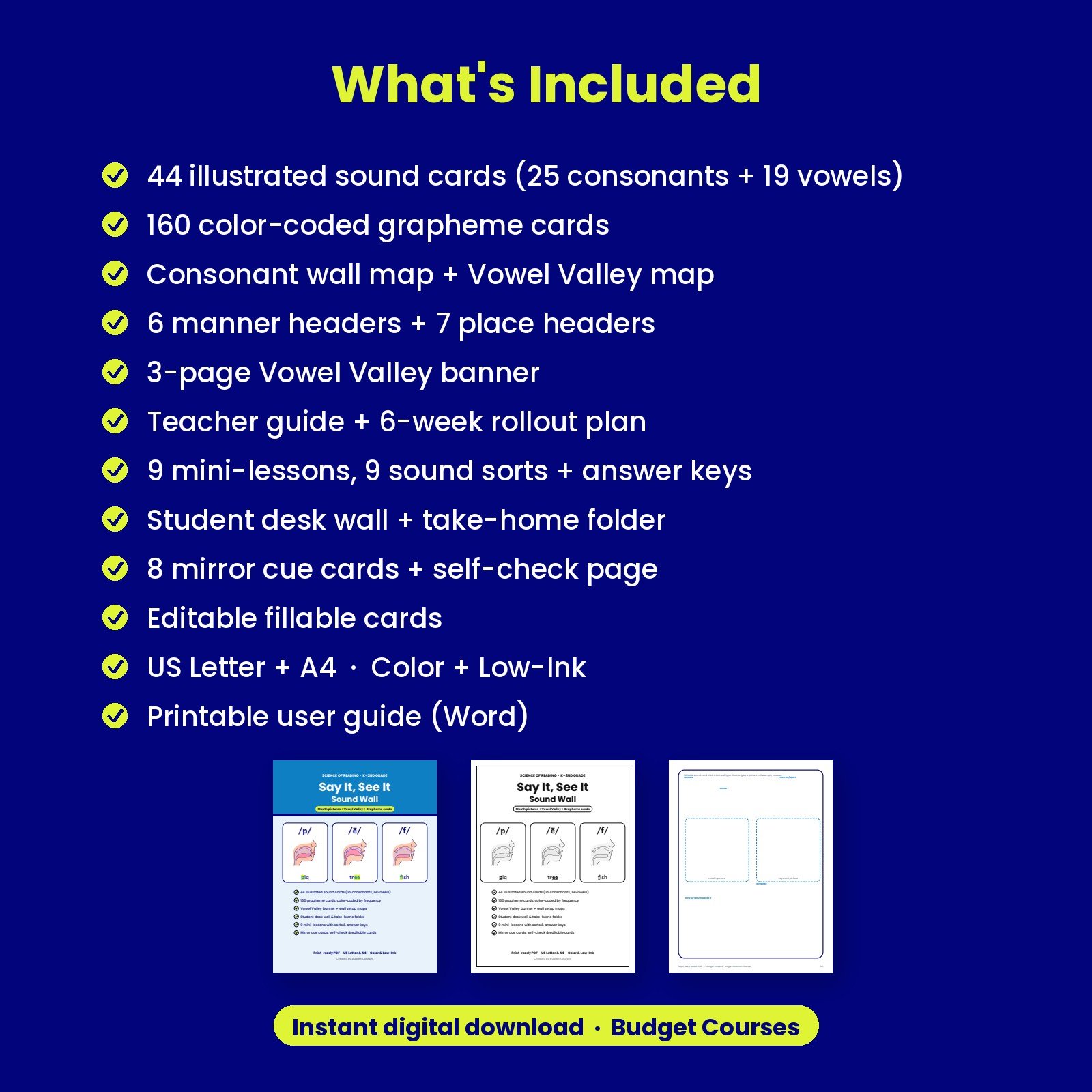
- 25 consonant sound cards with mouth picture, keyword picture, manner label (stop, nasal, fricative, affricate, glide, liquid), voice on / quiet icon and a kid-friendly “how my mouth makes it” cue
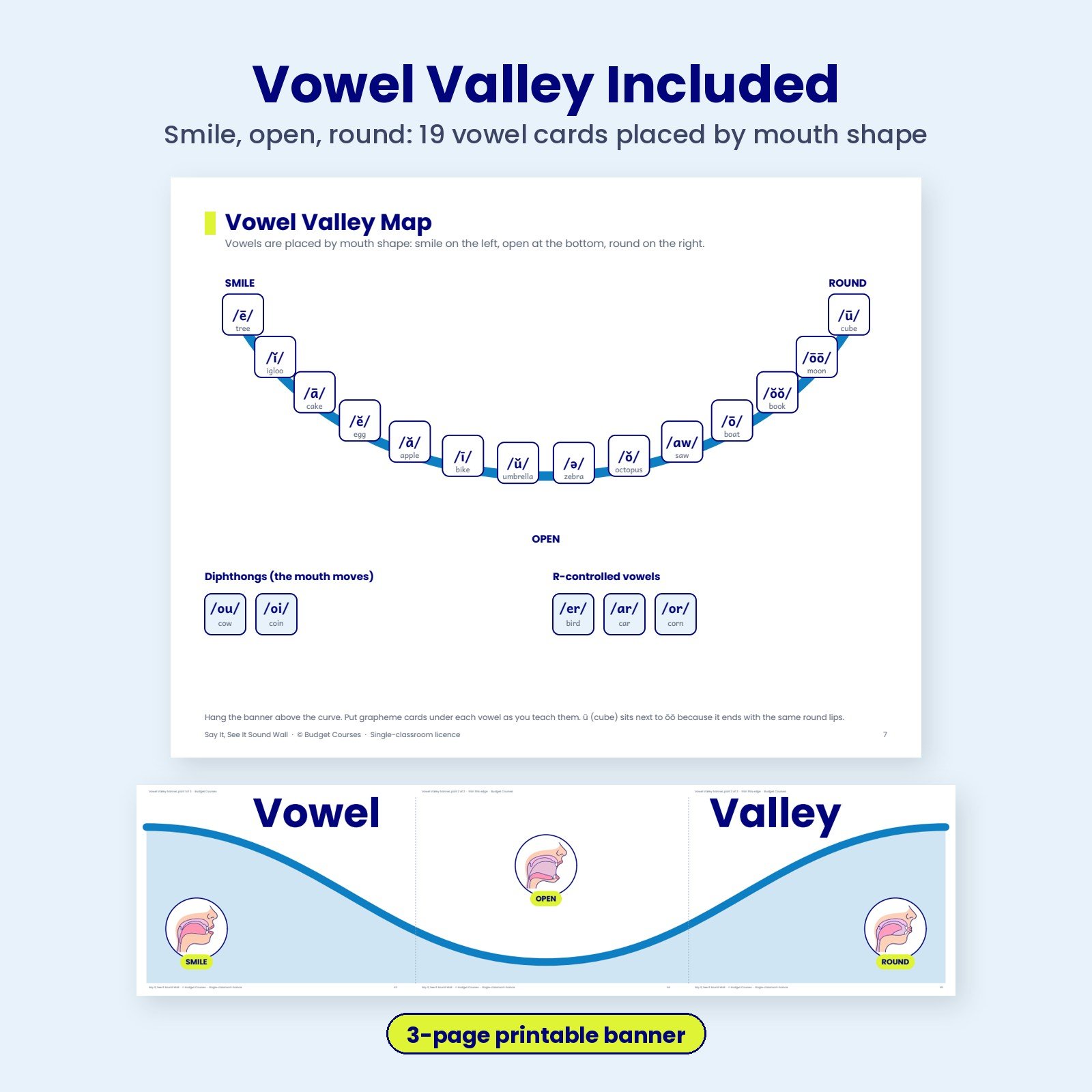
- 19 vowel sound cards for the Vowel Valley: short vowels, long vowels, schwa, diphthongs and r-controlled vowels. Glide vowels like /ā/ and /ī/ show a START and END mouth
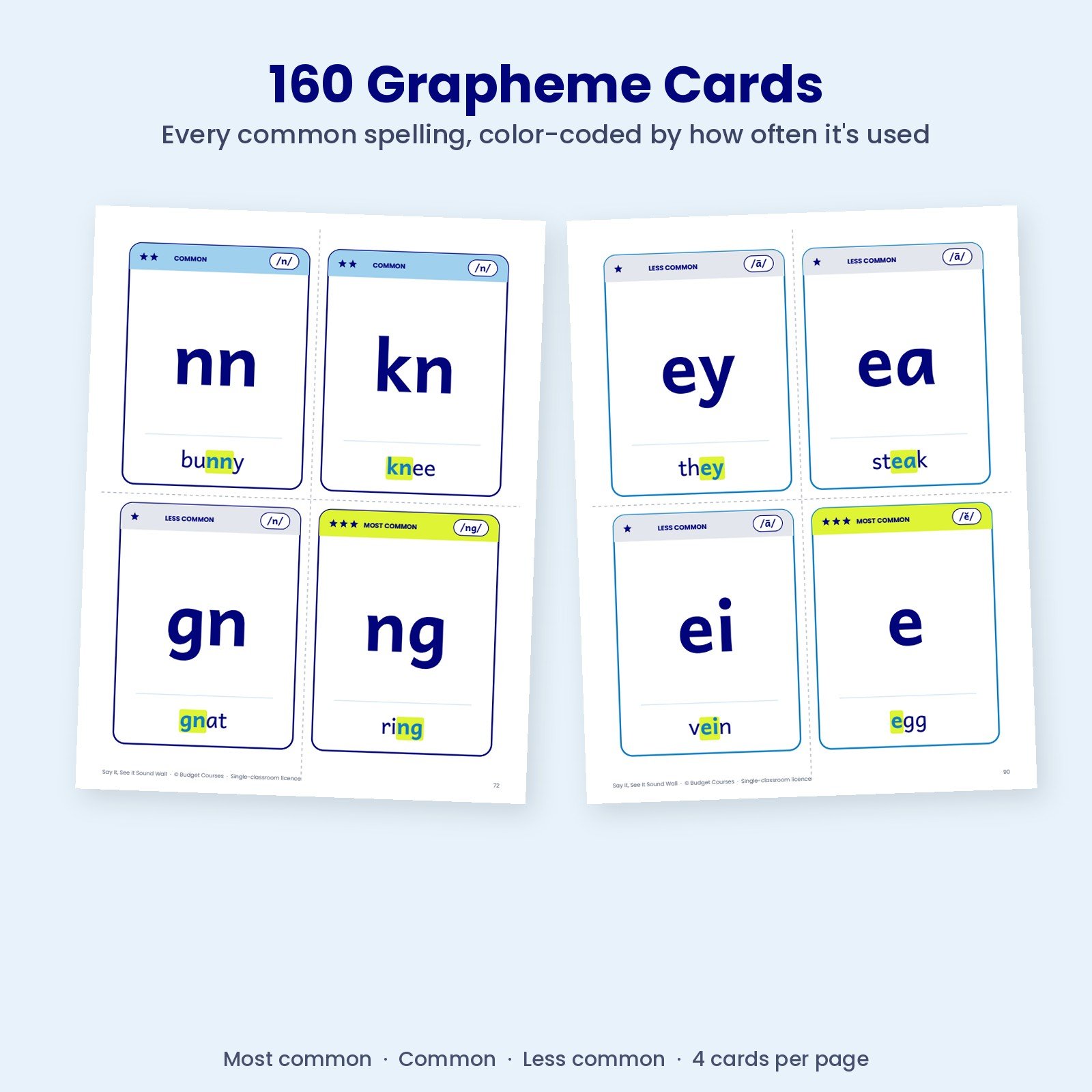
- 160 grapheme cards, 4 per page, color-coded most common, common and less common, with the target letters highlighted in an example word
- Vowel Valley banner (3 landscape pages that tape together)
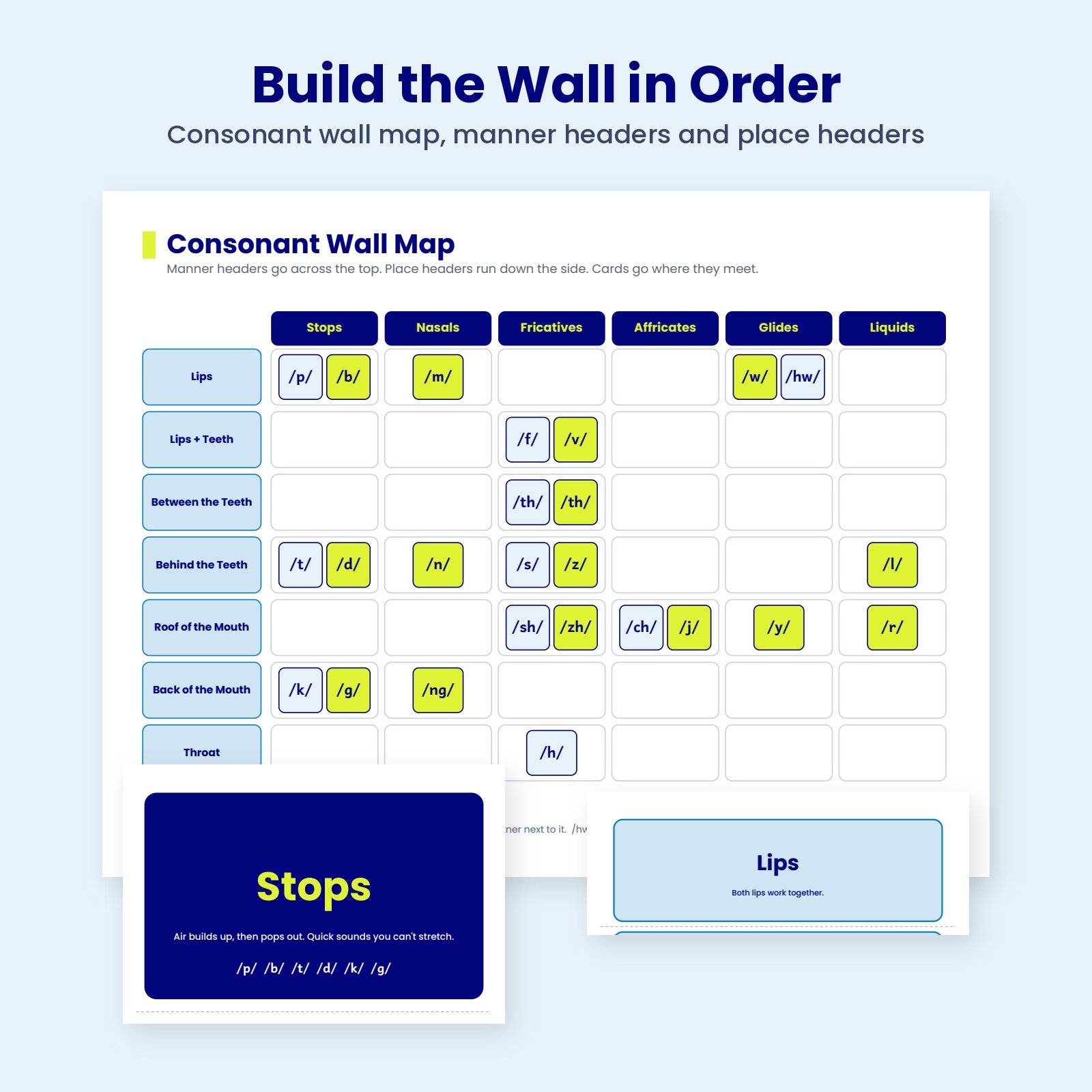
- 6 manner section headers and 7 place row headers
- Consonant wall map and Vowel Valley map so you know exactly where every card goes
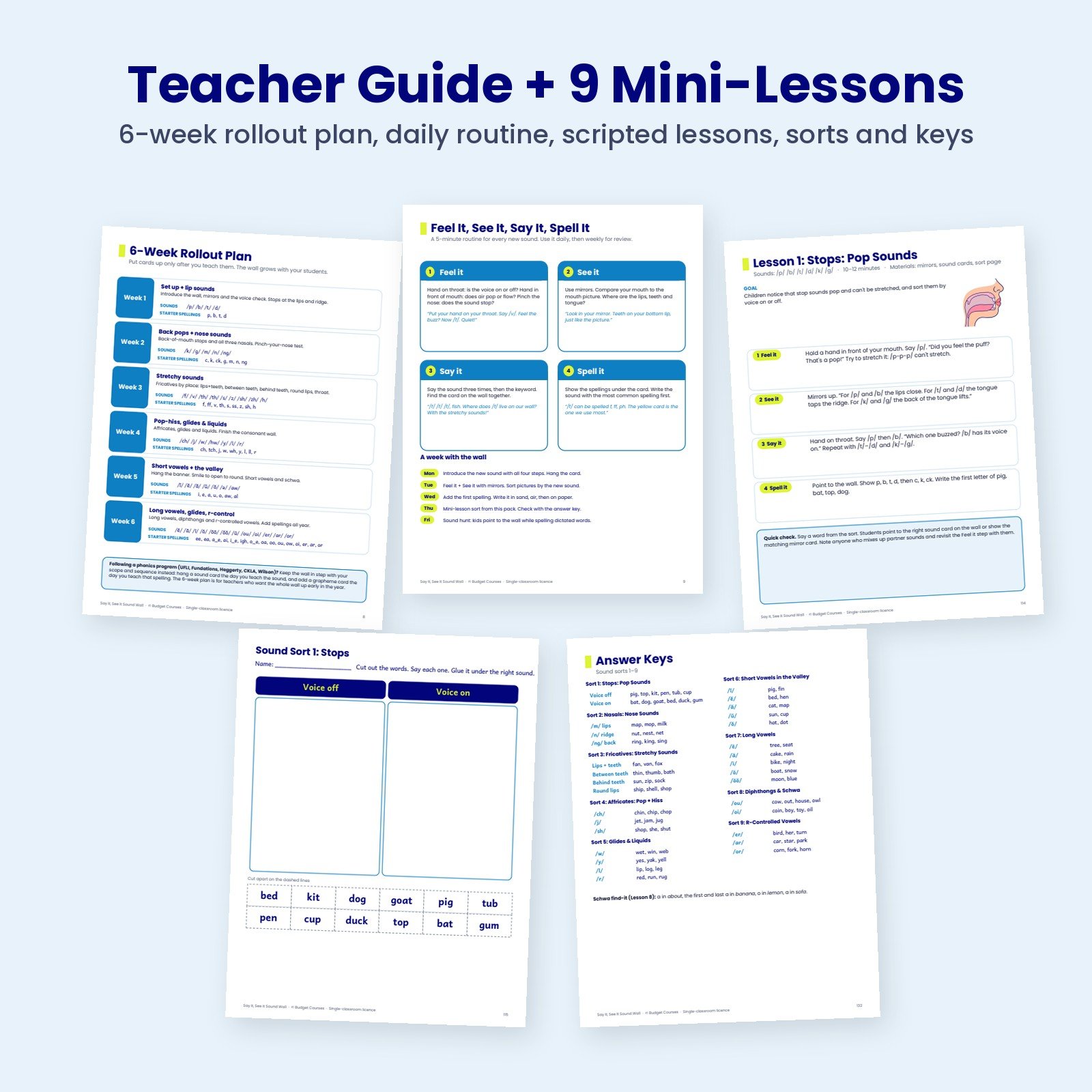
- Teacher guide: what a sound wall is, how it differs from a word wall, a 6-week rollout plan and a weekly Feel it, See it, Say it, Spell it routine
- 9 mini-lessons with a script, a cut-and-glue sound sort for each, and answer keys
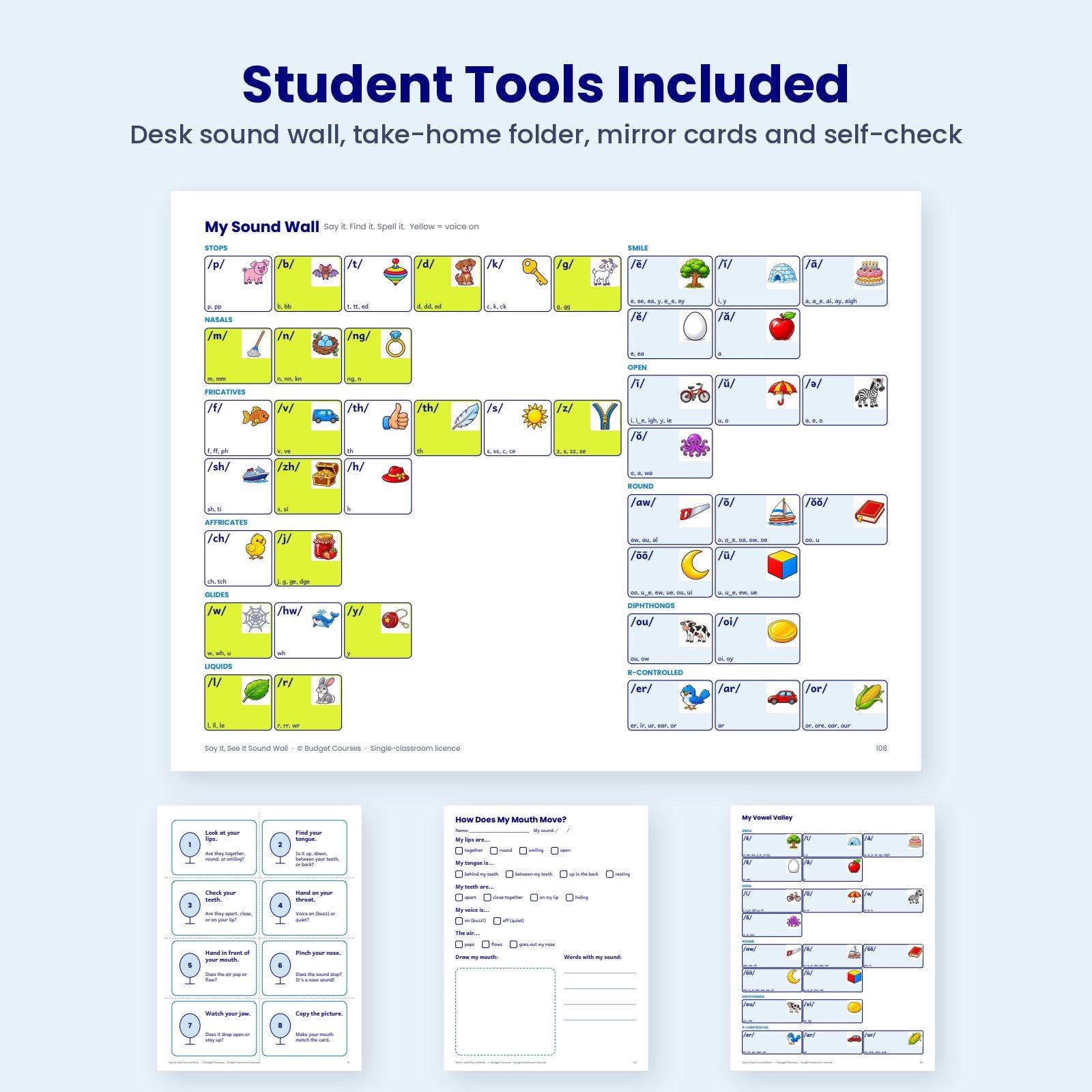
- Student desk sound wall on one landscape page, plus a 2-page take-home folder version
- 8 mirror-work cue cards and a “How Does My Mouth Move?” self-check page
- Editable fillable cards for sounds and spellings you want to add
- User guide in Word format
Sound wall kindergarten to 2nd grade: who it’s for
K–2 classroom teachers, reading specialists and interventionists get the most out of it. It also suits tutors and homeschool families. Older students who missed early phonics use it too, and the pictures are friendly without feeling babyish.
It sits next to any structured literacy program. If you teach UFLI, Fundations, Heggerty, CKLA or Wilson, hang each card on the day you teach that sound and add grapheme cards as the spellings come up. If you’d rather have the whole wall up early, follow the 6-week rollout plan.
How it works in the classroom
Every new sound gets the same 5-minute routine:
- Feel it. Hand on the throat. Is the voice on or off? Hand in front of the mouth. Does the air pop or flow?
- See it. Mirrors out. Match your mouth to the mouth picture.
- Say it. Sound three times, then the keyword. Find the card on the wall.
- Spell it. Point to the grapheme cards underneath. Start with the yellow one, the most common spelling.
During spelling, keep sending kids back to the sound wall classroom display. “What sound do you hear? Where does it live? Which spelling do we try first?” After a few weeks, they start doing it without being asked.
Built better than a basic sound wall poster set
A lot of sound wall poster sets stop at the sound cards. This one keeps going. You get the vowel valley printable, a full set of grapheme cards with frequency coding, wall maps, headers, lessons, sorts, student copies and editable cards. The grapheme cards each carry a small sound tag in the corner, so you never wonder where a card belongs. Voiced and quiet partners sit side by side on the map, which makes pairs like /f/ and /v/ easy to teach.
File formats and printing
- Printable PDF, 137 pages
- US Letter (8.5 x 11 in) and A4 versions
- Color and low-ink black-and-white versions of every page
- Editable cards as fillable PDF fields (open in the free Adobe Acrobat Reader)
- Clickable contents page and PDF bookmarks
- User guide as a Word (.docx) file
Sound cards print 1 per page. Grapheme cards print 4 per page with cut lines. Cardstock and lamination make the wall last the whole year. Tested in Adobe Acrobat Reader and Chrome’s PDF viewer.
Digital download
This sound wall with mouth pictures is a digital product. Nothing ships. You get instant access to every file after checkout, with unlimited downloads. Licence: one teacher, one classroom. Please don’t share the files with colleagues; send them the link instead.
FAQ
How many sounds does the sound wall cover?
All 44: 25 consonants (including the optional /hw/) and 19 vowels (including /ū/ as in cube).
Does it match UFLI?
It uses the same phonemes and standard spellings, so it works with UFLI, Fundations, Heggerty and most other science of reading programs. Follow your program’s order and hang cards as you go.
Why do some sounds share a mouth picture?
Because the mouth really does the same thing. /p/, /b/ and /m/ all close the lips. The difference is the voice or air through the nose, and the voice icon and manner label show that.
Can I print it in black and white?
Yes. Every page comes in a low-ink version with white backgrounds and light fills.
Can I edit the cards?
Yes. The editable sound card and grapheme cards have fillable fields. Type a sound, a spelling or a keyword, then print.
Is there a free sample?
Yes. Our free sound wall printables sampler has /p/ /b/ /m/, the Vowel Valley banner, two vowel cards and their grapheme cards. Find it on the Budget Courses blog.
What paper should I use?
Plain paper for the teacher guide and student pages. White cardstock (65 lb or 110 lb) for the wall cards.



Reviews
There are no reviews yet.