Financial accounting has a reputation for being dry, but it is really a set of simple rules applied again and again. If you understand the accounting equation, debits and credits, and the four financial statements, most of the first semester falls into place. This guide walks through the big ideas and gives you a study plan. A free chapter of our notes is included.
What Principles of Accounting I Covers
Most first-semester courses follow the same path.
| Stage | Topics |
|---|---|
| Foundations | GAAP, the accounting equation, the four financial statements |
| Recording | Debits and credits, journal entries, ledger, trial balance |
| Adjusting and closing | Accruals, deferrals, depreciation, closing entries |
| Merchandising | Purchases, sales, discounts, cost of goods sold |
| Assets | Inventory, cash, receivables, plant assets |
| Liabilities and equity | Payroll, bonds, stock, dividends |
| Reporting | Cash flows and ratio analysis |
Your instructor and textbook decide the exact order and emphasis, so use this as a map and your syllabus as the final word.
Want to see how our notes teach the basics? Grab the free chapter first. It covers the core assumptions, the accounting equation, and the four statements.

Free Financial Accounting Notes: Chapter 1 Sample (PDF)
The opening chapter: GAAP, assumptions, the accounting equation, and the four financial statements.

Want everything unlocked?
The free file is a sample. The full version has every page, tab and feature, plus the user guide.
See the full versionThe Accounting Equation Is Your Anchor
Everything starts with one equation: Assets = Liabilities + Equity. Every transaction changes at least two accounts and keeps the equation in balance.
- If you buy equipment with cash, one asset goes up and another goes down.
- If you buy supplies on account, assets and liabilities both go up.
- If you earn revenue, assets and equity go up.
- If you pay rent, assets and equity go down.
Practice writing the effect of five or six transactions on the equation before you move on. It builds the habit of checking that both sides stay equal.
Debits and Credits Without the Confusion
A debit is the left side of an account. A credit is the right side. Neither one means good or bad. Use the memory aid DEALER: Dividends, Expenses, and Assets increase with debits. Liabilities, Equity, and Revenues increase with credits.
Then use a simple routine for every transaction:
- Name the accounts affected.
- Classify each one (asset, liability, equity, revenue, expense, dividend).
- Decide whether it increased or decreased.
- Apply the debit and credit rules.
- Check that debits equal credits.
Full version
Trial Balance: Financial Accounting (Principles of Accounting I) Complete Course Notes
- Full accounting cycle with worked examples
- 185 practice questions with explanations
- 45-question practice exam
The Accounting Cycle
The cycle is a checklist: analyze transactions, journalize, post, prepare a trial balance, make adjusting entries, prepare financial statements, close the temporary accounts, and prepare a post-closing trial balance. Once you can walk through one example start to finish, you understand most of the course.
Adjusting entries deserve extra time
Adjusting entries are a favorite exam topic. Remember the four types: prepaid expenses, unearned revenues, accrued expenses, and accrued revenues, plus depreciation. Each entry touches one income statement account and one balance sheet account, and never cash. If you use cash in an adjusting entry, stop and check.
The Four Financial Statements
| Statement | What it shows |
|---|---|
| Income statement | Revenues minus expenses for a period |
| Statement of retained earnings | Beginning balance plus net income minus dividends |
| Balance sheet | Assets, liabilities, and equity at a date |
| Statement of cash flows | Cash from operating, investing, and financing activities |
Prepare them in that order. Net income feeds retained earnings, which feeds the balance sheet. If your balance sheet does not balance, trace the flow backward.
Topics That Trip Students Up
- Inventory methods. FIFO, LIFO, and weighted average split the cost of goods available into cost of goods sold and ending inventory. With rising prices, FIFO gives higher income and LIFO gives lower income. Understand the reason, not just the rule.
- Bank reconciliations. Only the book-side items need journal entries.
- Bad debts. The allowance method records the expense in the period of the sale. A write-off does not change net receivables.
- Depreciation. Compare straight-line, units-of-production, and double-declining-balance on the same asset.
- Bonds. If the stated rate is below the market rate, the bond sells at a discount.
- Cash flows. An increase in a current asset is subtracted in the indirect method. An increase in a current liability is added.
Ratios: Turning Statements into Answers
Once you can build the statements, ratios help you read them. Group every ratio under one of five questions. Can the company pay its bills? That is liquidity, measured by the current ratio and the quick ratio. Does it use its assets well? That is efficiency, measured by receivables and inventory turnover. Does it earn a return? That is profitability, measured by margins, return on assets, return on equity, and earnings per share. Is it carrying too much debt? That is solvency, measured by the debt ratio and times interest earned. What do investors think? That is the market view, measured by the price-earnings ratio and dividend yield.
When a ratio mixes an income statement item with a balance sheet item, use the average balance. When it uses only balance sheet items, use the ending balances. This one habit prevents many careless mistakes.
How to Practice Entries
Many students read a chapter and feel ready, then freeze on an exam. The fix is active practice. Cover the answer, write the journal entry, and say it aloud. Then check each account: is it an asset, liability, equity, revenue, or expense? Did it go up or down? Redo the same example later with different numbers. Ten minutes of entries a day beats a two-hour cram session before the test.
A Simple 8-Week Study Plan
| Week | Focus |
|---|---|
| 1 | Foundations, the equation, and the statements |
| 2 | Debits, credits, journals, and the trial balance |
| 3 | Adjusting entries, closing, and the cycle |
| 4 | Merchandising and inventory |
| 5 | Cash, internal control, and receivables |
| 6 | Plant assets and liabilities |
| 7 | Bonds, stock, and dividends |
| 8 | Cash flows, ratios, and a practice exam |
Study four or five days a week for 30 to 45 minutes. Always do the entry by hand before checking the answer. If you miss a question, write down why: a rule you forgot, a sign you flipped, or a number you copied wrong.
Want every chapter, not just the sample?
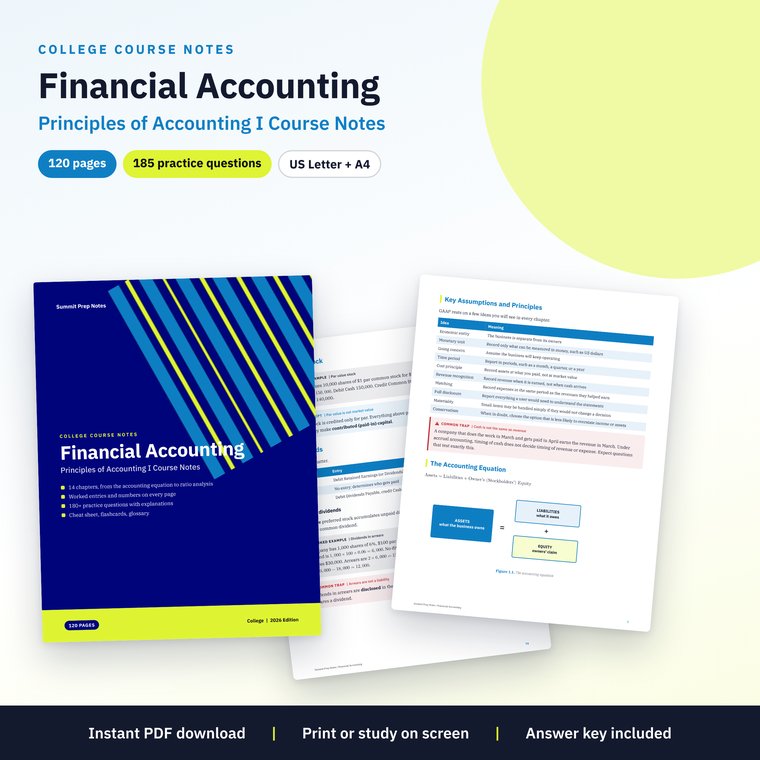
Trial Balance: Financial Accounting (Principles of Accounting I) Complete Course Notes gives you full accounting cycle with worked examples, plus the answer key and cheat sheet.
Common Mistakes to Avoid
- Using cash in an adjusting entry.
- Treating dividends as an expense. Dividends reduce retained earnings directly.
- Reversing the direction of a gain or loss. Gain or loss equals proceeds minus book value.
- Forgetting contra accounts. Accumulated depreciation, the allowance, and sales discounts reduce their related accounts.
- Mixing up stated rate and market rate on bonds.
- Skipping the check. Debits should equal credits, and the balance sheet should balance.
How to Use Your Free Chapter
Read Chapter 1 once, then answer the ten questions at the end without looking. Read every explanation, including those for questions you got right. Then work the five transactions from the accounting equation section again with different numbers. If you can do it without looking, you are ready for Chapter 2.
Frequently Asked Questions
Is financial accounting hard?
It is more about practice than talent. The rules are consistent, so repeated practice with entries pays off quickly.
Do I need to memorize every formula?
Learn the core ones: the accounting equation, depreciation, cost of goods sold, interest, and the main ratios. Understand how each one is built, and the rest becomes easier.
How many hours should I study each week?
Many students do well with three to five hours spread across the week, but it depends on your course load and how comfortable you are with math.
What is the difference between financial and managerial accounting?
Financial accounting reports to outsiders using GAAP. Managerial accounting supports internal decisions and has no required format.
Will this match my textbook?
It follows the usual first-semester sequence. Check your syllabus for any topics your instructor adds or skips.
Where to Go from Here
If you like the free chapter, the full Trial Balance notes cover the entire first-semester course in 14 chapters: 185 practice questions with explanations, a 45-question practice exam, a cheat sheet, 54 flashcards, and a glossary. Work through them in order, do every entry by hand, and walk into your exam with a plan.
