
If you are studying the Tudors for AQA A-level History (component 1C, England 1485-1603), you are tackling one of the most popular and most content-heavy options on the course. This guide explains how the paper works, what examiners reward, and how to revise it in a sensible order. We have also put together a free sample from our full revision pack so you can try the notes before you decide on anything.
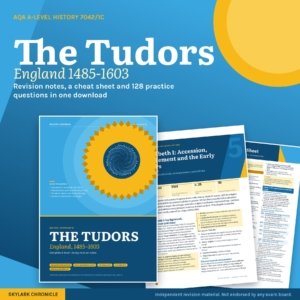
Free AQA A-Level History Tudors Revision Notes Sample (PDF)
A 10-page taster from the full pack: cover, contents, the complete chapter on Elizabeth's accession and Religious Settlement, a cheat sheet page and a page of retrieval questions.

Want everything unlocked?
The free file is a sample. The full version has every page, tab and feature, plus the user guide.
See the full versionWhat the exam looks like
Component 1C is a written paper lasting 2 hours 30 minutes. It is worth 80 marks and makes up 40 per cent of the A-level. It tests your knowledge of the whole period through two different kinds of question.
| Section | What you do | Marks | Main skill |
|---|---|---|---|
| A | One compulsory question on three extracts from historians | 30 | Evaluating interpretations |
| B | Two essays, chosen from three | 25 each | Analysis and judgement using your own knowledge |
The course is split into two parts. Part One covers the consolidation of the Tudor dynasty from 1485 to 1547 (Henry VII and Henry VIII). Part Two covers England, turmoil and triumph, 1547 to 1603 (the Mid-Tudor Crisis under Edward VI and Mary I, then the reign of Elizabeth I). The Section B essays usually draw on both parts across the three questions, so you cannot rely on one reign.
What is actually tested
Examiners are not looking for the longest story. They are looking for an argument that is supported by precise evidence. In practice, the questions fall into a few familiar families:
- Causes and consequences: why the Pilgrimage of Grace failed, why Mary’s restoration of Catholicism did not last, why England went to war with Spain.
- Change and continuity: how far the government of England changed under Henry VIII, or whether Elizabeth’s Church was a real compromise.
- Significance: how important Thomas Cromwell, William Cecil or the Dissolution of the Monasteries really was.
- Similarity and difference: comparisons of rebellions, ministers or religious policies across more than one monarch.
- Judgement on a quotation: “How far do you agree?” or “Assess the validity of this view.”
Section A is different. You are given three short extracts by historians and asked how convincing they are, in relation to a particular issue. You must test each argument against your own knowledge of the period and then decide which is most convincing overall.
How the marks work
Both sections are marked by levels. A top-level Section A answer (25 to 30 marks) analyses all three extracts in depth, tests them with detailed knowledge and reaches a supported judgement about which is most convincing. A top-level Section B answer (21 to 25 marks) is well organised, uses precise evidence and sustains a convincing judgement throughout. The message is the same in both: argue, support and judge. Narrative and description cap your level.
A sensible revision order
Do not start with the hardest topic. Revise in the same order as the specification, because chronology helps you see cause and effect and makes comparisons easier later.
- Henry VII: pretenders, finance, justice and foreign policy. Learn why his rule was secure and what he left to his son.
- Henry VIII: Wolsey, the Great Matter, the Break with Rome, Cromwell, the Dissolution, the Pilgrimage of Grace and the wars of the 1540s.
- Edward VI and Mary I: the Protectorate, the 1549 rebellions, Northumberland, the Device, Mary’s marriage and religious policy, and the debate about a “Mid-Tudor Crisis”.
- Elizabeth I: the 1559 Settlement, the Privy Council and Parliament, Puritans and Catholics, Mary Queen of Scots, Spain and the Armada, Ireland, poverty and the 1590s.
- Themes across the century: rebellion, succession, finance, religion and Parliament. This is where Section B comparisons are won.
Learn the Break with Rome as a sequence
Students lose marks by blurring the 1530s. Learn the order: the Submission of the Clergy (1532), the Act in Restraint of Appeals (1533), the Act of Supremacy (1534), the Treasons Act (1534) and the Dissolution Acts (1536 and 1539). Then be ready to explain which mattered most, and why.
Know the historians’ arguments, not just their names
For Section A you need a working grasp of the main debates. Elton argued for a “revolution” in government under Cromwell, while later historians stressed continuity. Dickens saw Protestantism rising from below, Haigh and Duffy emphasised the resilience of traditional religion. On the mid-century, historians disagree about whether there was a crisis at all. You do not need to quote them. You need to recognise the type of argument in an extract and test it with evidence.
How to revise actively
- Make one-page summaries for each reign, then cover them and rewrite from memory.
- Use retrieval questions. Short, quick questions with dated answers beat re-reading. Repeat the wrong ones after two days, a week and a month.
- Build an evidence bank for each theme (for example, rebellions, ministers, religion) with three or four dated facts per monarch.
- Plan, do not always write. A five-minute essay plan with a judgement is a very efficient way to practise 25-mark questions. Write two or three full essays under timed conditions, then mark them against the level descriptors.
- Practise Section A in a grid. For each extract write the argument, the evidence that supports it, the evidence that challenges it and a verdict.
Common mistakes
- Telling the story of a reign instead of answering the question set.
- In Section A, writing about the historian’s reputation instead of the strength of the argument in the extract.
- Listing facts without a link back to the question, or without dates.
- Ending with a conclusion that only repeats the paragraphs, instead of weighing the factors and reaching a clear judgement.
- Using all the time on Section A and rushing the second essay. Aim for roughly 60 minutes on Section A and 40 to 45 on each essay.
- Only revising the more popular topics. Elizabeth’s later years and the 1590s, and the social and economic strand, regularly appear in questions.
A revision timeline
| When | Focus |
|---|---|
| 8 to 12 weeks before | Build notes reign by reign; start retrieval questions each week. |
| 6 weeks before | First timed Section B essay; one Section A practice. |
| 4 weeks before | Themes across the century; fix weak topics identified by practice. |
| 2 weeks before | Full timed paper; cheat sheet and checklist daily. |
| Final week | Light recall, historians’ arguments, exam technique, sleep. |
Try the free sample, then decide
Our independent Skylark Chronicle pack is designed for exactly this process. The free sample above gives you the contents, a full chapter, a cheat sheet page and a page of retrieval questions. The complete Tudors revision pack has 89 pages of notes in specification order, a 3-page printable cheat sheet, four Section A practice sets with model answers, 28 essay plans with four full model essays, 96 retrieval questions and 8-week and 2-week revision plans.
Frequently asked questions
Is 1C The Tudors a hard option?
It has plenty of content, but the story is clear and chronological. Students usually find the second half harder because of the many foreign and religious threads in Elizabeth’s reign. A timeline and one-page summaries help.
Do I need to know everything about all five reigns?
Yes, the spec covers the whole period, and the essay choice usually spans both parts of the course. You can choose your two Section B essays, but you cannot ignore a reign altogether.
How many historians should I know?
Aim for the main arguments in each big debate: Cromwell and the Tudor revolution, the Reformation from above or below, the Mid-Tudor Crisis, Elizabeth and the Puritans, and the 1590s. You are assessing the arguments, not quoting names.
How long should I spend on Section A?
About one hour, including reading and planning, because it carries 30 of the 80 marks. Practise it more than once under timed conditions.
Where can I find the exam board’s materials?
On the AQA website, where you can find the specification, sample assessment materials and past papers. Always check the latest version for your exam year. Skylark Chronicle is independent and not endorsed by AQA, but our notes are written to match the content of specification 7042/1C.
If you would like the complete pack, see the full Tudors revision notes on budgetcourses.net.
