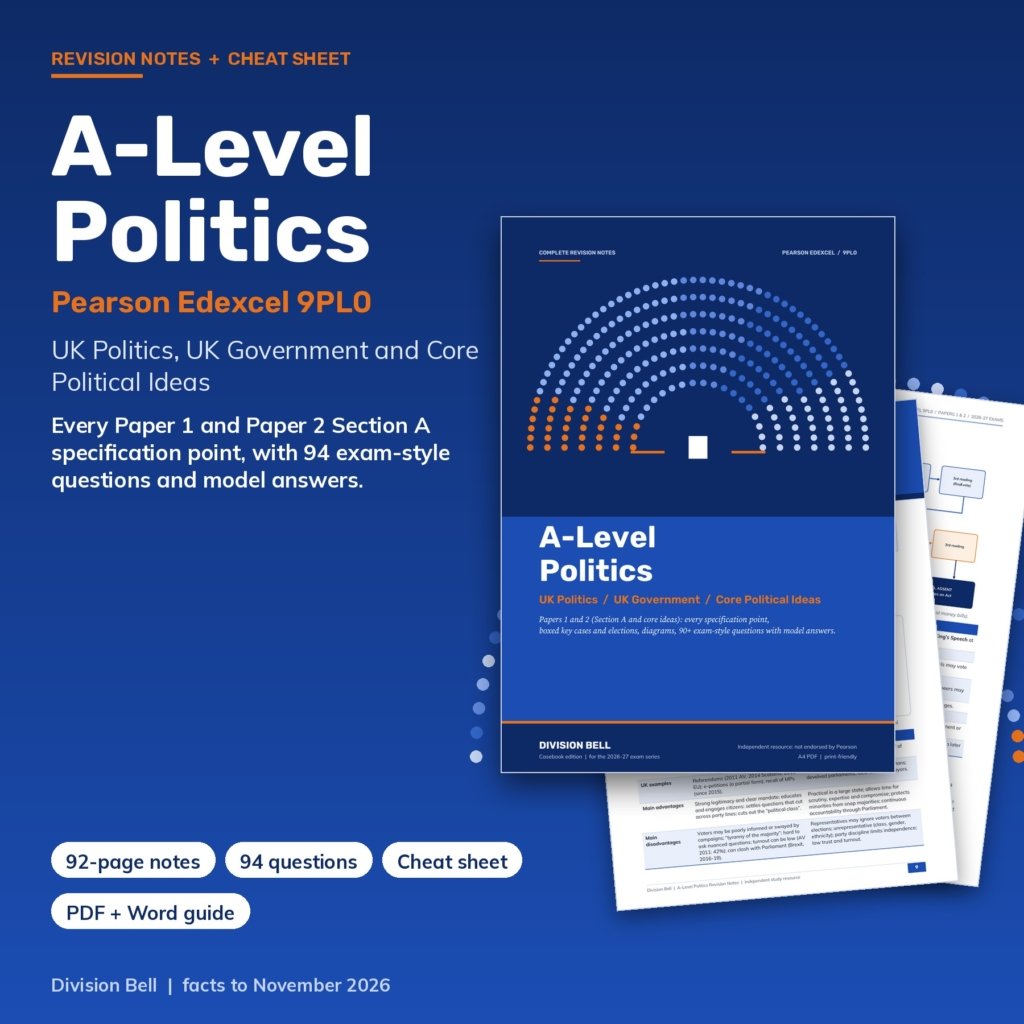
A-Level Politics rewards students who can do three things at once: know the content, compare ideas and evidence, and reach a judgement. This guide explains how the Pearson Edexcel A-Level Politics exams (specification 9PL0) are structured, what Paper 1 and Paper 2 test, and how to revise so that your knowledge turns into marks. Use the free sample below to see how a full chapter of notes looks.
Free A-Level Politics (Edexcel 9PL0) Revision Notes Sample (PDF)
A 10-page taster from the real notes: cover, full contents, the complete Parliament chapter with diagrams, a cheat-sheet page, sample practice questions with model answers, and details of the full pack.
Want everything unlocked?
The free file is a sample. The full version has every page, tab and feature, plus the user guide.
See the full versionHow the Edexcel A-Level Politics exams are structured
You sit three papers at the end of the course. Papers 1 and 2 are each two hours long, worth 84 marks and one third of the qualification. Paper 3 covers comparative politics (the USA or Global), which this guide does not cover.
| Section | Paper 1 | Paper 2 |
|---|---|---|
| Section A (60 marks) | UK Politics: one 30-mark source question and one 30-mark essay | UK Government: one 30-mark source question and one 30-mark essay (synoptic) |
| Section B (24 marks) | Core political ideas: one 24-mark essay on liberalism, conservatism or socialism | One non-core idea chosen by your school: one 24-mark essay |
In each section you choose from a pair of questions. Check the latest specification, sample assessment materials and any advance information on Pearson’s website for your exam series, because details can be updated.
What the papers test: the three assessment objectives
Every long answer is marked against AO1 (knowledge and understanding), AO2 (analysis) and AO3 (evaluation). In a 30-mark answer that means roughly 10 marks each, and in the 24-mark ideas essay 8 marks each. Two thirds of the marks therefore reward analysis and judgement, not description. Answers are marked by levels: the examiner chooses the level that best fits the whole answer, then the mark within it.
Command words to recognise
- Evaluate: weigh both sides, test them against evidence and reach a supported judgement.
- To what extent: say how far you agree, with a graded verdict rather than yes or no.
- Analyse: explain how and why, and draw out connections and differences.
What you need to know
Paper 1: UK Politics
- Democracy and participation: direct and representative democracy, the franchise from 1832 to today, pressure groups and rights.
- Political parties: functions, funding and the main parties, including Reform UK and the Greens, and how the party system has changed.
- Electoral systems: first-past-the-post, the Additional Member System, the Single Transferable Vote and closed lists, plus referendums.
- Voting behaviour and the media: why people vote as they do, three case-study elections, polls and the press.
Paper 1: Core political ideas
- Liberalism, conservatism and socialism: core ideas, differing views within each ideology, and the specified thinkers (for example Locke, Mill and Rawls; Hobbes, Burke and Oakeshott; Marx, Luxemburg and Crosland).
Paper 2 Section A: UK Government
- The constitution: its sources, change since 1997 and devolution.
- Parliament: the Commons and Lords, how a bill becomes law, and scrutiny of the executive.
- The Prime Minister and executive: prerogative powers, ministerial responsibility and the balance between Cabinet and Prime Minister.
- Relations between the branches: the Supreme Court, the EU, and where sovereignty lies.
How to revise A-Level Politics
- Learn the content in chunks. Take one specification point at a time, such as the powers of the House of Lords, and write a one-page summary from memory before checking it.
- Build an evidence bank. For every topic, collect about ten pieces of evidence: three cases or examples, three numbers, two quotations or definitions and two recent events. Politics essays are won with precise evidence.
- Memorise the thinkers properly. For each of the fifteen thinkers, know the key work, two ideas, and one criticism. The 24-mark question needs at least two named thinkers.
- Practise the three formulas. Source question: compare the two views in the same paragraph and use the source for analysis and evaluation. Essay: a thesis, three or four arguments, counter-arguments and a judgement that runs through the answer. Ideas essay: two or more thinkers, both sides and a clear conclusion.
- Use plans as well as full essays. A five-line plan takes five minutes and shows whether you can build an argument.
- Keep up with current politics. Examiners reward recent examples. Note changes in party leaders, legislation and election results and add them to your evidence bank.
A simple revision timeline
| When | Focus |
|---|---|
| 8 to 6 weeks before | Learn Paper 1 UK Politics and the three ideologies; make evidence banks. |
| 5 to 4 weeks before | Learn UK Government (constitution, Parliament, executive, branches); start timed paragraphs. |
| 3 to 2 weeks before | Timed source questions and essays; mark yourself against model answers and the levels. |
| Final fortnight | Full timed sections of each paper, checklist gaps, a Cheat Sheet read each day, and a news check. |
| Night before | Light recall of thinkers and cases only; sleep. |
Common mistakes to avoid
- Describing instead of evaluating. Every paragraph needs a point, evidence, analysis and a mini-judgement.
- Treating a source question as two summaries. Compare the views directly and use the source’s own evidence.
- Using only one thinker in the ideas question, or listing thinkers without setting them against each other.
- Out-of-date facts. Check the current Prime Minister, party leaders and recent legislation.
- Imprecise claims. Do not say the UK has “no constitution” (it has an uncodified one), or that first-past-the-post always gives the most seats to the party with most votes.
- No conclusion. Finish with “Overall … because …” and a clear judgement.
Frequently asked questions
How long should I spend on each question?
Aim for about one and a half minutes per mark: roughly 45 minutes for each 30-mark question and 30 minutes for the 24-mark essay, leaving a few minutes for planning.
Do I need to learn dates and statistics?
Yes, selectively. Precise evidence such as turnout figures, election results, case names and dates lifts AO1 and makes analysis more convincing, but accurate argument matters more than volume.
Is this guide a replacement for my teacher’s notes?
No. Use it with your lessons, and check your specification and school materials, especially for the non-core idea in Paper 2 Section B and for Paper 3.
Next step: the full pack
The free sample gives you the Parliament chapter, a Cheat Sheet page and practice questions. The full Division Bell A-Level Politics notes cover every Paper 1 and Paper 2 Section A specification point, with 94 exam-style questions and model answers, a glossary, a tick-box checklist, a printable Cheat Sheet and a user guide with 8-week and 2-week revision plans. You can see the contents and what is included on the product page.
Division Bell resources are independent and are not endorsed by or affiliated with Pearson or Edexcel. Pearson and Edexcel are registered trade marks of Pearson Education Limited.
