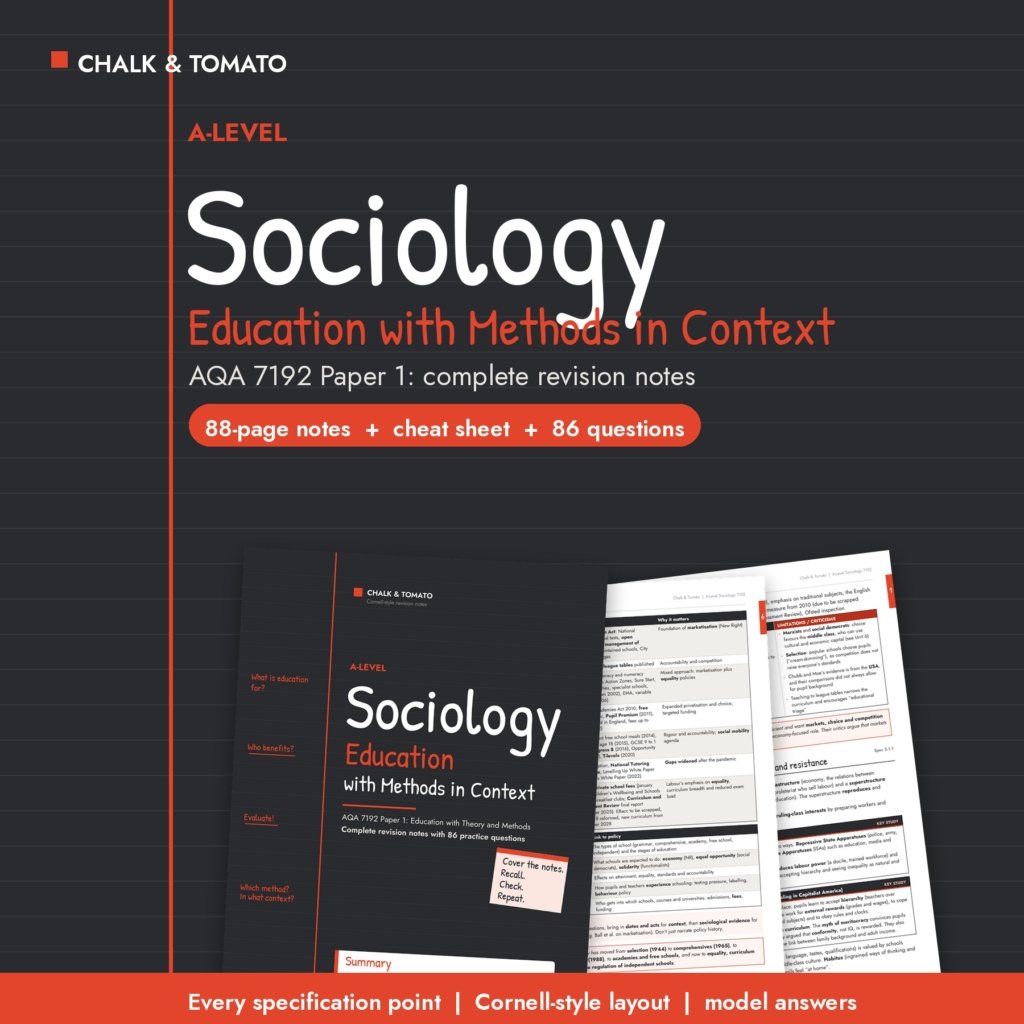
If you are taking AQA A-level Sociology, Paper 1 is the paper that mixes everything: a full Education topic, the Methods in Context question and a Theory and Methods question, all in two hours. This guide explains how the paper works, what is actually tested and how to revise it well. A free sample of our Paper 1 notes is below.
Free A-Level Sociology Education Revision Notes Sample (PDF)
A 9-page sample of the AQA 7192 Paper 1 notes: cover, contents, the labelling and subcultures topic with diagrams and study cards, a cheat sheet page and practice questions with model answers.
Want everything unlocked?
The free file is a sample. The full version has every page, tab and feature, plus the user guide.
See the full versionHow Paper 1 (7192/1) is structured
Paper 1 is called Education with Theory and Methods. It is worth 80 marks, lasts two hours and counts for one third of the A-level. All three papers are taken at the end of the course, in the same May or June series.
| Question | Marks | What you do |
|---|---|---|
| Q1 | 4 | Outline two ways (short, point-based) |
| Q2 | 6 | Outline three ways (point-based) |
| Q3 | 10 | Analyse two ways, using an Item |
| Q4 | 30 | Extended evaluation essay, using an Item and your knowledge |
| Q5 | 20 | Methods in Context: evaluate a named method for a topic in education |
| Q6 | 10 | Theory and Methods: outline and explain two reasons or ways |
That means 50 marks for Education, 20 for Methods in Context and 10 for Theory and Methods. Across the paper, about 35 marks reward knowledge (AO1), 27 reward application (AO2) and 18 reward analysis and evaluation (AO3). Roughly one and a half minutes per mark is a sensible time budget.
What is tested in the Education topic
Role and functions of education
You need to compare functionalist, New Right, Marxist and neo-Marxist, social democratic and postmodern views, and relate education to the economy and class structure. Think Durkheim and Parsons, Bowles and Gintis, Bourdieu and Willis.
Differences in achievement
The specification expects explanations of differences by social class, gender and ethnicity, both inside school and outside it. The best answers use current evidence. For example, in 2024/25 the Attainment 8 gap between disadvantaged pupils and others in England was about 15.5 points, which is far bigger than the gender gap of around 4 points.
Relationships and processes in schools
This covers teacher and pupil relationships (labelling and the self-fulfilling prophecy), pupil identities and subcultures, the hidden curriculum, and the organisation of teaching and learning, such as streaming, setting and banding.
Education policy
Expect selection, marketisation, privatisation, policies for equality of opportunity or outcome, and the impact of globalisation. Policy dates help, but the marks go to sociological evaluation: who benefits, and what does the research show?
Methods in Context and Theory and Methods
The Methods in Context question gives you a short Item about an education research topic and asks you to evaluate one named method. The common trap is writing generally about the method. High marks need every point applied to the topic, the group and the school setting, with practical, ethical and theoretical issues. Theory and Methods covers research design, data sources, positivism and interpretivism, theories, modernity and postmodernity, science, values and social policy.
How to revise Paper 1
- Build evidence cards. For each study note the date, method, finding, one strength and one limitation. Learn about ten studies per topic properly.
- Use active recall. Cover your notes and answer questions from memory, then check. This is the idea behind the Cornell layout.
- Practise evaluation. Pair perspectives (for example Marxists against the New Right on marketisation) and learn two or three phrases that introduce a criticism.
- Write timed answers. Do at least one 30-mark essay and one 20-mark methods answer every week in the final month.
- Interleave. Mix Education, Methods in Context and Theory and Methods in the same week so each stays fresh.
A simple six-week revision timeline
| Week | Focus |
|---|---|
| 1 | Role and functions of education; class differences in achievement |
| 2 | Gender and ethnicity; intersections of class, gender and ethnicity |
| 3 | School processes: labelling, subcultures, hidden curriculum, grouping |
| 4 | Policy: selection, marketisation, privatisation, equality, globalisation |
| 5 | Methods in Context and Theory and Methods |
| 6 | Timed papers, weak spots and cheat sheet recall |
Common mistakes to avoid
- Writing about all the research you know instead of answering the exact wording of the question.
- Ignoring the Item or copying it rather than building on it.
- Describing a method in general terms in the 20-mark question, with no link to education.
- Listing evaluation points (“some disagree”) without naming a perspective or a study.
- Treating class, gender and ethnicity as separate when the evidence shows they interact.
- Using out-of-date statistics. Check the latest Department for Education releases.
Frequently asked questions
Is Theory and Methods on Paper 1?
Yes. Q6 is a 10-mark Theory and Methods question on Paper 1, and Theory and Methods also appears on Paper 3.
How long should a 30-mark answer be?
Aim for about 45 minutes in the exam, including a short plan. A focused answer of roughly 1,000 to 1,200 words with four or five developed paragraphs and a judgement usually works well.
Do I need to learn lots of studies?
You need enough to give evidence and evaluation, but depth matters more than quantity. Ten well-learned studies per topic, with a strength and a limitation for each, beat fifty half-remembered names.
Where can I get structured notes?
The free sample above shows the layout. The complete Chalk & Tomato Paper 1 notes cover every specification point, with a cheat sheet, 86 practice questions and a revision planner.
Next steps
Download the sample, try the practice questions and then decide how to build your revision. When you are ready for the full pack, you can see everything included in the complete A-level Sociology Paper 1 notes.
This article is independent and is not endorsed by or affiliated with AQA. AQA is a registered trade mark of AQA Education.
