
Looking for free adapted morning work you can print tonight and use on Monday? This page has a 36-page sampler from our adapted morning work binder, plus the setup steps, leveling rules and data routine we use to make a special education morning run on its own.
The sampler comes from the Steady Start Binder. It includes “spell my name” at all three levels, the days of the week, today’s weather, counting to 10, tracing pages, a My Morning Steps checklist, a filled-in IEP rubric and every Velcro piece you need. It prints on US Letter or A4.
Get the free adapted morning work sampler
Enter your email below and the PDF is yours. Pick the paper size you use.

Free Adapted Morning Work Binder Sampler (PDF, US Letter)
36 printable pages from the Steady Start Binder: spell my name at 3 levels, days of the week, today's weather, counting 0 to 10, tracing, a My Morning Steps checklist, a sample IEP rubric and the matching Velcro piece sheets.

Want everything unlocked?
Steady Start Binder: Adapted Morning Work Binder for Special Education | PreK–4th Grade
The free file is a sample. The full version has every page, tab and feature, plus the user guide.
See the full versionFree Adapted Morning Work Binder Sampler (PDF, A4)
The same 36-page sampler sized for A4 paper: name pages at 3 levels, days of the week, weather, counting 0 to 10, tracing, a sample rubric and piece sheets.
Want everything unlocked?
Steady Start Binder: Adapted Morning Work Binder for Special Education | PreK–4th Grade
The free file is a sample. The full version has every page, tab and feature, plus the user guide.
See the full versionTHE FULL BINDER
361 pages. Every skill at 3 levels. Data pages and an editable file included.
The sampler is about a tenth of the Steady Start Binder. The full version adds the calendar, money, time, literacy, a whole Life Skills section and IEP data sheets.
What is adapted morning work?
Adapted morning work is a set of short, hands-on tasks that students with special needs complete at the start of the day. Instead of a worksheet, the student moves picture or word pieces onto Velcro targets, traces with a dry-erase marker and checks the work off. The pages live in a binder inside sheet protectors, so the same pages get used again and again.
Most adapted binders cover the same core skills:
- Personal information: name, birthday, age, address and phone number
- Calendar: day, date, month, yesterday, today and tomorrow
- Weather and seasons
- Early math: counting, number words, shapes and money
- Early literacy: letters, sounds and sight words
- Fine motor tracing
What makes it “adapted” is the format. Pieces replace writing for students who cannot write yet. Pictures sit next to words. Each page asks for one thing. And the same routine repeats every day, which is exactly what many of our students need.
Why routines help students with special needs
Walk into a self-contained classroom at 8:05 and you can feel it. Buses arrive at different times. One student is upset about a change at home. Another wants to talk about trains. Without a routine, the first 20 minutes disappear.
A morning binder fixes that. The student unpacks, grabs the binder and starts. Same pages, same order, every day. Predictability lowers anxiety. Repetition builds skills. And independence grows because the student knows what comes next without being told.
It helps the adults too. While students work, you can greet families, take attendance and check in with the student who had a rough morning. That is why so many teachers call morning work their favorite 15 minutes of the day.
How to set up an adapted morning work binder in 6 steps
You can have a binder ready in about an hour. Here is the order that saves the most time.
- Pick your pages. Start with 6 to 10. A good first binder is a cover, My Morning Steps, spell my name, today’s weather, days of the week and one counting page. The free sampler has all of these.
- Fill in the personal pages. Write the student’s name in the model boxes, or type it in the editable PowerPoint that comes with the full Steady Start Binder.
- Print at 100%. Choose “Actual size” in your print settings so the Velcro targets stay 0.75 inch (19 mm).
- Protect the pages. Slide work pages into heavy sheet protectors, or laminate them.
- Prep the pieces. Print the piece sheets on card stock, laminate and cut. Put a soft (loop) Velcro dot on the back of each piece and a rough (hook) dot on each dashed target.
- Teach it. Do each page together for three or four days. Then step back a little each week.
One tip that saves hours: every page in the Steady Start Binder has a code, like CAL-03, and every piece has the same code printed on it. When a piece turns up under the reading table, you know exactly where it goes.
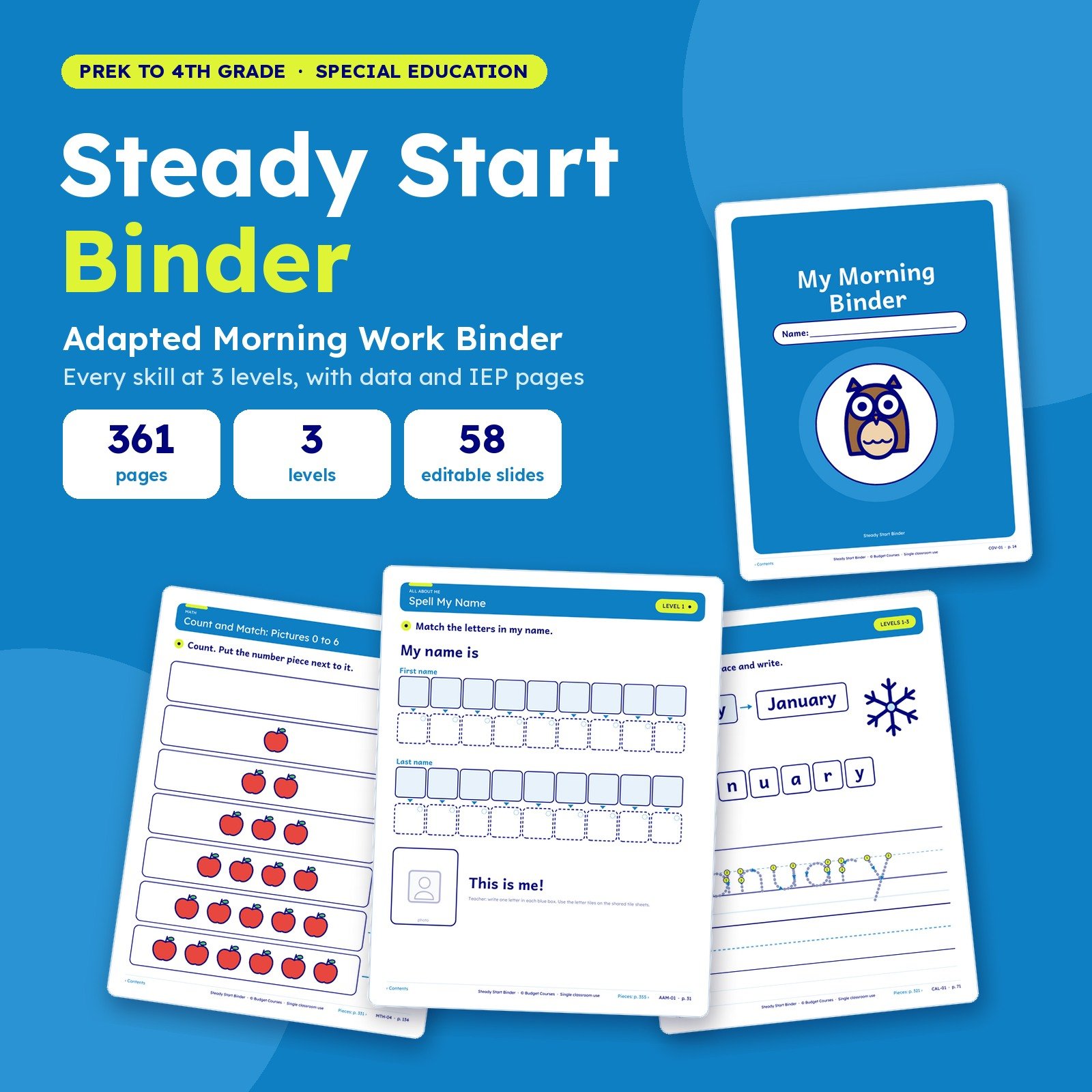
Steady Start Binder
Adapted Morning Work Binder for Special Education, PreK to 4th Grade
- 361 pages in US Letter and A4, color and ink saver
- Every skill at Level 1, 2 and 3
- Life Skills section and IEP data pages
- Editable PowerPoint that opens in Google Slides
How to choose a level for each student
This is where most binders fall short. They give everyone the same page. But a student who is just learning to match needs something very different from a student who can write the date from memory.
The Steady Start Binder puts every skill at three levels, and the sampler shows all three for “spell my name.”
- Level 1: errorless matching. The answer is right there, as a model above the target or as a faint letter inside it. The student matches what they see. This is the place to start for students who are new to the routine or need hand-over-hand help.
- Level 2: match and trace. The student picks pieces from a small set, then traces the word. Good for students who match reliably and are ready to choose between options.
- Level 3: on my own. No model on the page. The student writes, chooses or builds from memory.

When should a student move up? Use the 4 out of 5 rule. If the student completes a page correctly and independently on 4 of 5 days, try the next level on Monday. If they struggle for a full week, step back and try again later. Different skills can sit at different levels. A child might spell their name at Level 3 and count money at Level 1, and that is completely normal.
The full adapted morning work binder adds a Level Move-Up Log and a whole-class level tracker so you can see every student’s levels on one sheet.
A sample 15-minute morning routine
This is the routine most classrooms settle into after two or three weeks. Change the times to fit your schedule.
| Time | What happens | Sampler page |
|---|---|---|
| 0 to 2 min | Unpack, hang up the backpack, lunch in the bin | My Morning Steps |
| 2 to 4 min | Open the binder, check off “binder” | Cover and steps board |
| 4 to 7 min | Name page at the student’s level | Spell my name |
| 7 to 9 min | Day of the week, then today’s weather | Days of the week, weather |
| 9 to 12 min | One math page | Counting 0 to 10 |
| 12 to 15 min | Tracing page, then the “All done?” star | Tracing |
A few habits make this run without you:
- Keep the order the same every single day.
- Use a first/then strip for students who need a reason to finish: “First binder, then blocks.”
- Give the binder a home on the same shelf.
- Fade your help slowly. Point instead of touching. Look instead of pointing.
- End on success. If a page is hard today, finish with one the student can do.
Short on time? Do the name page, the weather and one skill page. A short routine done every day beats a long one done twice a week.
How to collect IEP data from morning work
Morning work is the easiest data you will ever collect. The tasks are the same every day, so you can see growth week by week. The trick is to record the prompt level, not just right or wrong.
Use these six codes, from most independent to least:
- I Independent: does it alone
- G Gestural: you point or tap
- V Verbal: you give a short spoken cue
- M Model: you show it first
- PP Partial physical: a light touch at the hand or elbow
- FP Full physical: hand-over-hand
Write one code per task per day on a weekly rubric. At the end of the week, count the independent days. Four or five means the student is ready to move up. That number also drops straight into your IEP progress report.
The free sampler includes a filled-in rubric so you can see how it works. The Steady Start Binder adds a blank editable rubric, a daily data sheet, a monthly progress graph, a class tracker and an IEP goal map that links common goals to the pages that practice them.

Free sampler vs the full Steady Start Binder
The sampler is a real, usable start. Here is everything the full binder adds.
| What you get | Free sampler | Full Steady Start Binder |
|---|---|---|
| Pages | 36 | 361 (US Letter) and 359 (A4) |
| Sections | Parts of 6 | All 13 sections |
| 3 levels on every page | Name pages only | Every skill |
| All About Me | Spell my name | 14 topics: birthday, address, phone, school, bus and more |
| Calendar and weather | Days of the week, today’s weather | All 12 months, calendar board, 13 weather graphs, thermometers, dress for the weather |
| Math | Counting 0 to 10 | 0 to 20, number words, skip counting, shapes, patterns, time and money |
| Other currencies | No | Canada, UK, Australia, New Zealand and euro coins |
| Literacy | No | 30 pages: letters, sounds, sight words, CVC words |
| Life Skills section | No | 20 pages: signs, feelings, safety, hygiene, routines |
| Tracing | 5 pages | 51 pages, thick and thin guides |
| Data and IEP pages | One sample rubric | Rubric, data sheet, graph, class tracker, goal map, logs, parent note, certificates |
| Editable PowerPoint (Google Slides too) | No | Yes, 58 slides |
| Ink-saver version | No | Yes, Letter and A4 |
| “I Can” cards | No | 42 skills, two versions |
Ready for the whole year?
361 pages at 3 levels, a Life Skills section, IEP data pages and an editable file. Print once and use it all year.
FAQ about free adapted morning work
Who is this free adapted morning work for?
Special education teachers, paraprofessionals, therapists and parents working with PreK to 4th grade students, including children with autism, Down syndrome and other developmental delays. Older students working on the same early skills can use it too.
What do I need to use the sampler?
A binder, sheet protectors or a laminator, Velcro dots and a dry-erase marker. Card stock helps the pieces last longer.
Is the sampler really free?
Yes. Enter your email and download it. There is nothing to cancel later.
Does it work on A4 paper?
Yes. There is a separate A4 download above. The full binder includes A4 too.
Can I edit the name pages?
In the sampler you write the name in by hand. The full Steady Start Binder comes with an editable PowerPoint where you type names, addresses and phone numbers, and it opens in Google Slides.
How many pages should a student do each morning?
Most students do best with 4 to 6 pages each morning and 8 to 15 pages in the binder overall. Rotate one page a week to keep it fresh.
Can I share the sampler with my team?
Please send colleagues to this page so they can download their own copy. It is free for them too.
