AP Microeconomics is one of the most manageable AP exams once you see its structure. There are six units, a short list of rules that do most of the work, and about a dozen graphs that the exam keeps coming back to. This guide lays out the exam format, what each unit tests, the graphs you must be able to draw, a study plan and the mistakes that cost the most points.
To see how clear AP Micro notes can make the course, start with our free Unit 1 chapter. It covers scarcity, the production possibilities curve, comparative advantage and marginal analysis, with labeled graphs and an 11-question quiz.

Free AP Microeconomics Notes: Unit 1 Sample (PDF)
The full Unit 1 chapter: scarcity, the PPC, comparative advantage and marginal analysis, with graphs and an 11-question quiz.

Want everything unlocked?
The free file is a sample. The full version has every page, tab and feature, plus the user guide.
See the full versionThe AP Microeconomics exam format
The exam is 2 hours and 10 minutes long.
| Section | Questions | Time | Weight |
|---|---|---|---|
| I: Multiple choice | 60 | 70 minutes | 66% |
| II: Free response | 3 (1 long, 2 short) | 60 minutes, including a 10-minute reading period | 33% |
The long free-response question is worth half of Section II, and each short question is worth a quarter. The exam is hybrid digital: you answer the multiple-choice questions in the Bluebook app and handwrite the free-response answers, including graphs, in a paper booklet. A four-function calculator is allowed.
Scores run from 1 to 5, and many colleges award credit for qualifying scores, with each college setting its own policy.
What each unit covers
Here is each unit with its share of the multiple-choice section.
Unit 1: Basic Economic Concepts (12-15%)
Scarcity and opportunity cost, economic systems, the production possibilities curve, comparative advantage and terms of trade, and marginal analysis, including the utility-maximizing rule.
Unit 2: Supply and Demand (20-25%)
What shifts demand and supply, price elasticity and the total revenue test, income and cross-price elasticity, consumer and producer surplus, and government intervention: price ceilings and floors, taxes, subsidies, quotas and tariffs.
Unit 3: Production, Cost, and the Perfect Competition Model (22-25%)
The biggest unit. Production and diminishing returns, cost curves, economies of scale, economic profit, the MR = MC rule, the shutdown rule and perfect competition in the short and long run.
Unit 4: Imperfect Competition (15-22%)
Monopoly, price discrimination, monopolistic competition, oligopoly and game theory.
Unit 5: Factor Markets (10-13%)
Derived demand, marginal revenue product, hiring decisions, the least-cost rule and monopsony.
Unit 6: Market Failure and the Role of Government (8-13%)
Externalities, public goods, common resources, government policies and income inequality.
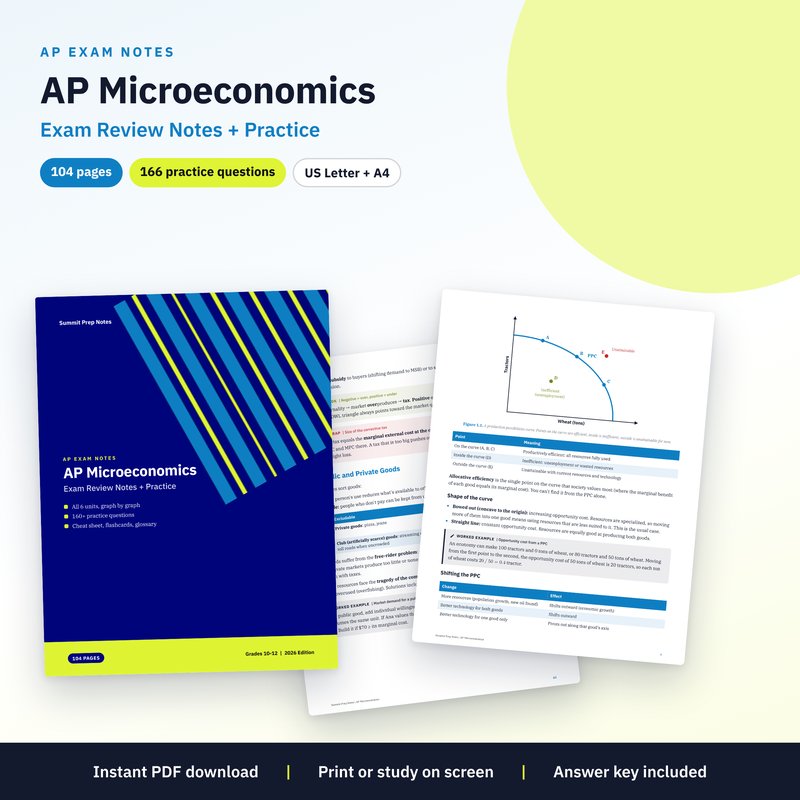
Full version
Price Signal: AP Microeconomics Exam Review Notes
- All 6 units in 104 printable pages
- 21 labeled graphs and 166 practice questions
- Free-response playbook, cheat sheet and flashcards
The graphs you must know
A big share of free-response points comes from correctly labeled graphs. Make sure you can draw each of these from memory:
- Production possibilities curve with points inside, on and outside the curve.
- Supply and demand with consumer surplus, producer surplus and shifts.
- Price ceiling and price floor with shortage or surplus and deadweight loss.
- Excise tax with the tax wedge, revenue and deadweight loss.
- Short-run cost curves: MC, ATC and AVC, with MC through the minimums.
- Side-by-side perfect competition: market and firm, showing profit or loss.
- Monopoly: demand, MR, MC and ATC, with profit and deadweight loss.
- Monopolistic competition in the long run: demand tangent to ATC.
- Competitive labor market: market and firm side by side.
- Monopsony: supply, MRC and MRP.
- Externalities: MSC versus MPC (negative) or MSB versus MPB (positive).
Every graph needs labeled axes, labeled curves, and the equilibrium quantity and price marked on the axes.
A six-week study plan
Weeks 1-3: units
Review one unit every three or four days. Redraw every graph from memory, then check yourself. Do a short quiz after each unit and write down every rule you missed.
Week 4: rules and numbers
Practice the calculations: midpoint elasticity, profit, surplus triangles, deadweight loss, tax revenue, MRP and opportunity cost. Use a four-function calculator so you’re comfortable with it.
Week 5: free response
The College Board publishes past free-response questions with scoring guidelines. Do one long and one short question every other day, then score yourself strictly. Notice how many points come from labels and short explanations.
Week 6: full practice and review
Take a full timed practice exam. Then spend the last days on a cheat sheet and flashcards.
Mistakes that cost the most points
Reading monopoly price at MR = MC
MR = MC gives the quantity. The price is on the demand curve above it.
Confusing a shift with a movement
A change in a good’s own price moves along its demand curve. Only other factors shift it.
Letting fixed costs change output
A lump-sum tax or rent increase shifts ATC, not MC, so the profit-maximizing quantity stays the same.
Mixing up the shutdown and break-even points
Shut down when price is below minimum AVC. Break even at minimum ATC.
Forgetting that the more inelastic side bears the tax
If demand is more inelastic than supply, buyers pay more of a per-unit tax.
Unlabeled graphs
A correct graph with missing labels can earn zero. Label every axis and curve.
Giving two answers
If you hedge with “it could rise or fall,” readers score the incorrect part. Commit to one answer.
Want every chapter, not just the sample?
Price Signal: AP Microeconomics Exam Review Notes gives you all 6 units in 104 printable pages, plus the answer key and cheat sheet.
The rules that do most of the work
AP Micro rewards students who can apply a small set of rules quickly. If you know these, you can answer a large share of the exam.
Produce where MR = MC
Every firm, in every market structure, maximizes profit where marginal revenue equals marginal cost. A perfectly competitive firm has MR equal to price, so it produces where P = MC. A monopoly has MR below price, so it produces less and charges more.
Shut down below minimum AVC
In the short run, a firm keeps operating as long as price covers average variable cost, even if it is losing money, because its fixed costs must be paid either way. Below minimum AVC, it shuts down.
Hire where MRP = MRC
In factor markets, a firm hires workers until the extra revenue the last worker brings in (marginal revenue product) equals the extra cost of hiring that worker. In a competitive labor market, that extra cost is simply the wage.
Produce where MSB = MSC
The socially efficient quantity is where marginal social benefit equals marginal social cost. Negative externalities lead to overproduction, which a per-unit tax can correct. Positive externalities lead to underproduction, which a per-unit subsidy can correct.
Equalize marginal utility per dollar
A consumer gets the most satisfaction from a budget by buying until the marginal utility per dollar is the same for every good. Firms use the same idea for inputs: the marginal product per dollar should be equal for labor and capital.
Compare opportunity costs
Comparative advantage goes to whoever gives up less to produce a good. Trade helps both sides when the terms of trade fall between the two opportunity costs.
Write these six rules on a single card and review it every day of your final week.
Frequently asked questions
Is AP Microeconomics hard?
It is one of the more approachable AP exams for students who practice graphs and rules regularly. The math is simple; the challenge is applying the right rule quickly.
Can I self-study AP Micro?
Yes. Many students do. Good notes, plenty of practice questions and past free-response questions are enough for a strong score.
How long should I study?
Five to six weeks of steady review, about 30 to 45 minutes a day, works well for students who took the class. Allow more time if you’re self-studying.
What’s in the full notes?
The free download is Unit 1. The full Price Signal AP Microeconomics notes cover all six units in 104 pages with 21 graphs, 166 practice questions, a free-response playbook, a full practice exam, a cheat sheet, flashcards and a glossary.
