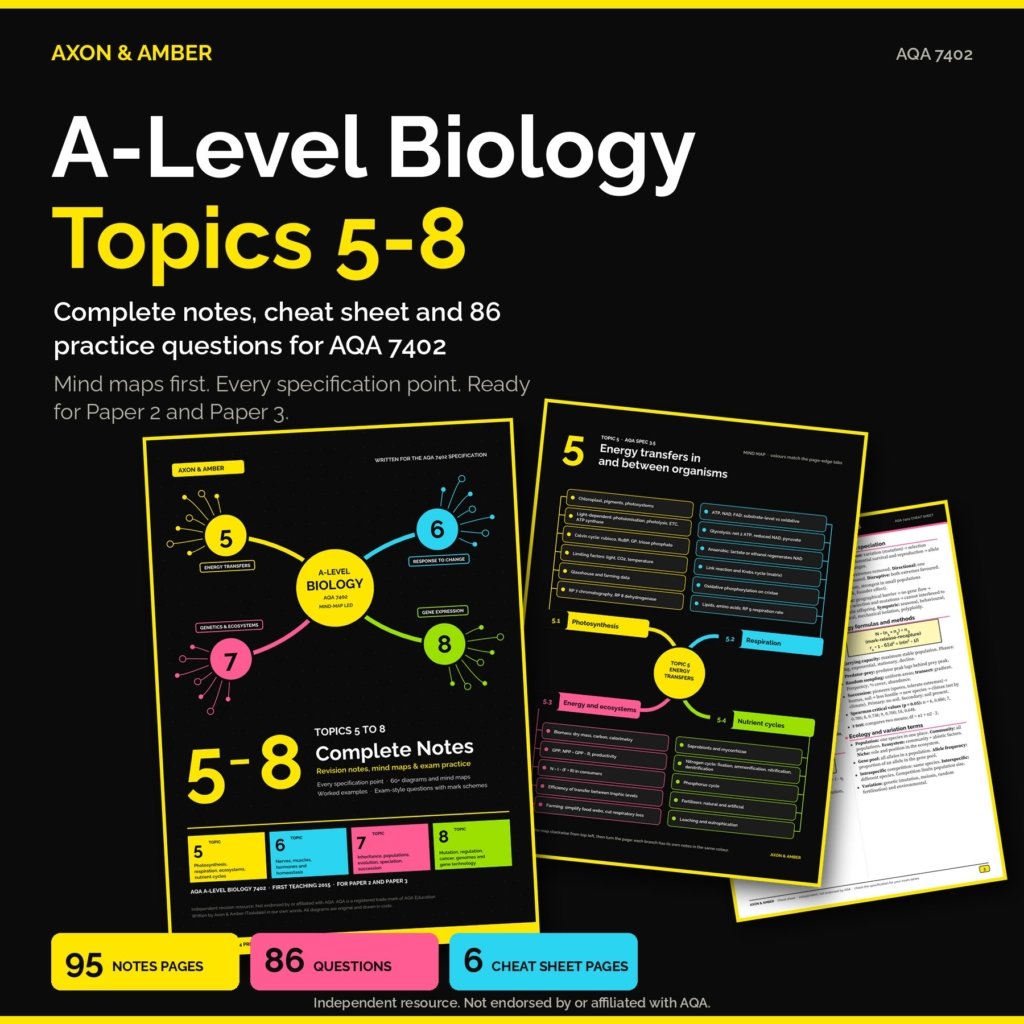
Topics 5 to 8 of AQA A-level Biology are the part of the course that students most often say they “understand in class and lose in the exam”. The ideas are connected, the vocabulary is heavy, and the questions reward precise wording. This guide explains how the papers are built, what the examiners are really testing in Topics 5 to 8, and a revision plan you can start today. A free sample from our revision pack is included below.
Free AQA A-Level Biology Topics 5-8 Revision Notes Sample (PDF)
A 10-page sample from the full pack: cover, contents, section 6.2 on nervous coordination with diagrams and a worked maths box, one cheat-sheet page and a page of exam-style questions.
Want everything unlocked?
The free file is a sample. The full version has every page, tab and feature, plus the user guide.
See the full versionWhat Topics 5 to 8 cover
These four topics make up the second half of AQA specification 7402. They are:
- Topic 5, Energy transfers in and between organisms: photosynthesis, respiration, energy transfer in ecosystems and nutrient cycles.
- Topic 6, Organisms respond to changes in their environments: receptors and reflexes, nerve impulses and synapses, muscle contraction and homeostasis.
- Topic 7, Genetics, populations, evolution and ecosystems: inheritance, the chi-squared test, Hardy-Weinberg, selection, speciation and succession.
- Topic 8, The control of gene expression: mutations, stem cells, epigenetics, cancer, genome projects and gene technologies.
How the exams are structured
Check the AQA website for the latest details for your exam series, but the structure of the A-level papers has been stable since the specification was first taught in September 2015.
| Paper | Content | Time and marks | Share of A-level |
|---|---|---|---|
| Paper 1 | Topics 1 to 4 | 2 hours, 91 marks (76 short and long answer, 15 extended response) | 35% |
| Paper 2 | Topics 5 to 8 | 2 hours, 91 marks (76 short and long answer, 15 comprehension) | 35% |
| Paper 3 | Topics 1 to 8 | 2 hours, 78 marks (38 structured, 15 critical analysis, 25 essay) | 30% |
Two things follow from this. First, Topics 5 to 8 are the main focus of Paper 2, but they come back in Paper 3, where you can be asked to link them to earlier topics. Second, at least 10 per cent of the marks across the papers test maths and at least 15 per cent test practical skills, so working through calculations and required practicals is not optional extra work.
What the examiners are looking for
Marks in A-level Biology are not given for “knowing about” a topic. They are given for specific points, linked in the right order. Look at the verbs in the question.
- Describe means say what happens, using the data if there is a graph or table. No reasons are needed.
- Explain means give the biological reason, usually as a short chain of cause and effect.
- Suggest means apply what you know to a situation you have not seen before.
- Evaluate means weigh up evidence on both sides and reach a reasoned conclusion.
A typical 3-mark explain question has three separate mark points. If you write one good point three times, you still get one mark. Plan your answer by naming the structure, the molecule and the process each time.
The four biggest problem areas
1. Energy pathways in Topic 5
Students learn the names of the stages but forget where each one happens and what goes in and out. Make a table with four columns: location, inputs, outputs and ATP. Do this for the light-dependent reaction, the Calvin cycle, glycolysis, the link reaction, the Krebs cycle and oxidative phosphorylation. Then practise explaining what happens to the products if the light is switched off or oxygen is removed.
2. Nerves and muscles in Topic 6
Action potentials, synapses and muscle contraction are described in sequences. The most common errors are mixing up which ion moves in which direction, and writing that “the neurone sends the signal” without naming the channel or the transmitter. Draw the action potential graph from memory and label each phase with the ion movement behind it. Then do the same for a synapse, step by step.
3. Genetics and statistics in Topic 7
Dihybrid crosses, epistasis and Hardy-Weinberg questions are mostly about method. Write your working in the same order every time: the genotypes, the gametes, the Punnett square or the equation, the ratio, the answer. For chi-squared, always state the null hypothesis, calculate using counts rather than percentages, find the degrees of freedom (categories minus one), compare with the critical value at p = 0.05, and then write a conclusion in words.
4. Gene expression and technology in Topic 8
This topic has long chains of terms such as promoter, transcription factor, methylation, histone acetylation, siRNA, restriction enzyme, ligase and primer. Make short summaries of each process in numbered steps, and learn the difference between a tumour suppressor gene and an oncogene. For gene technologies, be ready to compare in vivo and in vitro cloning and to explain every temperature step in PCR.
A practical revision timeline
If you have eight weeks before the exam, work through one numbered section of the specification at a time.
- Weeks 1 and 2: Topic 5. Redraw the pathways and finish the productivity calculations.
- Weeks 3 and 4: Topic 6. Learn the nerve and muscle sequences, then the homeostasis feedback loops.
- Weeks 5 and 6: Topic 7. Practise genetic crosses, chi-squared, Hardy-Weinberg and ecology sampling on paper.
- Week 7: Topic 8. Focus on gene regulation, cancer and gene technologies.
- Week 8: mixed timed questions, essays and weak points.
If you only have two weeks, spend one day on each of the 16 numbered sections, but do the questions for each section on the same day. Retrieval beats re-reading. Close the notes, write down everything you remember, then check what you missed.
Using the required practicals
For Topics 5 to 8 the required practicals are 7 to 12: chromatography of photosynthetic pigments, the activity of dehydrogenase in chloroplasts, the rate of respiration, animal behaviour with a choice chamber, a colorimeter calibration curve, and the distribution of a species in an ecosystem. For each one, be able to name the independent, dependent and control variables, give a source of error, and describe how you would improve reliability. Questions on unfamiliar contexts often use the same skills.
Common mistakes to avoid
- Saying that energy is “made” or “used up”. It is transferred.
- Writing that myelin “speeds up ions”. It insulates the axon, so depolarisation occurs only at the nodes of Ranvier.
- Forgetting the unit in a calculation, or giving too many significant figures.
- Describing a graph when the question asks you to explain it.
- Treating epigenetic changes as mutations. They alter gene expression without changing the base sequence.
Next step: get the full pack
The Axon & Amber A-Level Biology Topics 5-8 pack brings together 95 pages of mind-map-led notes in specification order, a printable six-page cheat sheet, 86 original exam-style questions with mark schemes, a glossary, a specification checklist and a Word user guide with 8-week and 2-week plans. You can see the full contents here.
Frequently asked questions
Is the free sample a full topic?
It includes the full section on nervous coordination, plus the cover, contents, a cheat-sheet page and some practice questions, so you can judge the style and level.
Are these notes enough on their own?
They are designed to cover every specification point in Topics 5 to 8, but you should still use your textbook, your teacher and past papers from the exam board.
Will this help with Paper 3?
Yes, because Paper 3 includes Topics 5 to 8, but you will also need Topics 1 to 4.
Is this an AQA publication?
No. The pack is independent and is not endorsed by or affiliated with AQA. AQA is a registered trade mark of AQA Education (AQA).
