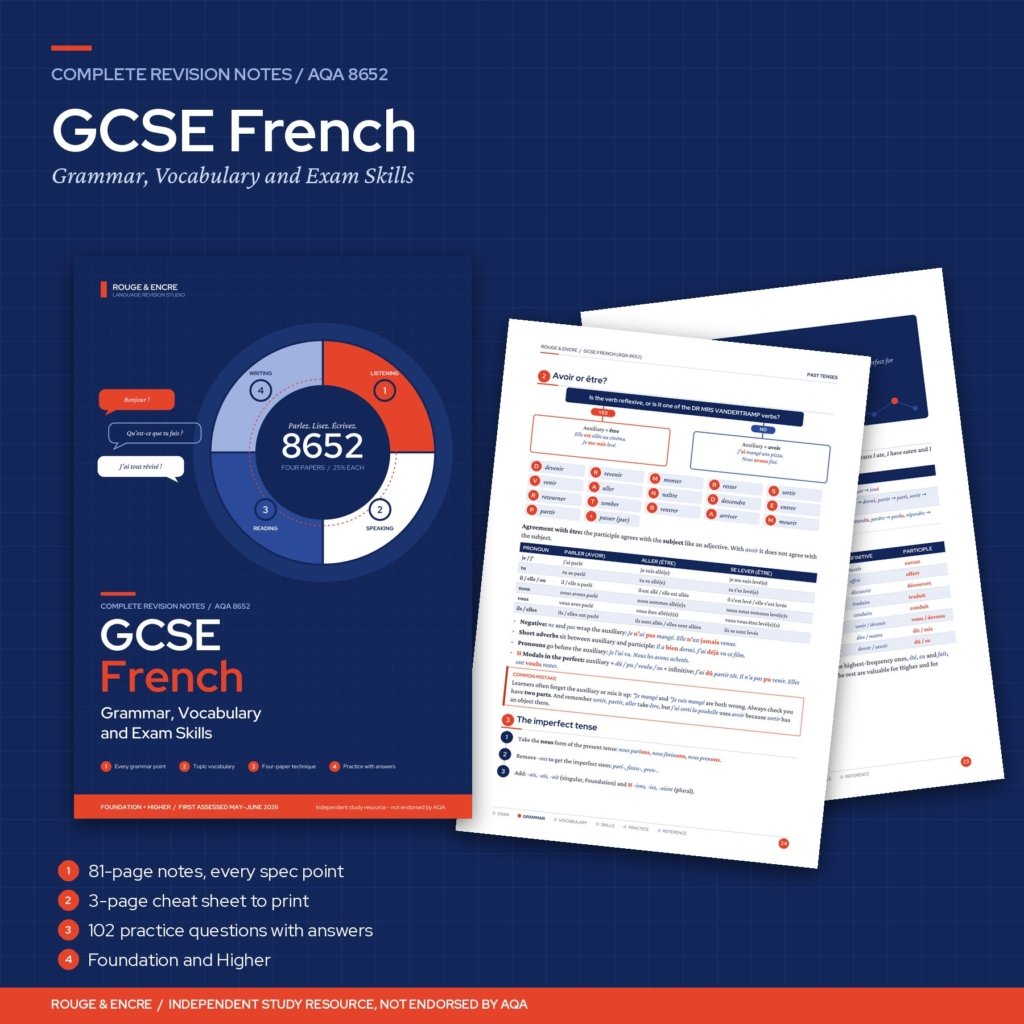
If you are sitting AQA GCSE French in 2026, you are among the first students to take the redesigned course. The papers look different, the vocabulary is prescribed, and every paper now tests grammar and word knowledge more directly. This guide explains what is on the exam, how the marks work and how to revise sensibly, and it comes with a free sample of our revision notes.
Free AQA GCSE French 8652 Revision Notes Sample (PDF)
A 9-page sample with the cover, contents, the full Past Tenses chapter, a listening-skills page, a cheat-sheet page and a page of practice questions.
Want everything unlocked?
The free file is a sample. The full version has every page, tab and feature, plus the user guide.
See the full versionWhat is on the AQA GCSE French (8652) exam?
There are four papers, each worth 25% of the grade. You take all four at the same tier, Foundation (grades 1 to 5) or Higher (grades 4 to 9), at the end of the course. There are no dictionaries in any paper.
| Paper | Foundation | Higher |
|---|---|---|
| 1 Listening | 35 minutes, 40 marks | 45 minutes, 50 marks |
| 2 Speaking | 7 to 9 minutes plus 15 minutes of preparation, 50 marks | 10 to 12 minutes plus 15 minutes of preparation, 50 marks |
| 3 Reading | 45 minutes, 50 marks | 1 hour, 50 marks |
| 4 Writing | 1 hour 10 minutes, 50 marks | 1 hour 15 minutes, 50 marks |
Foundation Listening is marked out of 40 and scaled so that every paper carries equal weight. Speaking is recorded by your teacher in the spring and marked by AQA.
What is tested?
Every task is drawn from three themes: People and lifestyle, Popular culture, and Communication and the world around us. Each has three topics, such as healthy living, festivals or the environment. Tasks are based on the prescribed vocabulary list and the grammar in the specification, so you cannot rely on guessing or on dictionary skills.
Paper 1: Listening
Section A has comprehension questions in English. Each item is played twice. Section B is dictation: you hear short French sentences three times and write them down. Marks are split between meaning and accurate spelling and grammar.
Paper 2: Speaking
There are three parts. The role-play is an informal chat with a friend with five two-mark tasks, one of which asks you to put a question. In the reading-aloud part you read a short text, then answer four questions. The photo card has two photos followed by a conversation on the theme.
Paper 3: Reading
Section A tests comprehension of notices, adverts, articles and emails, answered in English. Section B is a translation into English of at least 35 words (Foundation) or 50 words (Higher).
Paper 4: Writing
Foundation candidates write five sentences about a photo, a 50-word response, five short grammar tasks, a translation into French and a 90-word response. Higher candidates translate into French, write about 90 words and then about 150 words. Marks reward both content and the accuracy and range of your language.
Why accuracy matters more than ever
The new specification gives marks directly for grammar and vocabulary in several places: dictation, translation, pronunciation and the language marks in writing and speaking. Ambitious sentences with wrong verb endings do not help. A simple structure used correctly usually earns more than a complicated one that fails.
How to revise French for GCSE
- Know your tier and the papers. Ask your teacher which tier you sit and read the paper structure so that no question type surprises you.
- Master the core verbs first. Learn the present tense of regular verbs and the irregulars être, avoir, aller and faire, then the perfect tense with avoir and être, the imperfect and the near future. Higher candidates add the future and conditional.
- Learn vocabulary by topic, with the article. Learn la maison, not maison. Use cover-and-recall, say the words aloud and write them from memory.
- Practise each paper separately. Do dictation weekly, record your speaking answers, and translate short passages in both directions.
- Test, mark, repeat. Do timed practice, mark it strictly, and keep a list of repeated mistakes.
Common mistakes that cost marks
- Writing je suis 15 ans instead of j’ai quinze ans.
- Leaving out the auxiliary in the perfect tense, or using the wrong one.
- Forgetting agreement: adjectives, and participles with être.
- Translating word for word instead of by meaning, especially with il y a, on and depuis.
- Giving an opinion without a reason, or a single-tense answer in speaking and writing.
- In writing, ignoring one of the bullet points.
- In listening, writing the first answer you hear instead of the final decision.
A simple revision timeline
| When | Focus |
|---|---|
| 12 to 8 weeks before | Grammar foundations: nouns, adjectives, present tense, perfect tense. Start topic vocabulary. |
| 8 to 6 weeks before | Imperfect, near future, future and conditional, reflexive and modal verbs, negatives and questions. |
| 6 to 4 weeks before | Finish vocabulary for the nine topics. Weekly dictation and speaking recordings. |
| 4 to 2 weeks before | Timed practice for Reading and Writing, translation in both directions. |
| Final fortnight | Fix weak spots, learn connectives and set phrases, practise the cheat sheet, rest well. |
Remember that the Speaking assessment takes place in April and May, before the written papers, so begin your speaking preparation early.
How to prepare for the speaking test
Use your 15 minutes of preparation well. For the role-play, write a verb next to each task. For the reading-aloud text, underline silent endings and mark liaisons. For the photo card, plan a first minute that mentions both photos, then prepare flexible blocks of language about each topic in the theme. Every answer should include an opinion, a reason, a detail and a second time frame where it fits. Pronunciation is only a small part of the marks, but clear speech helps the examiner reward everything else.
How to prepare for dictation
Dictation rewards the silent endings and homophones that many students forget. Write each chunk as you hear it, then use the final hearing to check. Test yourself on pairs such as a/à, et/est, son/sont and ces/ses/c’est. Always ask whether the finished sentence makes sense.
Free GCSE French revision notes and the full pack
The free sample above gives you a taste of the Rouge & Encre style: the full chapter on past tenses, a page of listening and dictation technique, a cheat-sheet page and practice questions. When you are ready for everything, the complete AQA GCSE French 8652 revision pack has 81 pages of notes in specification order, a 3-page cheat sheet, a study guide with revision plans, and 102 original practice questions with full answers.
Frequently asked questions
Is GCSE French harder under the new specification?
The content is more tightly defined rather than simply harder. The vocabulary list is prescribed, and grammar and spelling are assessed more directly, so systematic learning pays off.
Which tier should I take?
Your teacher will decide with you. Foundation leads to grades 1 to 5 and Higher to grades 4 to 9. You must sit the same tier for all four papers.
Can I use a dictionary?
No. No dictionaries are allowed in any paper, including the speaking preparation.
How much of the grade is speaking?
Speaking is 25% of the qualification: the same as Listening, Reading and Writing.
How long should I revise each day?
Short and frequent is best. Twenty to thirty minutes of vocabulary and grammar a day, plus a timed paper section each week, beats a single long session.
When do the exams take place?
The speaking tests are in April and May, and the Listening, Reading and Writing papers are in the May and June series. Check your school timetable for exact dates.
This article is independent and is not endorsed by AQA. AQA is a registered trade mark of AQA Education. It describes the AQA GCSE French (8652) specification first assessed in 2026.
