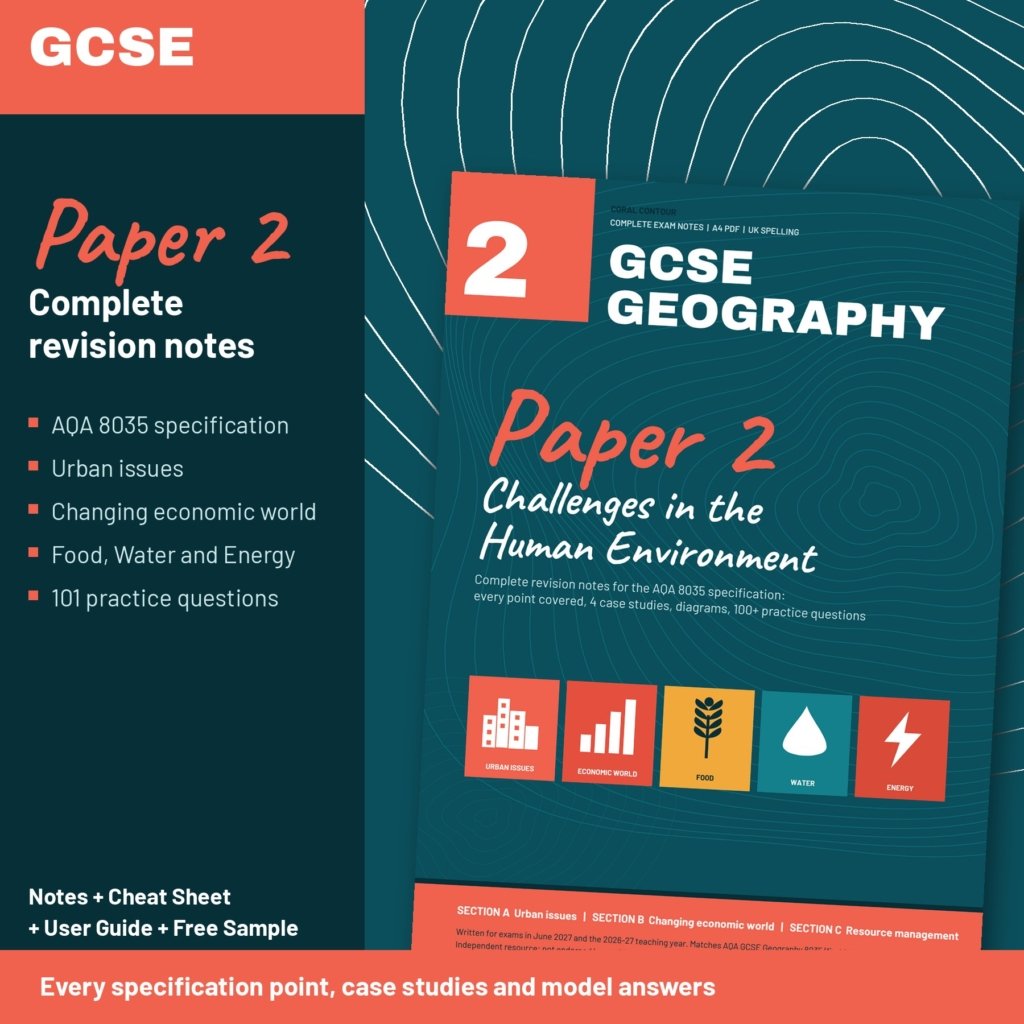
If you are revising AQA GCSE Geography, Paper 2 is where case-study knowledge matters most. It asks you to explain cities, development and resources using real places, real numbers and clear reasoning. This guide explains how Paper 2 (Challenges in the human environment) is structured, what it tests, how to revise for it, the mistakes that cost the most marks and a timeline you can adapt. It also includes a free sample of our revision notes so you can see the approach for yourself.
The free sample is a real extract from our complete Paper 2 pack, not a teaser. It contains the cover and contents, the opening of Section A on urban change and the start of the Lagos case study, two pages of exam-style practice questions and a page of the printable cheat sheet. Download it below.
Free AQA GCSE Geography Paper 2 Revision Notes Sample (PDF)
A 9-page sample from the full notes: cover, contents, the opening of Section A on urban change and the start of the Lagos case study, two pages of practice questions and a cheat-sheet page.

Want everything unlocked?
The free file is a sample. The full version has every page, tab and feature, plus the user guide.
See the full versionHow AQA GCSE Geography Paper 2 is structured
AQA GCSE Geography (8035) has three written papers, all sat at the end of the course. Paper 2 is called Challenges in the human environment. It lasts 1 hour 30 minutes, is worth 88 marks (including 3 marks for spelling, punctuation, grammar and specialist terminology) and makes up 35 per cent of the GCSE. It is not tiered, so every candidate sits the same paper and can be awarded grades 9 to 1.
| Section | Topic | Marks | What you answer |
|---|---|---|---|
| A | Urban issues and challenges | 33 | All questions |
| B | The changing economic world | 30 | All questions |
| C | The challenge of resource management | 25 | Question 3 (14 marks) plus one of Food, Water or Energy (11 marks) |
Many questions are based on a figure such as a map, graph, table or text extract, and the paper mixes multiple choice, short answers and extended writing. The longest answers are levels-of-response questions of 6 and 9 marks, where the quality of your reasoning and evidence decides the level you reach. The final 9-mark question carries up to three extra SPaG marks.
What is tested
- Urban issues and challenges: why cities grow, especially in lower income countries and newly emerging economies, and the opportunities and challenges that follow. You study one major city in an LIC or NEE, one major UK city, a regeneration project, sustainable urban living and ways to reduce traffic congestion.
- The changing economic world: how development is measured, why it is uneven, how the gap can be reduced, a case study of one LIC or NEE, and how the UK economy has changed, including its place in the wider world.
- The challenge of resource management: the global importance of food, water and energy, the pattern of supply and demand, and then a detailed study of one of the three, covering insecurity, supply strategies, a large-scale example and sustainability.
The assessment objectives are weighted roughly as follows across Paper 2: knowledge of places and processes (AO1), understanding (AO2), applying that understanding to analyse and judge (AO3) and geographical skills (AO4). In practice that means you need accurate facts, but marks in the longer questions go to those who use the facts to build an argument.
How to revise Paper 2
- Start with the specification. List every point and rate your confidence. A checklist turns a vague worry into a plan.
- Build a case-study bank. For each named example, learn a location, two or three figures, a cause, an effect and a response. One line of located evidence is worth more than a paragraph of general statements.
- Practise retrieval, not rereading. Cover the page and write what you know. Then check and fill gaps.
- Learn the command words. Describe, explain, assess, evaluate and to what extent each ask for something different.
- Practise skills. Read graphs carefully, calculate means and percentages, interpret choropleth maps and describe patterns with figures.
- Write timed answers. Aim for about one minute per mark and check your work against a mark scheme.
Case studies: use what your school taught
The specification expects specific named examples, but it does not prescribe which ones to choose in most cases. Your teacher may have chosen different places from the ones in our notes. The best approach is to learn the structure of a strong case study (where, why, what happened, who benefited, what problems remain) and fill it with your own examples. Well-known choices include Lagos or Rio for a city in a lower income or newly emerging country, London or Birmingham for a UK city, India or Nigeria for an NEE, and examples of food, water and energy projects of different scales.
Writing 6 and 9-mark answers
Levels-of-response questions are marked by overall quality, not by ticking points. A reliable structure is point, evidence, explanation, link back to the question. For 9-mark evaluation questions, plan a short argument: state a judgement, give two or three developed points with case-study evidence, consider another view and reach a conclusion that answers the exact wording of the question. Spend two or three minutes planning before you write.
Common mistakes that cost marks
- Vague answers. “It creates jobs” is weak. “Tourism jobs in Jamaican resorts, but many are seasonal and low paid” is strong.
- Describing when asked to explain. An explanation needs a reason or a because.
- Mixing up scales. Know whether a question wants a city, a country or a global answer.
- Ignoring the figure. If a graph or map is provided, use data from it and quote units.
- Forgetting the second half of a question. Questions often ask for both advantages and disadvantages.
- Leaving the 9-mark question to the end without time. Plan to have at least 15 minutes for it.
- Learning facts without checking dates. Use recent, rounded figures and say “about” when you are not sure.
A simple revision timeline
If you have eight weeks, spend the first three learning Sections A and B, two weeks on Section C and its resource choice, and the final three on timed practice and weak spots. A short example plan looks like this.
- Weeks 8 to 6: make notes on urban issues and the changing economic world and build your case-study bank.
- Weeks 5 to 4: cover resource management, concentrating on the resource you studied.
- Weeks 3 to 2: practise graph skills and short questions, then write 6-mark answers.
- Final week: sit a timed paper, redo weak questions and use a one-page cheat sheet each day.
With only two weeks left, spend the first five days on the checklist and case-study banks, the next seven on timed questions and the last two on light retrieval, sleep and exam logistics.
Free sample and full notes
Our complete AQA GCSE Geography Paper 2 notes run to 62 A4 pages and cover every specification point in order, with around 40 diagrams, case-study fact boxes, 101 original practice questions with answers, a glossary and a tick-box checklist with page references. The pack also includes a two-page printable cheat sheet and a user guide with an 8-week and a 2-week revision plan. You can see the full contents and what is included on the product page, or go straight to the complete Paper 2 revision pack.
Frequently asked questions
Which exam board are these notes for?
They are written to match AQA GCSE Geography (8035), Paper 2. Check with your teacher that this is the specification you are following.
Is Paper 2 tiered?
No. All candidates sit the same paper and can achieve any grade from 9 to 1.
Do I need to learn every case study?
You need the case studies your school taught, because the specification names the types of example you must know. Learn those in detail, and use extra examples to strengthen longer answers.
How should I use the free sample?
Read the Section A pages, then try the practice questions without notes and mark them with the guidance. This shows how the full pack works.
Can I print the free sample?
Yes. It is A4 and designed to print at 100 per cent. Colour helps, but the layout also works in black and white.
Coral Contour is an independent publisher. This article and the free sample are not affiliated with, endorsed by or connected to AQA. AQA is a registered trade mark of AQA Education and is mentioned only to describe the specification the notes are designed to match.
