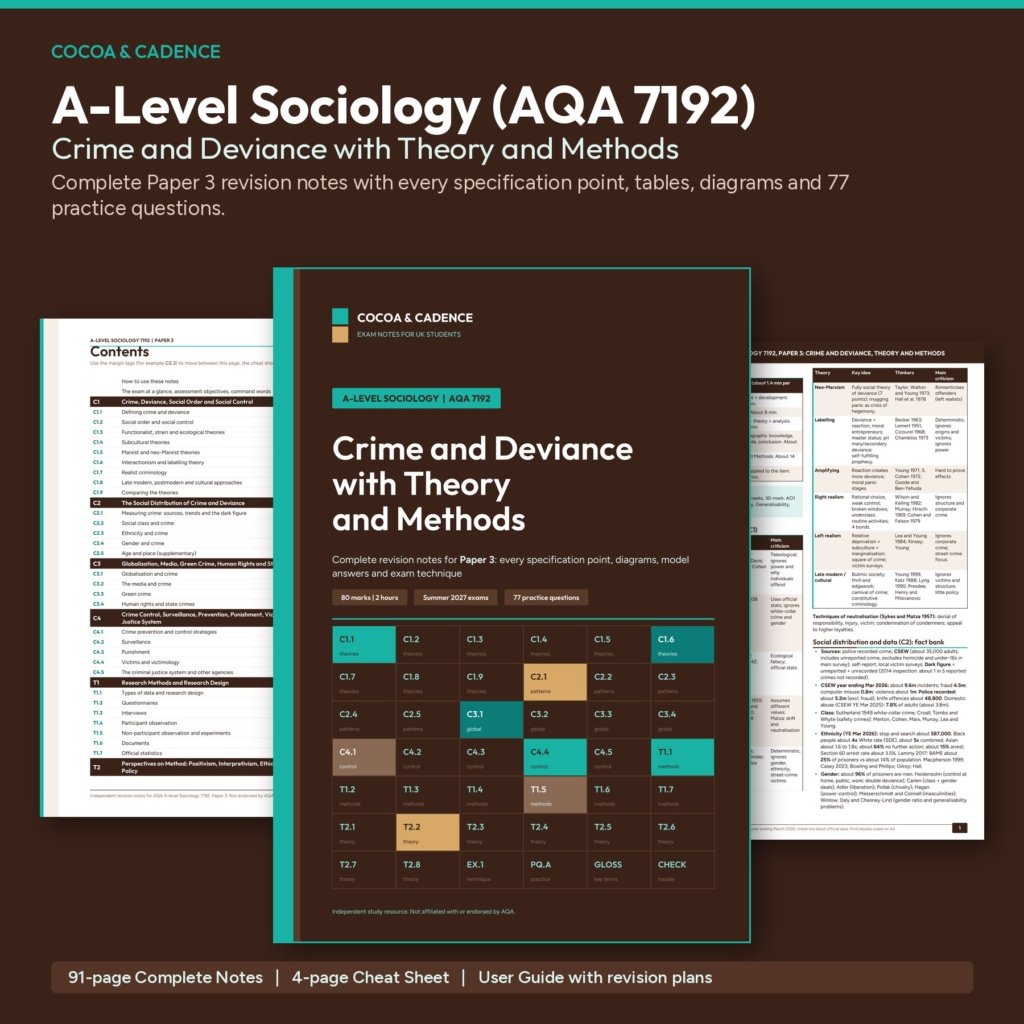
If you are revising for AQA A-Level Sociology Paper 3, you are being tested on two things at once: what you know about crime, deviance and social control, and how well you understand sociological research methods and theory. Many students find it the hardest paper because it asks for wide knowledge, current evidence and confident evaluation in just two hours. This guide explains the paper, how to plan your revision and the mistakes that cost marks. You can also download a free sample of our revision notes below.

Free A-Level Sociology 7192 Paper 3 Revision Notes Sample (PDF)
An 8-page sample with the cover, contents, the labelling theory and moral panics section, practice questions with answers and a cheat sheet page.
Want everything unlocked?
The free file is a sample. The full version has every page, tab and feature, plus the user guide.
See the full versionWhat is on Paper 3?
Paper 3 is called Crime and Deviance with Theory and Methods. It is a two-hour paper worth 80 marks and counts for one third of the A-Level. It has two sections, and you answer every question.
| Section | Content | Questions and marks |
|---|---|---|
| A: Crime and Deviance | Theories of crime, social distribution, globalisation, media, green crime, state crime, prevention, punishment and victims | A 4-mark outline, a 6-mark outline, a 10-mark question using an item and a 30-mark essay |
| B: Theory and Methods | Research methods, positivism and interpretivism, ethics, the major theories, postmodernity, science and values | A 10-mark outline-and-explain question and a 20-mark essay using an item |
The exact mark totals are published in the specification and sample assessment materials, so always check the exam board website for the current layout. The pattern above is the structure students have met in recent series.
What examiners reward
Sociology answers are marked on three skills, called assessment objectives. Knowledge and understanding means accurate theories, concepts, studies and evidence. Application means using that knowledge to answer the question that has been set, including the item when there is one. Analysis and evaluation means weighing up strengths, weaknesses and alternative views and reaching a judgement. In the long essays, evaluation carries a large share of the marks, so a description of theories with no criticism will usually sit in the middle bands.
Topics you must be able to explain
Crime and Deviance
- Theories: functionalist, strain and subcultural, Marxist and neo-Marxist, interactionist and labelling, realist, and late modern approaches
- Patterns of crime by social class, ethnicity, gender and age, and the problems with using official statistics
- Globalisation, the media, green crime, human rights and state crime
- Crime prevention, surveillance, punishment, victims and the criminal justice system
Theory and Methods
- Questionnaires, interviews, observation, experiments, documents and official statistics
- Positivism and interpretivism, and debates about science and objectivity
- Ethics, values and the link between sociology and social policy
- Modernity, postmodernity and the contribution of each major theory
A simple revision timeline
Whatever time you have left, split your revision into learning, applying and testing. The table gives a flexible 8-week outline.
| Weeks | Focus | What to do |
|---|---|---|
| 1 to 2 | Theories of crime | Make a one-page comparison grid, then write short answers on each theory |
| 3 to 4 | Patterns, globalisation, media, green crime and state crime | Learn a few up-to-date statistics and one case for each |
| 5 | Control, punishment and victims | Practise a plan for the 30-mark essay |
| 6 to 7 | Methods and Theory and Methods debates | Practise the 10-mark and 20-mark questions under timed conditions |
| 8 | Full practice | Do a timed paper, mark it, and target your weakest areas |
If you only have two weeks, spend the first week on the theories and patterns, and the second on methods, timed essay plans and retrieval practice. Keep a short list of up-to-date examples and add to it.
Common mistakes to avoid
- Ignoring the item. In the questions that use an item, you must apply the material directly, not just mention it.
- Describing instead of evaluating. Each paragraph should end with a strength, a weakness or a comparison, and the essay should finish with a judgement.
- Out-of-date evidence. Old statistics are not wrong, but recent figures and legislation show wider knowledge.
- Mixing up theories. Keep a grid showing who argued what and avoid attributing a view to the wrong thinker.
- Poor time management. The long essays deserve about 40 minutes (30 marks) and about 30 minutes (20 marks); do not leave them to the last ten minutes.
- Treating methods as a list. Link each method to a theory (positivism or interpretivism), to validity and reliability, and to a real study.
How to make revision stick
Retrieval practice works better than re-reading. After each section, close your notes, write down everything you can remember, and check what you missed. Use spaced repetition: revisit each topic after a day, a week and a month. Practise writing under timed conditions early, even if your first attempts are short, and mark them against a mark scheme. Finally, use a checklist to track every specification point as red, amber or green so you never spend all your time on the topics you already like.
Get the free sample
Our free sample shows how the notes are organised, with margin specification codes, evaluation boxes and model answers. If you like the style, the complete A-Level Sociology 7192 Paper 3 revision notes cover the whole paper in 91 pages, with a 4-page cheat sheet, 77 practice and retrieval questions and a user guide with 8-week and 2-week revision plans.
Frequently asked questions
How long should I spend revising Paper 3?
Most students benefit from six to eight weeks of steady revision, but a focused two-week plan can work if you prioritise the theories and essay practice.
Do I need to know exact statistics?
You do not need to memorise lots of decimals. Short, accurate figures such as a rounded proportion or a clear trend are enough, and examiners value accuracy over quantity.
Which topic should I revise first?
Start with the theories of crime, because they underpin almost every other topic and are useful in the Theory and Methods questions too.
Are these notes approved by the exam board?
No. They are an independent resource written to match the published specification, and they are not affiliated with or endorsed by AQA. AQA is a registered trade mark of AQA Education (AQA). For the latest rules, always read the specification on the exam board website.
Can I use the notes for another exam board?
Much of the theory and methods content overlaps, but the notes are organised for AQA 7192, so check your own specification before relying on them.
