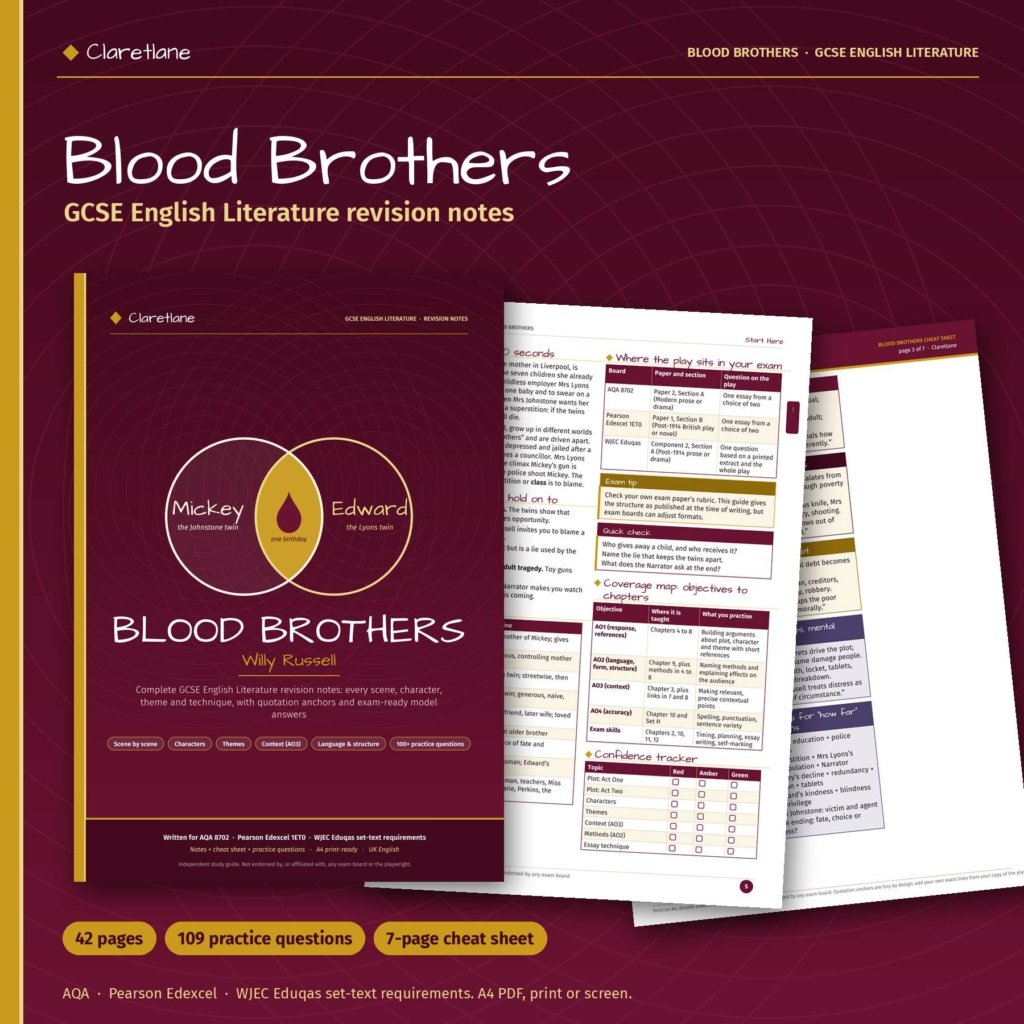
Blood Brothers is a set text for many GCSE English Literature students, and it rewards students who can link the story to class, fate, secrets and motherhood rather than simply retell it. This guide explains what examiners are looking for, how the main boards assess the play, and how to revise it in a way that sticks. At the end you can download a free nine-page sample of our revision notes.
Free Blood Brothers GCSE Revision Notes Sample (PDF)
A nine-page extract from the full pack: the cover, the About page, two character pages, the themes opener, two practice-question pages and a cheat sheet page.
Want everything unlocked?
The free file is a sample. The full version has every page, tab and feature, plus the user guide.
See the full versionWhat is Blood Brothers about?
Willy Russell’s musical play follows twin boys separated at birth. Mrs Johnstone, a poor Liverpool mother already struggling with debt, gives one baby to her wealthy, childless employer, Mrs Lyons. One twin grows up as Mickey, the other as Edward. The boys meet, become friends and swear to be blood brothers without knowing they are twins. As they grow older, class pulls them apart. The play begins with the end of the story, and a Narrator reminds the audience that a debt must be paid. Your essays should show how Russell uses these events to explore a central question: is it fate and superstition that destroy the brothers, or is it class?
How is Blood Brothers assessed?
The play appears on several specifications, and the question style differs. Always check your own board’s current papers and your teacher’s advice, because details can change.
| Board | Where it appears | What you do |
|---|---|---|
| AQA (8702) | Paper 2, Section A (modern prose or drama) | Write one essay from a choice of two, 34 marks including 4 for spelling, punctuation and grammar. |
| Pearson Edexcel (1ET0) | Paper 1, Section B (post-1914 drama) | Write one essay from a choice of two, 40 marks including 8 for spelling, punctuation and grammar. |
| WJEC Eduqas | Component 2, Section A | Answer one question on a printed extract and the whole play, 40 marks including 5 for spelling, punctuation and grammar. |
Across all of them, the assessment objectives are similar in spirit. You need a personal, well-argued response with quotations (AO1), analysis of language, form and structure (AO2), links to context (AO3), and accurate writing (AO4). The balance changes by board, so look at the mark scheme for your paper.
What examiners reward
- A clear argument. Answer the exact question, such as how far Russell presents Mrs Lyons as a villain, rather than describing the plot.
- Short, embedded quotations. Use two to six words and analyse one word or phrase. Long quotations waste time.
- Methods and effects. Dramatic irony, the Narrator, songs, stage action, symbols such as shoes and the locket, structure and dialect all count.
- Relevant context. Mention Liverpool in the 1960s to 1980s, class, unemployment, education and superstition only when they help your argument.
- Judgement. Strong answers weigh both sides, for example showing that Mrs Johnstone is a victim of circumstances but also makes choices.
The ideas you must know
- Class: the twins share a birthday and a bond but their homes, schools, jobs and speech separate them.
- Fate and superstition: omens such as shoes on a table, a magpie and the devil build tension, and Mrs Lyons turns a belief into a weapon.
- Nature and nurture: if the boys were swapped, would their lives be the same? Russell invites the audience to decide.
- Motherhood: compare Mrs Johnstone and Mrs Lyons, and how love, fear and money shape each woman.
- Friendship, growing up and violence: childhood games with toy guns grow into real danger.
- Secrets and money: a hidden deal and a debt drive the plot.
How to revise Blood Brothers
1. Learn the story in order
Break each act into short movements and learn them with a mnemonic or timeline. Then retell the play out loud from memory. You cannot analyse what you cannot place.
2. Build one profile per character
For each main character, write what they are like, how Russell shows it, how they change and what they represent. Add two or three tiny quotations from your own copy of the play.
3. Link themes to scenes
Choose three scenes for each theme and note the method that carries the idea. This makes planning quick because the same scenes can answer several questions.
4. Practise in short bursts
Write single paragraphs first, using point, method, effect and a link to context. Then plan a full essay in five minutes. Only after that should you do a timed essay.
5. Mark your own work
Compare your answer with a mark scheme or model, then rewrite the weakest paragraph. Improvement comes from redoing, not just rereading.
Common mistakes to avoid
- Retelling the plot instead of answering the question.
- Copying long quotations from memory and getting them wrong. Short and accurate is better.
- Bolting on context as a paragraph at the end. Weave it into the argument.
- Treating a character as all good or all bad. Mrs Lyons and Mickey are both victims and wrongdoers in different ways.
- Ignoring the Narrator and the songs. They are part of how Russell shapes the audience’s response.
- Weak accuracy. Use capital letters for names, check apostrophes and proofread for five minutes.
A simple revision timeline
| When | Focus |
|---|---|
| Weeks 8 to 6 | Plot, context and the exam format for your board. |
| Weeks 5 to 4 | Characters and themes; one paragraph a session. |
| Weeks 3 to 2 | Methods and exam technique; two full timed essays. |
| Final week | Cheat sheet, plans for the commonest questions, one last timed essay and a light final day. |
If your exam is closer than eight weeks away, compress the plan but keep the self-testing. Retrieval practice is the part that makes revision stick.
Frequently asked questions
How many quotations should I learn?
Aim for about ten to fifteen tiny anchors that cover the main characters, themes and methods. Learn them as short phrases and practise explaining what a single word shows.
Do I need to know the songs?
You should know what the songs do. They carry emotion, repeat ideas and foreshadow the ending. Know the key titles and what each one contributes to the story.
Which context matters most?
Class and unemployment in Liverpool, education such as the 11-plus, superstition and the situation of working-class women. Use it to explain choices Russell makes.
Is the final shooting accidental?
Guides and productions disagree. Argue from your own copy and be careful with wording, because examiners reward a supported interpretation.
Get the full pack
The free sample shows the style. If you want the complete scene-by-scene notes, character and theme chapters, model answers, a cheat sheet and over a hundred practice questions with answers, get the full Blood Brothers GCSE revision pack. You can also read more on the product page.
This article is independent guidance and is not endorsed by any exam board. Check your board’s current specification and papers before relying on mark allocations.
