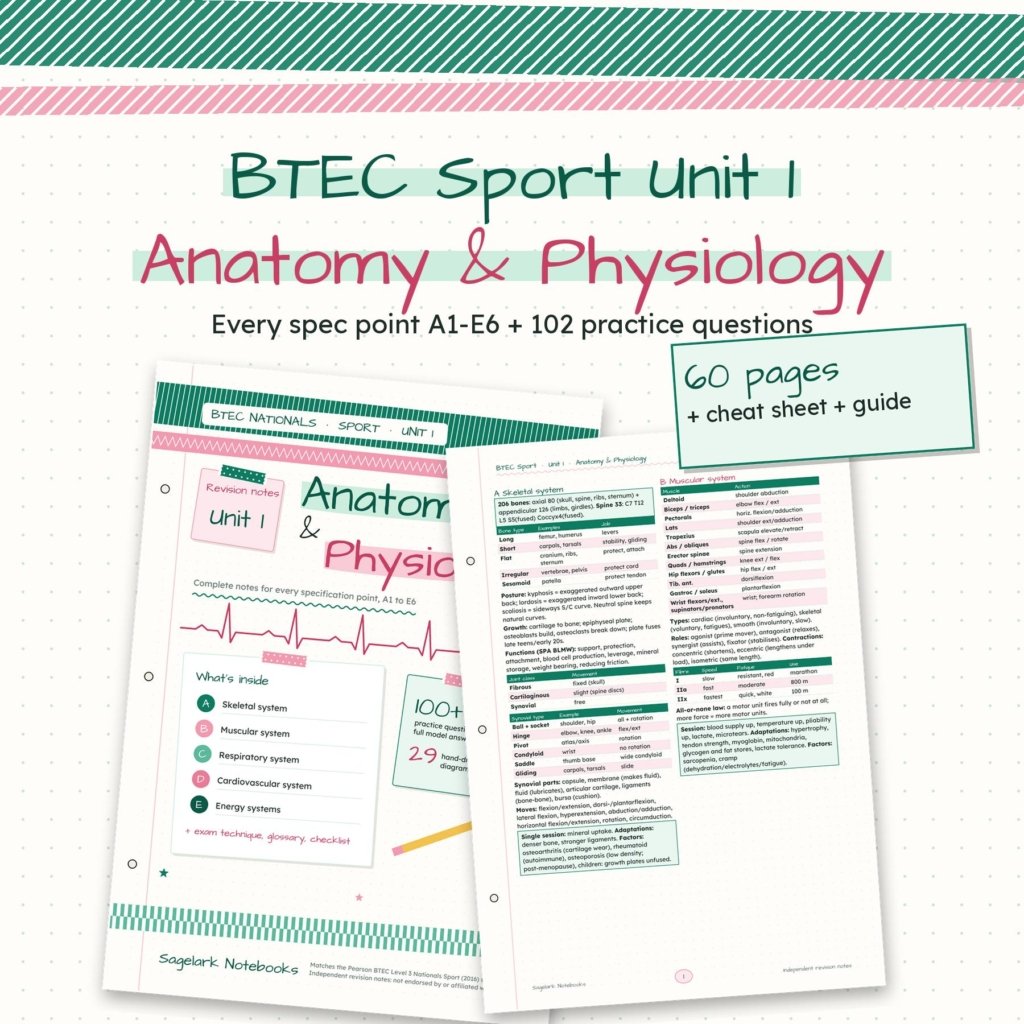
If you are preparing for the BTEC Level 3 National Sport Unit 1 exam, you already know that Anatomy and Physiology is a content-heavy paper. This guide explains what the exam looks like, what examiners actually test, and how to revise it in a sensible order. At the end you can download a free ten-page sample of our revision notes.
Free BTEC Sport Unit 1 Anatomy and Physiology Revision Notes Sample (PDF)
Ten pages from the full notes: cover, contents, the start of the respiratory system section, a cheat sheet page and practice questions with answers.
Want everything unlocked?
The free file is a sample. The full version has every page, tab and feature, plus the user guide.
See the full versionWhat the Unit 1 exam is
Unit 1: Anatomy and Physiology is the externally assessed unit in the Pearson BTEC Level 3 Nationals in Sport (2016 specification). It is a written exam of 1 hour 30 minutes worth 80 marks, set and marked by Pearson, and offered in January and May/June. It is a core unit in the Sport suite, so the knowledge also underpins later units on training, nutrition and performance.
The five content areas
The specification is organised into five areas. Each follows the same pattern: structure, function, response to a single session, long-term adaptations and additional factors.
| Area | Topic | Typical tasks |
|---|---|---|
| A | Skeletal system | Name bones and joints, joint types and movements, bone growth, osteoporosis |
| B | Muscular system | Muscle names and actions, antagonistic pairs, fibre types, contraction types |
| C | Respiratory system | Breathing mechanics, gaseous exchange, lung volumes, control, asthma, altitude |
| D | Cardiovascular system | Heart structure, conduction, cardiac output, blood pressure, vascular shunting |
| E | Energy systems | ATP-PC, lactate and aerobic systems, recovery, diabetes, children |
How marks are earned
Questions range from one-word answers to extended writing. In broad terms you will meet:
- Give, name, state, identify (1 to 2 marks): recall a fact. Be precise: “gastrocnemius”, not “calf”.
- Describe and explain (2 to 4 marks): make a point and, for explain, say why using words such as because or so.
- Analyse and assess (6 marks): break the topic into parts, show how they link and judge importance.
- Discuss, evaluate and to what extent (8 marks): weigh up both sides, link systems together and finish with a clear judgement.
The extended questions carry a large share of the marks, and they are where grades are decided. They are often linked to a scenario such as a named athlete or session, so always refer to the sport in your answer.
How to revise each area
Skeletal system
Learn the names and positions of the major bones and the numbers in the spine (7, 12, 5, 5 fused, 4 fused). Build a table of joint, joint type and movement. Understand how bone grows at the epiphyseal plate and why children need careful resistance training. Practise sketching a synovial joint and labelling it.
Muscular system
Make flashcards for the named muscles: location, action, sporting example. Learn antagonistic pairs as pairs, then practise naming the agonist, antagonist, synergist and fixator for a squat, a press-up and a bicep curl. Compare fibre types in a table and be able to match them to events such as the marathon and 100 m. The all-or-none law is a favourite: whole motor units fire or do not fire, so force is controlled by recruiting more units.
Respiratory system
Know the air path in order, then the muscles of inspiration and expiration at rest and during exercise. Gaseous exchange is about diffusion down partial pressure gradients. Learn the lung volumes and practise calculations such as minute ventilation (tidal volume multiplied by breathing rate) and vital capacity (tidal volume plus the two reserve volumes). For control of breathing, remember the medulla oblongata and chemoreceptors detecting carbon dioxide and acidity.
Cardiovascular system
Draw the heart from memory, trace the blood path, and learn the conduction route: SAN, AVN, bundle of His, Purkinje fibres. Cardiac output equals heart rate multiplied by stroke volume. Be ready to explain why a trained athlete has a lower resting heart rate, and how blood is redirected to working muscle by vasodilation and vasoconstriction.
Energy systems
Create one comparison table with fuel, site, duration, ATP yield, by-products and recovery for the ATP-PC, lactate and aerobic systems. Then link each to sporting examples. Remember that the systems overlap as a continuum and that the aerobic system rebuilds phosphocreatine during recovery.
A simple eight-week timeline
- Weeks 1 and 2: skeletal system, then start the muscular system.
- Week 3: finish muscular, recap skeletal with questions.
- Week 4: respiratory system including calculations.
- Weeks 5 and 6: cardiovascular system and the first part of the energy systems.
- Week 7: finish energy systems, then practise linking systems for the 8-mark questions.
- Week 8: timed practice, cheat sheet, and fixing weak points.
If you only have two weeks, cover one content area every two days, then spend the last four days on questions and technique.
Common mistakes to avoid
- Confusing ligaments (bone to bone) with tendons (muscle to bone).
- Mixing up stroke volume (blood per beat) and cardiac output (blood per minute).
- Describing a response without explaining it. For example, say that heart rate rises because the sympathetic nervous system and adrenaline increase the rate of the pacemaker.
- Saying cramp or soreness is simply “lactic acid”.
- Forgetting units in calculations (L/min, mL, bpm).
- Ignoring the scenario in extended questions.
Exam day timing
With 80 marks in 90 minutes you have a little over one minute per mark. Spend about five minutes reading the paper, work through short questions quickly, and keep about 35 minutes for the extended answers. Plan 6 and 8-mark answers briefly: two or three key points, a link between systems, and a conclusion.
Frequently asked questions
Is the exam on paper or on screen? Check with your centre, as arrangements vary and can change between series.
Can I resit? Yes, there are two windows a year, subject to the rules of your centre and Pearson.
How much of the paper is long-answer? A substantial share. Practise 6 and 8-mark questions under timed conditions from the start of your revision.
What is the best way to learn the muscle names? Use the body: touch the muscle, move the joint, and say the name and action aloud.
Get the complete notes
The sample above shows how our notes teach respiratory system content with diagrams and questions. The complete Sagelark BTEC Sport Unit 1 revision pack covers every specification point from A1 to E6, with 29 diagrams, over 100 original practice questions with model answers, a printable cheat sheet and a revision planner. You can see the full list of what is included on the product page.
This article and the linked products are independent and are not endorsed by or affiliated with Pearson. BTEC and Pearson are registered trade marks of Pearson Education Limited. Always check your centre’s current specification and exam arrangements.
