Passing the CLEP College Algebra exam can earn you 3 semester hours of college credit for a $97 test fee, often a fraction of what the course would cost. The exam is very predictable: four content domains, a fixed list of topics and the same kinds of traps every time. This guide explains exactly what is tested, how to prepare in about four weeks and which mistakes cost the most points. It also includes a free download of the first chapter of our full notes.
What the CLEP College Algebra Exam Looks Like
| Item | Detail |
|---|---|
| Questions | About 60 (some unscored pretest questions) |
| Time | 90 minutes |
| Calculator | Built-in scientific (TI-30XS MultiView), no graphing |
| Score scale | 20 to 80 |
| ACE credit score | 50, recommended for 3 semester hours |
| Fee | $97, plus any test center fee |
About half the questions are routine computation and half test understanding. There is no penalty for wrong answers, so answer every question. Your college decides what score it accepts and which course you receive, so check its policy before you register.
Get the Free CLEP College Algebra Notes (Chapter 1)
Our free sample is the full first chapter: the exam format and domains, the real number system, properties of real numbers, order of operations, interval notation, absolute value and scientific notation, with worked examples and a 10-question check with explained answers. Download it here:

Free CLEP College Algebra Notes: The Exam and the Real Number System (PDF)
Chapter 1 in full: exam format and domains, number sets, properties, order of operations, intervals, absolute value and a 10-question check with answers.

Want everything unlocked?
The free file is a sample. The full version has every page, tab and feature, plus the user guide.
See the full versionThe Four Content Domains
Algebraic Operations (25%)
Exponents (including rational exponents), factoring and expanding polynomials, operations with algebraic expressions, absolute value and properties of logarithms. Factoring is the single most useful skill on the test because it shows up in equations, rational expressions and graphs.
Equations and Inequalities (25%)
Linear, quadratic and absolute value equations and inequalities, systems of equations and inequalities, and exponential and logarithmic equations. Expect at least one problem where an answer choice is an extraneous solution.
Functions and Their Properties (30%)
The largest domain. Domain and range, evaluating functions, combining and composing functions, graphs (intercepts, symmetry, transformations) and inverse functions. The functions include linear, polynomial (up to degree 5), rational, absolute value, power, exponential, logarithmic and piecewise.
Number Systems and Operations (20%)
Real numbers, complex numbers, factorials and the binomial theorem. These questions are often quick points if you know the rules for powers of i and binomial coefficients.
Full version
Clear Roots: CLEP College Algebra Complete Exam Notes
- All 4 CLEP domains in numbered steps
- 167 practice questions with worked answers
- 60-question timed practice exam
Is CLEP College Algebra Right for You?
CLEP works best for students who already know some algebra, perhaps from high school, a past course or work, and want credit without sitting through a full semester. If you passed Algebra II in high school, much of the exam will look familiar; your job is to refresh the rules and practice under time pressure. If algebra feels brand new, plan on six weeks or more and work every example by hand. Either way, confirm that your college accepts the exam for the course you need, and note any score above 50 that it may require.
A 4-Week Study Plan
| Week | Focus |
|---|---|
| 1 | Real numbers, exponents, radicals, polynomials and factoring |
| 2 | Rational expressions, linear and absolute value equations, quadratics |
| 3 | Systems, functions, graphs and transformations |
| 4 | Exponentials and logs, complex numbers and the binomial theorem; full practice exam; review |
Plan for about an hour a day. For each topic, read the explanation, work the examples on paper without looking, then do a set of practice questions and check every answer.
Three Sample Questions, Explained
1. Solve |2x − 3| = 9.
Split into two equations: 2x − 3 = 9 gives x = 6, and 2x − 3 = −9 gives x = −3. Both check. The trap answer choice is “x = 6 only,” which forgets the negative case.
2. What is the domain of f(x) = 1 / √(x − 2)?
The expression under the square root must be positive, not just zero or more, because it sits in a denominator. So the domain is x > 2. The trap is x ≥ 2, which would put a zero in the denominator.
3. Solve √(x + 3) = x − 3.
Square both sides: x + 3 = x² − 6x + 9, so x² − 7x + 6 = 0 and x = 1 or x = 6. Now check both in the original equation. For x = 6: √9 = 3 and 6 − 3 = 3, which works. For x = 1: √4 = 2 but 1 − 3 = −2, which fails. The only solution is x = 6. On the exam, “x = 1 or x = 6” will be one of the choices, and it is wrong.
Notice the pattern: each question is short, but each has a tempting wrong answer built from a skipped step. Most points on this exam are won or lost on those steps, which is why our notes put a trap box in every chapter.
Calculator Strategy
The built-in calculator is scientific, not graphing. It handles arithmetic, powers, roots, logarithms and fractions, but it will not graph or solve equations. Use it to:
- evaluate expressions and check arithmetic,
- compute logarithms with change of base: log base b of M = ln M ÷ ln b,
- test answer choices by substituting them back into an equation.
Practice with a basic scientific calculator so the on-screen version feels familiar.
The Mistakes That Cost the Most Points
- Forgetting to flip an inequality when multiplying or dividing by a negative.
- Thinking (a + b)² = a² + b². It equals a² + 2ab + b².
- Canceling terms instead of factors in rational expressions.
- Moving the wrong way on horizontal shifts. f(x − 3) moves the graph right, not left.
- Keeping extraneous roots from radical, rational and logarithmic equations.
- Multiplying square roots of negatives directly. √−4 · √−9 = −6, not 6.
- Off-by-one binomial terms. The (k + 1)th term of (a + b)ⁿ has bᵏ.
Test-Day Tips
- Pace yourself at about 90 seconds per question. Flag long problems and come back.
- Plug in answer choices when solving looks slow. Many questions can be checked faster than they can be solved.
- Use test values to compare expressions: pick x = 2 or x = 3 (avoid 0 and 1) and evaluate the original and each choice.
- Read the last line of the question before calculating, so you answer what is asked.
How to Use the Free Chapter
Work through the free chapter in one or two sittings. Do every example on paper, then take the 10-question check. If you score 8 or more, your foundation is solid; move on to exponents and factoring. If not, review the sections behind each miss before continuing.
Want the Complete Guide?
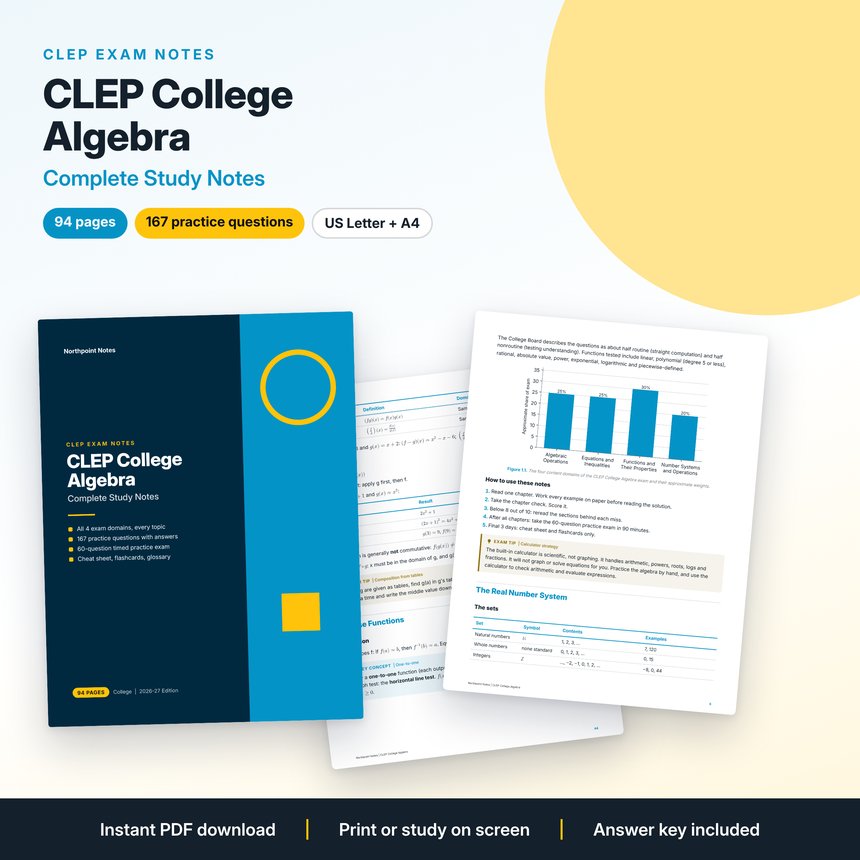
The free sample is one chapter. The full Clear Roots CLEP College Algebra notes cover all ten chapters and every topic in the outline, with 167 practice questions and worked explanations, a 60-question practice exam weighted like the real test, 18 graphs and diagrams, a cheat sheet, 48 flashcards and a 75-term glossary.
Want every chapter, not just the sample?
Clear Roots: CLEP College Algebra Complete Exam Notes gives you all 4 clep domains in numbered steps, plus the answer key and cheat sheet.
Frequently Asked Questions
Is CLEP College Algebra hard?
It covers a standard one-semester college algebra course. Students who review each topic and practice under timed conditions usually find it manageable.
Can I use a graphing calculator?
No. A scientific calculator is built into the exam.
How long should I study?
Many students prepare in three to six weeks, depending on how recently they took algebra.
Can I retake the exam?
CLEP has a waiting period before you can retake the same exam. Check the current policy on the College Board’s CLEP site.
Will every college accept my score?
No. Policies vary, so check your college’s CLEP credit policy first.
