Earning three college credits with a single 90-minute exam is one of the best deals in higher education, and the CLEP Principles of Macroeconomics exam is a popular place to start. The material is logical: once you understand a handful of models, most questions follow from them. This guide covers the exam format, every content area, the graphs and formulas that matter most, a study plan, and common mistakes.
The CLEP Macroeconomics Exam Format
| Feature | Details |
|---|---|
| Questions | About 80 multiple choice (some unscored pretest items) |
| Time | 90 minutes |
| Score scale | 20 to 80 |
| Credit recommendation | ACE recommends 3 credits for a score of 50 |
Each college sets its own CLEP policy, so check your school’s required score and how the credit will appear on your transcript.
If you want to see how we explain the material, download the free sample below. It is the complete first chapter of our CLEP macroeconomics notes, with graphs, worked examples and review questions.

Free CLEP Macroeconomics Notes: Chapter 1 Sample (PDF)
The full Chapter 1 (Basic Economic Concepts) with graphs, worked examples and 10 review questions.

Want everything unlocked?
Curvewise CLEP Principles of Macroeconomics Study Guide: Complete Notes with Practice Exam | College
The free file is a sample. The full version has every page, tab and feature, plus the user guide.
See the full versionWhat the Exam Covers
The College Board’s outline has seven content areas:
| Content area | Approximate share |
|---|---|
| Basic Economic Concepts | 8–12% |
| Measurement of Economic Performance | 12–16% |
| National Income and Price Determination | 15–20% |
| Financial Sector | 15–20% |
| Inflation, Unemployment, and Stabilization Policies | 20–25% |
| Economic Growth and Productivity | 5–10% |
| Open Economy: International Trade and Finance | 9–13% |
Basic economic concepts
Scarcity, opportunity cost, the production possibilities curve, comparative advantage, and supply and demand. Know that a point inside the PPC means unemployment and an outward shift means growth.
Measurement of economic performance
GDP = C + I + G + (X − M). Know what is excluded (intermediate goods, used goods, transfer payments, stocks and bonds), how to compute real GDP and the inflation rate, and the three types of unemployment.
National income and price determination
The aggregate demand and aggregate supply model is the heart of the course. Practice identifying recessionary and inflationary gaps and predicting the effect of shifts on the price level and real GDP. Learn the spending multiplier, 1 ÷ (1 − MPC).
The financial sector
Money’s functions, M1 and M2, the inverse relationship between bond prices and interest rates, money creation with the money multiplier (1 ÷ reserve ratio), the money market and the loanable funds market. The Federal Reserve’s tools belong here too.
Stabilization policies
The largest section. Expect questions on expansionary and contractionary fiscal and monetary policy, crowding out, deficits and debt, and the short-run and long-run Phillips curves.
Full version
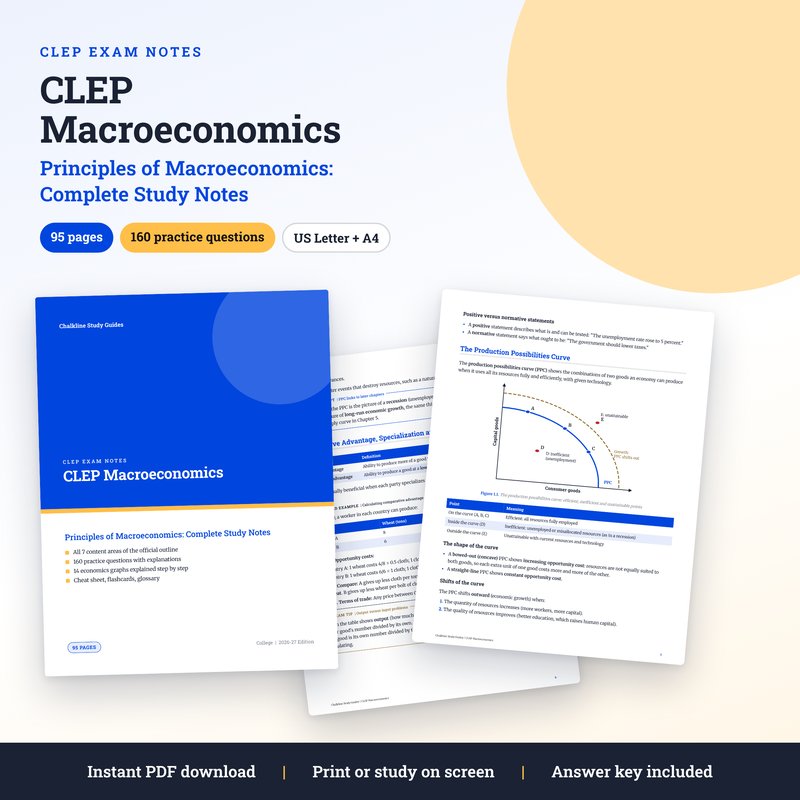
Curvewise: CLEP Principles of Macroeconomics Complete Study Notes
- All 7 official CLEP content areas
- 160 practice questions with explanations
- 14 economics graphs explained
Growth and the open economy
Growth comes from more and better capital, human capital and technology. In the open economy, know the current and financial accounts and how interest rates affect exchange rates and net exports.
The Graphs You Must Be Able to Draw
- Production possibilities curve
- Supply and demand
- AD-AS with SRAS and LRAS
- Money market
- Loanable funds market
- Short-run and long-run Phillips curves
- Foreign exchange market
For each, know the axes, the slope, and the main shifters. Many questions simply describe an event and ask what happens to one variable; a quick sketch answers them.
Formulas Worth Memorizing
- Spending multiplier = 1 ÷ MPS; tax multiplier = −MPC ÷ MPS
- Real GDP = nominal GDP ÷ deflator × 100
- Inflation rate = percent change in the price index
- Unemployment rate = unemployed ÷ labor force × 100
- Money multiplier = 1 ÷ required reserve ratio
- Real interest rate = nominal rate − inflation
- MV = PY
- Rule of 70: years to double ≈ 70 ÷ growth rate
A Worked Example
Suppose real GDP is $500 billion below potential output and the marginal propensity to consume is 0.8. How much should government spending increase to close the gap?
- The spending multiplier is 1 ÷ (1 − 0.8) = 5.
- Divide the gap by the multiplier: 500 ÷ 5 = $100 billion.
If the government cut taxes instead, the tax multiplier would be 0.8 ÷ 0.2 = 4, so the tax cut would need to be 500 ÷ 4 = $125 billion. This difference, spending versus taxes, is a favorite exam question.
A Four-Week Study Plan
- Week 1: Basic concepts, GDP, inflation and unemployment.
- Week 2: Aggregate demand and supply, the multiplier, the business cycle.
- Week 3: Money, banking, the Fed, fiscal policy and the Phillips curve.
- Week 4: Growth and the open economy; take a full practice exam and review every miss.
Common Mistakes
- Treating transfer payments as government purchases. Social Security is not in G.
- Confusing the money market and the loanable funds market. The money market sets the nominal rate; loanable funds sets the real rate.
- Forgetting that bond prices move opposite to interest rates.
- Using the gap instead of dividing by the multiplier when sizing fiscal policy.
- Thinking the long-run Phillips curve has a trade-off. It is vertical at the natural rate.
- Mixing up appreciation effects. A stronger dollar reduces U.S. net exports.
Want every chapter, not just the sample?
Curvewise: CLEP Principles of Macroeconomics Complete Study Notes gives you all 7 official clep content areas, plus the answer key and cheat sheet.
How CLEP Macroeconomics Questions Are Worded
Most questions fall into four patterns. Recognizing the pattern tells you which tool to reach for.
- Definition questions. “Which of the following is included in M1?” or “Structural unemployment is best described as…” These reward clean vocabulary. A glossary and flashcards are the fastest way to lock them in.
- Event and effect questions. “If the Federal Reserve sells government bonds, which of the following will most likely occur?” Sketch the relevant graph, shift the right curve, and read off the result. Here the money supply falls, interest rates rise, investment falls and aggregate demand shifts left.
- Calculation questions. “If the MPC is 0.75, a $20 billion increase in investment will increase real GDP by up to…” Write the formula, plug in, and estimate. The multiplier is 4, so the answer is $80 billion.
- Policy questions. “Which combination of policies would best reduce inflation?” Decide the direction first (contractionary), then find the answer where both tools point the same way: lower government spending or higher taxes, plus selling bonds or raising rates.
Test Day Tips
- Pace yourself. With about 80 questions in 90 minutes, aim for roughly one minute per question and flag anything slow.
- Sketch freely. Use scratch paper for quick graphs. A ten-second sketch prevents most direction errors.
- Watch the word “not.” Questions such as “Which would NOT shift aggregate demand?” are easy to misread under time pressure.
- Eliminate first. Each question has five choices. Crossing out two obvious misses raises your odds even when you must guess.
- Answer every question. Your score is based on the number of correct answers, so a blank never helps.
FAQ
Is CLEP Macroeconomics hard?
It is very manageable with steady study. The material is model-based, so understanding beats memorizing.
Can I take it without a class?
Yes. Many test takers self-study using a structured guide and practice questions. The key is to work through the topics in order, because later ideas (fiscal and monetary policy) build on earlier ones (aggregate demand and supply, money and banking).
How long should I study?
Most learners need about four to six weeks of steady study, depending on background. If you have taken an economics course recently, two or three weeks of focused review may be enough. Take a full practice exam about a week before your test date so you have time to fix weak areas.
Is the free sample enough?
The free sample is one full chapter. The complete Curvewise guide covers all seven content areas in eleven chapters, with 160 practice questions, a 50-question practice exam, a cheat sheet, flashcards and a glossary.
