Discrete math is the first course where many students are asked to write proofs, count things without listing them, and reason about graphs. Exams mix all three, often on one page. This guide gives you the map of the course, a way to study each part, and a free sample so you can see how the full notes read.
If you want to look at the notes first, here is the free sample.

Free Discrete Math Notes: Chapter 1 Sample (PDF)
Chapter 1 of the Logicrest discrete math notes: propositions, truth tables, equivalences, and rules of inference, with a quiz.

Want everything unlocked?
The free file is a sample. The full version has every page, tab and feature, plus the user guide.
See the full versionWhat a college discrete math course usually covers
Whether your class is called Discrete Mathematics, Discrete Structures, or Foundations of Computer Science, the plan is similar:
- Logic: propositions, truth tables, and quantifiers.
- Proofs: direct, contrapositive, contradiction, and induction.
- Structures: sets, functions, and relations.
- Number theory: divisibility, gcd, and modular arithmetic.
- Counting: permutations, combinations, recurrences, and probability.
- Graphs and trees: paths, circuits, traversals, and spanning trees.
Exams usually combine multiple choice, truth tables, short proofs, and counting or graph problems. The multiple choice items check definitions. The proofs and counting problems check whether you can use them.
Logic traps that cost the most points
Three ideas account for a large share of lost marks in the first weeks.
The conditional is false in only one case. The statement “if p then q” is false only when p is true and q is false. When p is false the statement is true, which feels strange until you remember it makes no promise.
The contrapositive is equivalent, the converse is not. From “if p then q”, the contrapositive “if not q then not p” always has the same truth value. The converse “if q then p” does not.
Negating a quantifier flips it. The negation of “all students passed” is “some student did not pass,” never “no student passed.”
| Statement | Negation |
|---|---|
| For all x, P(x) | There exists x with not P(x) |
| There exists x with P(x) | For all x, not P(x) |
| For all x, if P(x) then Q(x) | There exists x with P(x) and not Q(x) |
Full version
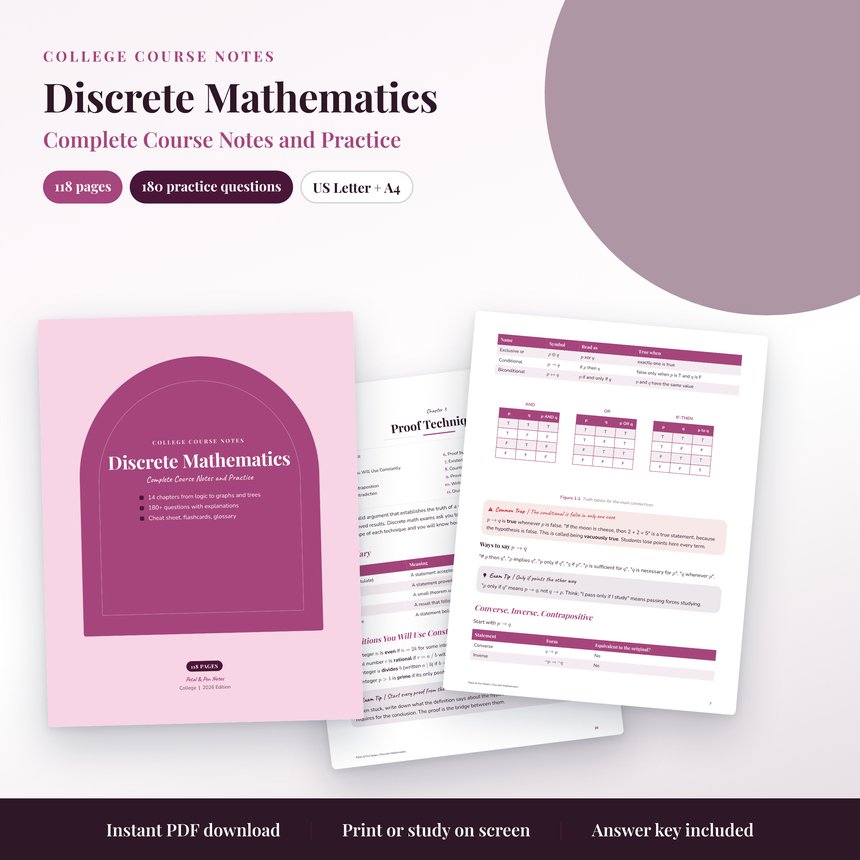
Logicrest: Discrete Mathematics Complete Course Notes
- 14 chapters from logic to graphs and trees
- 180 practice questions with explanations
- Cheat sheet, flashcards, and glossary
How to choose a proof technique
Most short proofs use one of four methods, and the choice is usually clear after a few seconds.
- Direct proof: assume the hypothesis and work forward to the conclusion. Start here.
- Contraposition: prove “if not q then not p” when the conclusion is easier to negate. It is the usual choice for statements about evenness, such as “if n squared is even then n is even.”
- Contradiction: assume the claim is false and reach an impossibility. This is the method for the irrationality of the square root of 2 and for the infinitude of primes.
- Induction: use it for a statement about every integer from some starting point, especially sums, inequalities, and divisibility.
Whatever you choose, say so in your first line. Graders give credit for a clear plan, and writing “we argue by contraposition” keeps you from drifting into the wrong direction.
The induction template
Induction has two steps, and both must appear. The basis step proves the statement for the first value. The inductive step assumes the statement for k and proves it for k plus 1. Mark the exact line where you use the inductive hypothesis, because graders look for it. A frequent error is to check several values and call it a proof. That never works.
Counting without the guesswork
Counting problems become routine when you ask two questions. Does order matter? Is repetition allowed? The answers pick the formula.
| Order matters? | Repetition allowed? | Count |
|---|---|---|
| Yes | No | n! / (n – r)! |
| Yes | Yes | n to the power r |
| No | No | n choose r |
| No | Yes | (n + r – 1) choose r |
Add the pigeonhole principle for “at least” and “guarantee” questions, and inclusion-exclusion when sets overlap. For repeated letters, divide by the factorial of each repeat count. When a problem says “and,” multiply. When it says “or,” add the disjoint cases.
Graphs, Euler, and Hamilton
Graph questions are mostly definitions plus a few counting rules. The handshake theorem says the degrees add up to twice the number of edges, which tells you quickly whether a degree sequence is possible. An Euler circuit uses every edge once and exists in a connected graph exactly when every vertex has even degree. A Hamilton circuit visits every vertex once, and no simple test decides it. Mixing these two up is the most common graph mistake, so write them next to each other on your cheat sheet.
Want every chapter, not just the sample?
Logicrest: Discrete Mathematics Complete Course Notes gives you 14 chapters from logic to graphs and trees, plus the answer key and cheat sheet.
A study plan for exam week
Five days out. Rewrite the logical equivalences and the proof templates from memory.
Four days out. Do the quizzes for logic, sets, relations, and number theory. Redo every miss.
Three days out. Work three induction proofs and six counting problems from scratch.
Two days out. Take the practice exam in one sitting. Read the explanations for every miss.
The day before. Read the cheat sheet, run through the flashcards, and sleep.
Common mistakes students make
- Proving by example. Checking cases never proves a universal statement.
- Skipping the basis step in induction.
- Treating symmetric and antisymmetric as opposites. A relation can be both or neither.
- Counting ordered when the problem is unordered. Ask whether swapping two items changes the outcome.
- Confusing independent with mutually exclusive. Mutually exclusive events with positive probabilities are dependent.
- Dividing in modular arithmetic. You may only multiply by an inverse, and only if the gcd is 1.
- Forgetting that the remainder is never negative. Minus 7 mod 3 is 2.
Number theory and modular arithmetic in one page
Four tools handle most number theory questions. The division algorithm writes a as dq plus r with r between 0 and d minus 1. The Euclidean algorithm finds the gcd by repeatedly replacing the pair (a, b) with (b, a mod b). A number has an inverse modulo m exactly when its gcd with m is 1, and the extended Euclidean algorithm finds it. Fermat’s Little Theorem says that for a prime p that does not divide a, a to the power p minus 1 is 1 modulo p, which makes huge powers easy.
For example, to compute 2 to the 100 modulo 7, note that 2 cubed is 1 modulo 7. Since 100 is 33 times 3 plus 1, the answer is 2. Reducing before you compute keeps every number small, and this one habit solves most modular arithmetic problems on exams.
Free sample versus the full notes
The free file is Chapter 1 of the Logicrest notes. It covers propositions, connectives, truth tables, equivalences, rules of inference, and the common fallacies, with a chapter quiz. The full guide has fourteen chapters, 180 questions with explanations, a 40-question practice exam, a cheat sheet, flashcards, and a glossary.
Frequently asked questions
Is discrete math hard?
The material is not advanced, but it asks for precise reasoning and clear writing. Most students find it easier once they use templates for proofs and a fixed routine for counting.
Do I need to know programming?
No. Computer science students will see the connections to algorithms, but the course is about mathematical reasoning.
What is the difference between a permutation and a combination?
In a permutation, order matters, so AB and BA are different. In a combination, order does not matter. Choosing a president and a treasurer is a permutation. Choosing a committee of two is a combination.
How do I know when to use induction?
Use it when the statement is about every integer from some starting value and the case for k plus 1 can be built from the case for k. Sums, inequalities, and divisibility claims are typical.
Can I use these notes with my textbook?
Yes. They work best as a companion that keeps the ideas organized while you do the assigned readings.
Ready to study?
Start with the free sample, set a schedule, and use the plan above. When you want the full set of chapters, quizzes, and review tools, the complete guide is below.
Full version
Logicrest: Discrete Mathematics Complete Course Notes
- 14 chapters from logic to graphs and trees
- 180 practice questions with explanations
- Cheat sheet, flashcards, and glossary
