The DSST Human Resource Management exam lets you earn college credit for an introductory HR course in a single two-hour sitting. It rewards organized, practical knowledge: the main HR functions, the models behind them, and a solid grip on U.S. employment and labor law. This guide explains the exam format, what each content area covers, how to study, and the traps to avoid. It also includes free DSST Human Resource Management notes to get you started.
The exam at a glance
| Fact | Detail |
|---|---|
| Questions | 100 multiple choice, four options each |
| Time | 2 hours |
| Minimum passing score | 400 |
| ACE credit recommendation | 3 semester hours, lower-level baccalaureate |
You have about 72 seconds per question. That is enough time if you know the vocabulary, but not enough to puzzle out every law from scratch. Memorizing the key acts is the single biggest lever on your score.
Our free sample is the complete first chapter of Hire Ground, our full DSST HRM notes. It covers the exam format and An Overview of the Human Resource Management Field: HR’s history, functions, the HR manager’s roles and ethics, with a 10-question quiz and explanations.

Free DSST Human Resource Management Notes: Chapter 1 Sample (PDF)
The full first chapter: exam overview, the history of HR, HR functions and roles, and ethics, with a 10-question quiz.

Want everything unlocked?
The free file is a sample. The full version has every page, tab and feature, plus the user guide.
See the full versionThe ten content areas
| Content area | Share |
|---|---|
| An Overview of the Human Resource Management Field | 8% |
| Human Resource Planning | 9% |
| Staffing / Talent Acquisition | 11% |
| Training and Development | 9% |
| Performance Management (Appraisals) | 11% |
| Compensation and Benefits / Total Rewards | 12% |
| Safety and Health | 12% |
| Employment Law | 12% |
| Labor Relations | 10% |
| Current Issues and Trends | 6% |
Three areas share the top spot at 12 percent: compensation, safety and health, and employment law. Together with labor relations, that is 46 percent of the exam on topics heavy with laws, numbers and rules.
What each area asks
Overview and planning
The history of HR (Taylor’s scientific management, the Hawthorne studies), HR functions, line vs staff roles, ethics, forecasting methods such as the Delphi technique, diversity and inclusion, job analysis (job descriptions vs job specifications) and job design (enlargement vs enrichment, the job characteristics model).
Staffing, training and performance
Recruiting sources, realistic job previews, reliability and validity of selection tools, interview types, the WARN Act; needs assessment, the ADDIE model, learning principles and Kirkpatrick’s four levels; appraisal methods such as BARS and MBO, and rater errors such as halo, leniency and central tendency.
Compensation, safety and law
Job evaluation methods, pay structures, compa-ratios, incentive plans, mandatory and voluntary benefits; OSHA, the general duty clause, the hierarchy of controls, workers’ compensation; Title VII, ADEA, ADA, the Equal Pay Act, FLSA, FMLA, ERISA, COBRA and more.
Labor relations and current issues
The Wagner, Taft-Hartley and Landrum-Griffin Acts, unfair labor practices, union security, organizing, collective bargaining, mediation vs arbitration, grievance procedures; HR technology, contingent work, global HR, social media, sustainability and AI in hiring.
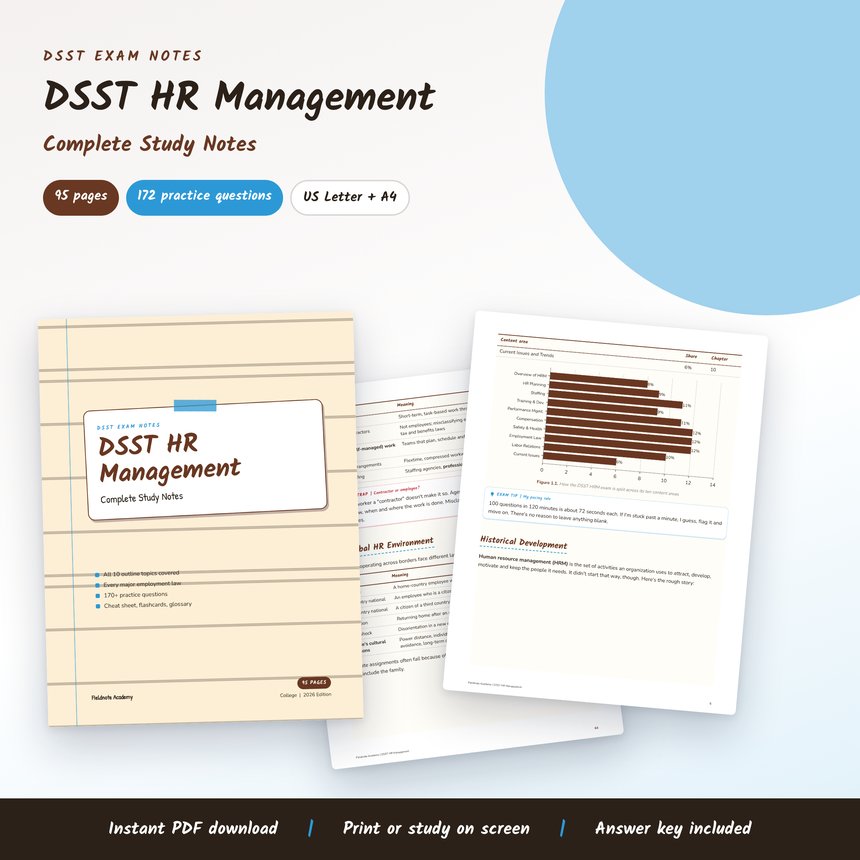
Full version
Hire Ground: DSST Human Resource Management Exam Notes
- All 10 DSST HRM content areas
- 172 questions with explanations
- Every key employment law in tables
The laws worth memorizing first
| Law | Year | Key fact |
|---|---|---|
| Wagner Act (NLRA) | 1935 | Right to organize; created the NLRB |
| FLSA | 1938 | $7.25 federal minimum wage; overtime at 1.5x over 40 hours |
| Taft-Hartley | 1947 | Union unfair labor practices; closed shop banned; right-to-work |
| Equal Pay Act | 1963 | Equal pay for substantially equal work |
| Title VII | 1964 | Race, color, religion, sex, national origin; 15+ employees |
| ADEA | 1967 | Age 40+; 20+ employees |
| OSHA | 1970 | General duty clause; safe workplaces |
| ERISA | 1974 | Private pension and benefit plan standards |
| ADA | 1990 | Reasonable accommodation unless undue hardship |
| FMLA | 1993 | 12 weeks unpaid leave; 50 employees, 12 months, 1,250 hours |
Learn each law as four facts: name, year, who it covers, what it requires.
A worked example
Question. 100 men and 50 women apply for a job. 60 men and 20 women are hired. Does the process show adverse impact under the four-fifths rule?
The men’s selection rate is 60 percent; the women’s is 40 percent. Divide the lower rate by the higher: 40 / 60 = 0.67. Because 0.67 is below 0.80, the process shows adverse impact, and the employer would need to show that its selection method is job related. This calculation appears in many forms, so practice it until it takes ten seconds.
Second example. An employee earns $54,000, and the midpoint of her pay range is $60,000. What is her compa-ratio? Divide pay by midpoint: 54,000 / 60,000 = 0.90. She is paid at 90 percent of the midpoint, which usually means she is newer to the role or still building skills. A compa-ratio above 1.00 means pay is above the midpoint.
How to study the laws without drowning
Most students try to memorize employment law as one long list and forget half of it by test day. A better approach is to sort the laws into the same three groups the DSST outline uses:
- Equal employment opportunity: Equal Pay Act, Title VII, ADEA, Pregnancy Discrimination Act, ADA, Civil Rights Act of 1991, GINA.
- Compensation and benefits: FLSA, ERISA, COBRA, HIPAA, FMLA, the Affordable Care Act.
- Health, safety and employee rights: OSHA, WARN, the Employee Polygraph Protection Act.
Then do the same for labor law: Norris-LaGuardia and Wagner protect unions, Taft-Hartley balances the field, Landrum-Griffin regulates unions themselves, and the Civil Service Reform Act extends rights to federal workers.
Once each law has a home, review with flashcards for ten minutes a day. Short daily review beats long weekend sessions, a finding you will also meet in the training chapter as distributed practice.
A four-week study plan
| Week | Focus |
|---|---|
| 1 | Overview, planning, staffing |
| 2 | Training, performance management, compensation |
| 3 | Safety and health, employment law (build your law table) |
| 4 | Labor relations, current issues, one timed practice exam, review |
Common mistakes
- Confusing job enlargement (more tasks) with job enrichment (more responsibility).
- Mixing up mediation (nonbinding help) and arbitration (binding decision).
- Forgetting that race can never be a BFOQ.
- Calling MBO a comparative method; it compares results with goals, not people with people.
- Mixing up coverage thresholds: 15 employees (Title VII, ADA), 20 (ADEA, COBRA), 50 (FMLA), 100 (WARN).
- Believing pay is a motivator in Herzberg’s model; it is a hygiene factor.
Get the full notes
The free chapter covers the first content area. The full Hire Ground notes cover all ten areas in the official order, with 12 diagrams, chapter quizzes, a 60-question practice exam with explanations, a cheat sheet, flashcards and a 90-term glossary.
Want every chapter, not just the sample?
Hire Ground: DSST Human Resource Management Exam Notes gives you all 10 dsst hrm content areas, plus the answer key and cheat sheet.
FAQ
What is the passing score for DSST Human Resource Management?
The minimum passing score is 400. Your school decides how many credits to award.
How hard is the exam?
Most students find the concepts straightforward. The challenge is the volume of laws and terms, so steady memorization and practice questions matter most.
Is there a guessing penalty?
No. Answer every question.
Do I need HR work experience?
No. Experience helps, but the exam tests textbook knowledge that you can learn from organized notes.
Is the exam only about U.S. law?
The employment and labor law content is U.S. federal law, which is what most college HR courses teach. Global HR appears in the Current Issues area, mainly as concepts such as expatriate assignments and cultural differences.
What should I study last?
In the final two days, review the cheat sheet, your law table and the rater-error list, and retake any chapter quiz where you scored below 80 percent.
