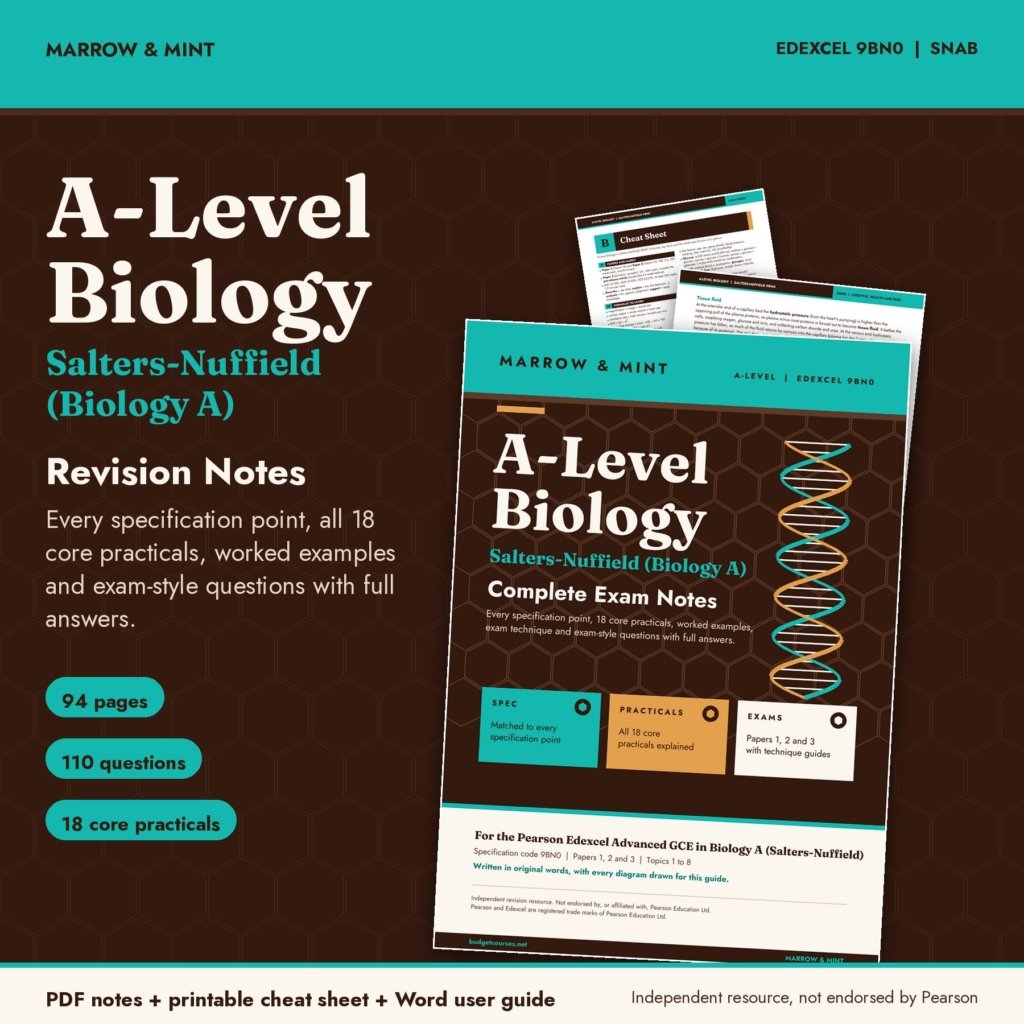
If you are studying Edexcel A-Level Biology A (Salters-Nuffield), also known as SNAB and coded 9BN0, you will know that the course is demanding: eight topics, eighteen core practicals, a stack of calculations and three two-hour papers at the end. This guide explains how the exam works, what is actually tested, and how to revise in a way that earns marks. A free sample of our revision notes is included below.
Free Edexcel A-Level Biology 9BN0 Revision Notes Sample (PDF)
A 9-page taster from the full notes: cover, contents, the Run for Your Life topic opener and first pages, a cheat sheet page, sample practice questions and a link to the full pack.
Want everything unlocked?
The free file is a sample. The full version has every page, tab and feature, plus the user guide.
See the full versionWhat the 9BN0 exam looks like
All assessment is by written exam at the end of the course, in a single May or June series. There is no coursework. The Practical Endorsement is assessed separately by your teacher and reported as a pass or not classified, so it does not change your grade, but practical knowledge is examined in the papers.
| Paper | Title | Topics | Time | Marks |
|---|---|---|---|---|
| Paper 1 | The Natural Environment and Species Survival | 1 to 6 | 2 hours | 100 |
| Paper 2 | Energy, Exercise and Co-ordination | 1 to 4, 7 and 8 | 2 hours | 100 |
| Paper 3 | General and Practical Applications in Biology | All topics | 2 hours | 100 |
Each paper is worth one third of the A-level. Questions include multiple choice, short answers, calculations and extended writing up to nine marks. At least 10% of the marks across the papers test maths at Level 2 or above, and about two thirds of all marks reward applying and analysing, not recalling.
The assessment objectives in plain English
- AO1 (31 to 33%): recall and understand ideas, processes and techniques.
- AO2 (41 to 43%): apply that knowledge to an unfamiliar situation, experiment or calculation.
- AO3 (25 to 27%): analyse data, evaluate evidence and reach a judgement.
The biggest slice is application, which is why learning definitions alone is never enough. You must practise using them.
The eight topics and what examiners love to test
The Salters-Nuffield approach teaches biology through real contexts: heart disease, cystic fibrosis, forensics, exercise and the brain. Exam questions follow the same pattern, giving you a short scenario and then asking a mixture of recall and application.
- Topic 1, Lifestyle, Health and Risk: the cardiac cycle, atherosclerosis, risk factors, reading health data, and the chemistry of carbohydrates and lipids.
- Topic 2, Genes and Health: gas exchange, membrane transport, protein synthesis, enzymes and the genetics of cystic fibrosis.
- Topic 3, Voice of the Genome: cell structure, meiosis, mitosis, stem cells and gene regulation, including the lac operon and chi-squared tests.
- Topic 4, Biodiversity and Natural Resources: diversity calculations, Hardy-Weinberg, classification, plant structure, drug testing and conservation.
- Topic 5, On the Wild Side: sampling, succession, photosynthesis, productivity, climate change and speciation.
- Topic 6, Immunity, Infection and Forensics: time of death, PCR, electrophoresis, pathogens, antibodies and antibiotic resistance.
- Topic 7, Run for Your Life: sliding filaments, respiration, the heartbeat, ventilation, homeostasis and the ethics of performance enhancement.
- Topic 8, Grey Matter: action potentials, synapses, vision, brain scanning, habituation and genetic technology.
Why Paper 3 feels different
Paper 3 is synoptic, so questions can draw on any topic and often link two or three at once. It also includes a section based on a scientific article that the board publishes about eight weeks before the exam. You will be given a clean copy in the exam, but the candidates who do best are those who have already read it three times: once for the story, once to mark the methods, data and conclusions, and once to connect each idea to the specification.
When you meet the questions, remember that examiners want biology applied to the article, not a summary of it. Quote data with units, name the structure or process precisely, and always offer a reason why a method or conclusion is strong or weak (sample size, controls, confounding variables, correlation and causation).
A revision timeline that works
| When | What to do |
|---|---|
| 8 to 6 weeks before | Finish the content. Build a one-page summary for each topic and start an error log. |
| 6 to 4 weeks | Closed-book question sets by topic. Learn the core practical variables and every formula. |
| 4 to 2 weeks | Timed past papers, one per week, marked strictly. Practise 6 and 9 mark answers with a plan. |
| Article released | Read it three times, annotate, and write likely questions and answers. |
| Last 2 weeks | Mixed questions across topics, weakest areas first, then a cheat sheet each evening. |
| Final 48 hours | Light recall, diagrams from memory, sleep. |
Ten techniques that raise your mark
- Retrieve, do not re-read. Close the notes and write what you remember, then check. This beats highlighting every time.
- Draw the diagrams from memory: the heart, the sarcomere, the light-dependent reactions, the synapse and the immune response all appear regularly.
- Learn the maths: magnification, cardiac output, Q10, mitotic index, Hardy-Weinberg, the index of diversity, percentage change and the statistical tests.
- Underline the command word. Describe means say what happens, explain means give reasons, and evaluate means weigh evidence and decide.
- Use the context. If the question names a species or gives numbers, use them in the answer.
- Write chains of reasoning for extended answers: because, so, which means, therefore.
- Know the practicals: for each of the 18 core practicals, be able to name the variables, a hazard, an improvement and the analysis.
- Quote the data with units from every graph or table.
- Keep an error log and re-read it each week.
- Time yourself: 1.2 minutes per mark, with five minutes at the end to check units.
Common mistakes that cost marks
- Writing “it” without saying what it is.
- Saying hydrogen bonds are within water molecules, when they form between them.
- Describing osmosis as movement from low to high concentration, instead of down a water potential gradient.
- Mixing up transcription (making mRNA in the nucleus) and translation (making protein at the ribosome).
- Forgetting that the A band stays the same length when a sarcomere shortens.
- Claiming that a correlation proves a cause.
- Leaving units off calculations, or rounding too early.
Using the free sample
The free sample gives you the cover and contents, the opening pages of Topic 7 (muscle contraction and respiration), a page of the cheat sheet, and a selection of exam-style questions, so you can judge the style before buying. If it helps, the complete 9BN0 revision pack has all eight topics, all 18 core practicals, 110 original questions with full mark-scheme answers, a printable cheat sheet and a Word user guide with 8-week and 2-week plans.
Frequently asked questions
Is 9BN0 the same as Biology B?
No. 9BN0 is Edexcel Biology A (Salters-Nuffield). Some people call it “Biology B” informally, but the Edexcel Biology B qualification is a different course, coded 9BI0.
How many core practicals are there?
There are 18 core practicals in the specification, and they can be examined on any of the three papers. Knowing the method, variables and analysis for each is essential.
Can I use past papers?
Yes. Past papers and mark schemes are free from the exam board. Use them for timed practice and always mark with the scheme. Our questions are original and are designed to be used alongside them.
How long should I spend on a 9-mark question?
About eleven minutes. Spend the first minute planning the strands you will cover, then write in linked sentences and finish with a conclusion if the question asks you to evaluate.
Where can I get the full notes?
The Marrow & Mint Edexcel A-Level Biology 9BN0 revision pack is available on budgetcourses.net.
Pearson and Edexcel are registered trade marks of Pearson Education Ltd. This article and the linked products are independent and are not endorsed by, or affiliated with, Pearson Education Ltd. Check the current specification on the exam board’s website.
