
Paper 2 of Edexcel A-Level Economics A is the macroeconomics paper. It tests Theme 2 (the UK economy: performance and policies) and Theme 4 (a global perspective), and it makes up 35% of your A-level. This guide explains what is on the paper, how the marks work and how to revise for it, and it comes with a free sample from our full Paper 2 revision pack.
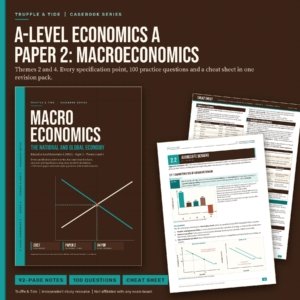
Free Edexcel A-Level Economics A Paper 2 Revision Notes Sample (PDF)
A 10-page sample with the cover, contents, the full Aggregate Demand section, a cheat sheet page, a page of practice questions and a guide to the full pack.

Want everything unlocked?
The free file is a sample. The full version has every page, tab and feature, plus the user guide.
See the full versionWhat is on Paper 2?
Paper 2 (9EC0/02) lasts two hours, carries 100 marks and allows a calculator. There are three sections, and you can answer them in any order.
| Section | Marks | Suggested time | What you will meet |
|---|---|---|---|
| A | 25 | About 30 minutes | Five questions mixing multiple-choice, short-answer and calculation items. There are no evaluation marks. |
| B | 50 | About 60 minutes | One data-response case study with extracts and figures, with parts worth 5, 8, 10, 12 and 15 marks. |
| C | 25 | About 30 minutes | A choice of one from two 25-mark essays. |
The rule of thumb is about 1.2 minutes per mark. Spend the first five to ten minutes of Section B reading the extracts properly: most of the application marks are sitting in the data.
What is tested
Theme 2: The UK economy
- Measures of performance: growth, inflation, unemployment and the balance of payments.
- Aggregate demand and supply: what shifts AD, SRAS and LRAS, and how the AD/AS model is used.
- National income: the circular flow, equilibrium and the multiplier.
- Economic growth: its causes, output gaps and the trade cycle.
- Policy: fiscal, monetary and supply-side policy, Phillips curves and the conflicts between objectives.
Theme 4: A global perspective
- International economics: globalisation, comparative advantage, trade restrictions, exchange rates and competitiveness.
- Poverty and inequality: measures such as the Lorenz curve and Gini coefficient.
- Emerging and developing economies: the Human Development Index, barriers to growth and development strategies.
- The financial sector and the role of the state: central banks, market failure in finance, taxation, public spending and government borrowing.
How the marks work
The assessment objectives are knowledge (AO1), application (AO2), analysis (AO3) and evaluation (AO4). Roughly a quarter of the marks on Paper 2 reward evaluation, and all of them sit on the longer questions. Short questions are marked on points; the longer ones are marked on levels, so a detailed and well-judged answer can climb a level in a single step.
| Mark tariff | Typical command word | What earns the marks |
|---|---|---|
| 2 | Define | A precise definition, no development |
| 4 to 5 | Explain, calculate | Knowledge, application and a developed chain of reasoning |
| 8 | Examine | Two developed points plus a short evaluation |
| 10 to 15 | Assess, discuss | Balanced analysis with evidence and a judgement |
| 25 | Evaluate, to what extent | A sustained argument, evaluation throughout and a justified conclusion |
How to revise for Paper 2
- Revise in specification order. Tick each point off a checklist so that nothing is missed. Themes 2 and 4 contain a lot of material, and the topics you like least are the ones you will skip.
- Learn the diagrams until you can draw them blind. AD/AS shifts, the multiplier, Phillips curves, tariffs and quotas, exchange rates, the Lorenz curve and the Laffer curve appear again and again. Label the axes, the curves and the equilibrium every time.
- Build a bank of cases. You need a handful of real episodes for each theme, such as the 2008-09 recession, the energy-price inflation of 2021-23 or the economies of Nigeria and Botswana. Know the facts, the outcome and why it matters.
- Practise chains of reasoning. Write short chains such as: interest rate up, borrowing dearer, consumption and investment fall, AD shifts left, inflation falls. Then add the numbers and the time scale.
- Do timed practice. Do a Section A set in 30 minutes, a data response in 60 and an essay in 35, then mark each against a mark scheme.
- Keep an error log. One line per mistake: what went wrong and what rule fixes it.
A simple revision timeline
| When | Focus |
|---|---|
| Weeks 8 to 5 before the exam | Work through Theme 2 (measures, AD and AS, multiplier, growth, policy). Do short questions after each topic. |
| Weeks 4 to 3 | Work through Theme 4 (trade, exchange rates, development, finance, the state). Add your case bank. |
| Weeks 2 to 1 | Full timed essays and data responses; one full mock paper; fix weak topics. |
| Final days | Cheat sheet, glossary and diagrams only. Sleep. |
If you only have a fortnight, keep the same order but compress each theme into five days, then spend the last four days on mock questions and review.
Common mistakes to avoid
- Not answering the question set. Underline the command word and the topic before you write.
- Describing instead of analysing. Write “which leads to” and “because”, not just “this happens”.
- Confusing a movement with a shift. A change in the price level moves you along AD; anything else shifts it.
- Mixing up percentages and percentage points, or real and nominal values.
- Generic evaluation. “It depends” earns little unless you say what it depends on and which case is likelier.
- Ignoring the data. Quote figures and dates from the extract; that is where application marks come from.
Get the free sample
The free sample gives you a flavour of how the notes work: the contents, the full Aggregate Demand section with diagrams, a page of the cheat sheet and a page of exam-style practice questions. If you like the approach, the full Paper 2 revision pack covers every specification point in Themes 2 and 4, and adds a cheat sheet, 100 original practice questions with model answers, a mock paper and a revision plan.
Frequently asked questions
Is Paper 2 harder than Paper 1?
Not necessarily. Paper 2 relies more heavily on diagrams and on current-affairs knowledge of the UK and global economy, so many students find it easier to prepare for, provided they have enough real cases.
How much current affairs do I need?
Know the main UK economic events of roughly the last ten years and a small number of international cases. Check the latest data on inflation, interest rates, growth and unemployment shortly before the exam.
Do I need to learn the whole specification?
Yes. The paper samples widely, and Section C essays can be about any part of Themes 2 and 4. Use a checklist so that you can see any gaps.
Are past papers worth using?
Absolutely. Use recent papers and mark schemes from the exam board website once you have covered a theme, and compare your answers with the indicative content.
Where can I find the full pack?
You can find the complete pack, with all files, on budgetcourses.net.
This is an independent study resource written to match the Edexcel A-Level Economics A (9EC0) specification. It is not endorsed by or affiliated with Pearson or Edexcel. Edexcel and Pearson are trade marks of Pearson Education Ltd.
