
If you are taking Edexcel GCSE Business (1BS0), the hardest part is often not the content but knowing what the examiners actually reward. This guide explains how the two papers are built, what is tested, how to revise each theme and the mistakes that cost the most marks. Download the free sample below to see the style of the full revision casebook.
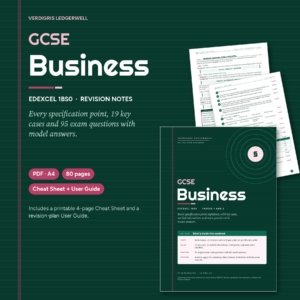
Free Edexcel GCSE Business (1BS0) Revision Notes Sample (PDF)
A 9-page extract: the cover and contents, the opening of topic 1.3 on aims, costs, profit and break-even, a Cheat Sheet page and practice questions with model answers.

Want everything unlocked?
The free file is a sample. The full version has every page, tab and feature, plus the user guide.
See the full versionHow Edexcel GCSE Business is assessed
There are two written papers, and there is no coursework. Each paper lasts 1 hour 45 minutes, is worth 90 marks and counts for 50% of your grade. The qualification is untiered, so everybody sits the same papers and is graded from 9 to 1. Formulae are not given, and you may use a calculator.
| Paper | Theme | Topics |
|---|---|---|
| Paper 1 (1BS0/01) | Investigating small business | 1.1 Enterprise; 1.2 Spotting an opportunity; 1.3 Putting an idea into practice; 1.4 Making the business effective; 1.5 External influences |
| Paper 2 (1BS0/02) | Building a business | 2.1 Growing the business; 2.2 Marketing; 2.3 Operations; 2.4 Finance; 2.5 Human resources |
Each paper is split into three sections worth 35, 30 and 25 marks. The questions in Sections B and C are based on business contexts printed in a source booklet, so you must apply what you know to a named business, not just recall it. Paper 2 builds on Theme 1, so ideas such as break-even, limited liability and cash flow can appear there too.
What the marks are for
Every question is tagged to one of three assessment objectives:
- AO1 (35%): knowing and understanding business concepts, terms and formulae.
- AO2 (35%): applying that knowledge to the business in the question, including calculations.
- AO3 (30%): analysing and evaluating, then reaching a supported judgement.
That means two-thirds of the marks depend on using the case rather than reciting notes. About one mark in ten is quantitative, always in a business setting.
Command words you must know
- Define, give, state: short recall.
- Calculate: use the correct formula and show your workings.
- Outline: two linked points, in context.
- Explain: a point with two expansions.
- Analyse: an extended answer in context, built from chains of reasoning.
- Justify: use the information to recommend one of two options and reject the other.
- Evaluate: weigh both sides, then reach a supported conclusion.
The formulae to learn
Formulae are not provided, so learn all of them: revenue, total costs, profit, interest as a percentage, break-even output and revenue, margin of safety, net cash flow, opening and closing balances, gross profit, net profit, gross and net profit margins and average rate of return. Practise each one with at least five different sets of numbers, and always write the formula, then the substitution, then the answer with units or a percentage sign.
How to revise each theme
Theme 1
Start with 1.3, because it contains most of the calculations and the cash-flow ideas that appear throughout the course. Then build the people and structure topics: ownership forms (sole trader, partnership, private limited company, franchise), location and the marketing mix, and the eight stakeholders. Finish with the external influences: technology, consumer law, employment law and the six economic factors.
Theme 2
Treat Theme 2 as a series of decisions. Growth (organic and external), marketing (the four Ps working together), operations (production methods, stock and quality), finance (margins and returns) and people (structures, recruitment, training and motivation) each have a small set of options with advantages and disadvantages. For every option, ask when it suits a business and when it does not.
A revision timeline
| When | Focus |
|---|---|
| 8 to 5 weeks before | Learn Theme 1 topic by topic; do the questions for each; start the checklist. |
| 5 to 3 weeks before | Learn Theme 2; revisit weak Theme 1 topics; practise calculations weekly. |
| 3 to 1 weeks before | Timed practice of 6, 9 and 12-mark questions; mark them strictly. |
| Final week | Red topics only, plus the cheat sheet, case examples and formulae. |
Common mistakes to avoid
- Defining without applying. Use the business name and its numbers in every extended answer.
- Confusing cash and profit. A profitable business can run out of cash if customers pay late.
- Mixing up margin and mark-up. Margins are a percentage of revenue, not of cost.
- One-sided evaluation. Give points for and against, then make a judgement and say what it depends on.
- Not rejecting the alternative in a Justify question. Say why the other option is weaker.
- Forgetting units. Add pounds, units or a percentage sign to every calculation.
Planning your answers under time pressure
Because each paper is 105 minutes for 90 marks, you have a little over a minute per mark. A sensible plan is to spend a few minutes reading the source booklet, underline the business type, its customers and every number, then work through Section A quickly, because those marks are easy to bank. Leave enough time for the extended answers in Sections B and C, where a short plan of two points for and two against, plus a conclusion, keeps your writing focused. Finish by checking calculations and making sure each long answer ends with a clear judgement.
Using real businesses as evidence
Examples such as Kodak (technology making a product obsolete), Dyson (risk and reward), Kraft and Cadbury (a takeover) or Toyota (just in time) give you something concrete to point to, but the exam uses fictional businesses, so use real cases only to show you understand the idea. Always link the example back to the business in the source booklet.
Frequently asked questions
Is there any coursework? No. The whole grade comes from the two written papers.
Is the subject tiered? No. Every candidate takes the same papers.
How long should I spend on a 12-mark question? Roughly one minute per mark, so about 12 to 14 minutes, including a minute to plan.
Do I need to learn case studies? You do not need to memorise them, but a handful of well-chosen examples makes your answers more convincing.
Where can I find all of this in one place? The complete Edexcel GCSE Business revision notes cover every specification point in order, with worked examples, 95 original questions with model answers, a cheat sheet and a revision plan. If you want the structure and tick-box checklist for your whole revision, see the full casebook pack.
Independent guidance, not endorsed by or affiliated with Pearson or Edexcel. Written for specification 1BS0 and the 2027 exam series; always check the exam board for updates.
