Edexcel GCSE Chemistry (specification 1CH0) rewards students who can do three things: remember a large body of facts, apply them to unfamiliar situations, and explain their reasoning in clear, linked sentences. This guide explains how the exam is set up, what examiners actually test, and how to organise your revision so the marks add up. At the end you can download a free nine-page sample of our revision notes.
Free Edexcel GCSE Chemistry (1CH0) Revision Notes Sample (PDF)
A nine-page taster from the real notes: the cover, the contents, the full Groups in the Periodic Table topic, a cheat sheet page and a page of practice questions.
Want everything unlocked?
The free file is a sample. The full version has every page, tab and feature, plus the user guide.
See the full versionHow the Edexcel GCSE Chemistry exam is structured
Chemistry is assessed by two written papers at the end of the course. Each lasts 1 hour 45 minutes, carries 100 marks and is worth half of the qualification. You are entered for either Foundation tier (grades 1 to 5) or Higher tier (grades 4 to 9). Students who take separate (triple) science sit these papers; Combined Science students sit different papers, so check which one applies to you.
| Paper | Topics | What it covers |
|---|---|---|
| Paper 1 | 1 to 5 | Key concepts, states of matter and mixtures, chemical changes, extracting metals and equilibria, separate chemistry 1 |
| Paper 2 | 1 and 6 to 9 | Key concepts, groups in the periodic table, rates and energy changes, fuels and Earth science, separate chemistry 2 |
Topic 1 (atoms, bonding and calculations) appears on both papers, so it is the best place to build a strong foundation early. Expect a mix of multiple-choice questions, short answers, calculations and extended open-response questions worth six marks.
What the examiners are looking for
The marks are split across three assessment objectives. Understanding what each one means helps you answer in the right way.
- AO1 (about 40%): recall and understanding of ideas, techniques and procedures. Typical command words are state, name and describe.
- AO2 (about 40%): applying that knowledge, including calculations and unfamiliar contexts. Typical command words are calculate, explain and suggest.
- AO3 (about 20%): analysing data and evaluating methods and conclusions. Typical command words are evaluate, compare and justify.
Practical skills are tested inside the written papers. You will not carry out experiments in the exam, but you will be asked about the eight core practicals: how to set them up, how to make them safe and accurate, and how to interpret the results.
The topics students find hardest
- Moles and calculations. Many marks depend on moving between mass, moles, concentration and gas volume. Always write the formula, substitute, calculate and add the unit.
- Bonding and structure. You need to link the type of bonding to properties. The classic error is to say that covalent bonds break when a simple molecular substance melts. It is the weak forces between molecules that are overcome.
- Electrolysis. Predicting products in solution needs a clear rule for the cathode and for the anode. Practise with several electrolytes until it feels automatic.
- Rates and equilibrium. Collision theory answers need two ideas: how often particles collide and how many of the collisions have enough energy.
- Tests for ions and gases. This is pure recall, so use flash cards or a cheat sheet and test yourself daily.
A revision timeline that works
| When | What to do |
|---|---|
| 8 to 6 weeks before | Go through Topics 1 to 4 with notes and short questions after each section. Start a list of the points you cannot explain without help. |
| 6 to 4 weeks before | Cover Topics 5 to 9 (if you sit separate chemistry). Do one topic test every week and fix the errors the same day. |
| 4 to 2 weeks before | Switch from reading to retrieval: blurt notes from memory, redo questions you got wrong and complete one past paper a week under timed conditions. |
| Final fortnight | Alternate content days with timed practice. Learn the tests for ions, the reactivity series, group trends and the core practicals. Read the mark scheme of every paper you complete and copy the wording that earned marks. |
| Night before | Skim a one-page summary, pack your equipment and sleep. New material at this point rarely sticks. |
How to revise well: five habits
- Retrieve before you re-read. Close the notes and write what you remember. Checking the gaps is far more effective than highlighting.
- Space it out. Return to each topic after a few days, then after a couple of weeks.
- Practise with marks in mind. Allow about a minute per mark. If a question is worth three marks, you need three separate, creditworthy points.
- Use the mark scheme language. Words such as “because”, “so” and “which means” signal reasoning, and examiners look for them in explanations.
- Keep an error log. Write down every mark you lose and why: knowledge gap, misread question, arithmetic slip or missing unit. Patterns appear quickly.
Mistakes that cost marks every year
- Writing “it” without naming the substance, or saying “heat” when the answer is “temperature”.
- Forgetting state symbols, or balancing an equation by changing a subscript instead of adding a coefficient.
- Describing what you see (bubbles) when the question asks you to identify the gas, or giving a test without the result.
- Mixing up anode and cathode, or oxidation and reduction. The memory aids PANIC and OIL RIG help.
- Rounding too early in a multi-step calculation, or mixing cm3 and dm3.
- Stopping a six-mark answer at description. Plan three or four linked points and give a reason for each.
How to answer a six-mark question
These questions are marked on the quality and logic of your reasoning, not on a checklist of facts. Spend a minute planning. Identify the key ideas, put them in a sensible order, and connect each with a reason. For example, in a question about why a catalyst increases the rate, say that it provides an alternative route with a lower activation energy, so a greater proportion of collisions are successful, so the rate rises. Finish with a short conclusion if the command word is evaluate or justify.
Free Edexcel GCSE Chemistry notes and the full pack
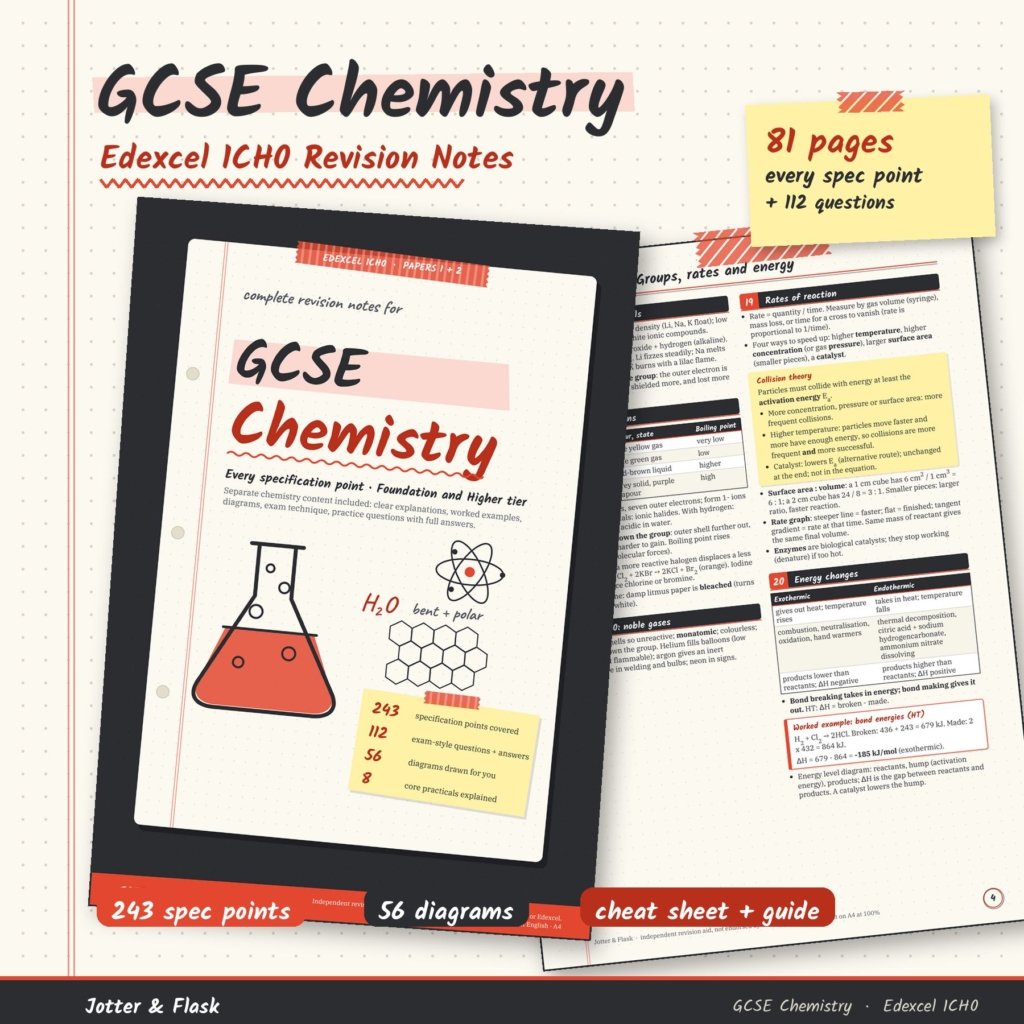
The free sample above is taken from our full Edexcel GCSE Chemistry (1CH0) revision notes. The complete pack has 81 pages that cover all 243 specification points in order, with 56 diagrams, worked examples, 112 original exam-style questions with answers, a glossary and a checklist with page references. It also includes a 6-page printable cheat sheet and a user guide with 8-week and 2-week revision plans. You can see the whole bundle on the product page.
Frequently asked questions
Which tier should I take?
Your teacher will decide, usually based on mock results. Higher tier covers all grades from 4 to 9, with a grade 3 allowed. Foundation tops out at grade 5, so a student who is working at grade 5 should talk to their teacher about the trade-off.
What do I need to learn by heart?
The first 20 elements and common ions, the reactivity series, the trends for Groups 1, 7 and 0, the tests for gases and ions, the main formulae and the methods for the core practicals. Data is given for many calculations, but check what is provided in your own papers.
How many past papers should I do?
Aim to complete at least three or four full papers under timed conditions, and mark each carefully. Learning from the mark scheme matters more than the number of papers.
Are the core practicals examined?
Yes. Questions on methods, variables, hazards, accuracy and conclusions appear throughout both papers, and they are often where AO3 marks are earned.
What can I do if I am behind?
Be selective. Revise Topic 1 first because it appears on both papers, then the topics where you lost most marks in your mocks. Short daily sessions with questions beat long sessions of re-reading.
This article is independent guidance. Edexcel and Pearson are registered trade marks of Pearson Education Limited. This site is independent and is not endorsed by Pearson or Edexcel.
