
Elizabethan England is one of the four British depth studies in AQA GCSE History, and it is a popular choice for good reason: plots, rebellions, a famous queen, a war with Spain and a castle or two. It also asks for a lot of precise knowledge. This guide explains exactly what the paper asks, what to learn, how to revise it and where students lose marks. At the end you can download a free sample of our revision notes.
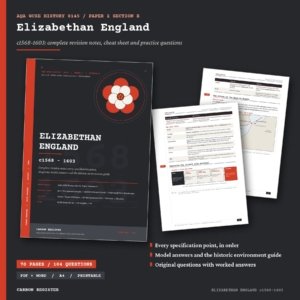
Free AQA GCSE History Elizabethan England Revision Notes Sample (PDF)
A 9-page sample from the full pack: the cover, contents, the 16-mark historic environment method with a Kenilworth model answer, a cheat-sheet page and practice questions.

Want everything unlocked?
The free file is a sample. The full version has every page, tab and feature, plus the user guide.
See the full versionWhere Elizabethan England sits in the AQA GCSE
AQA GCSE History (8145) has two written papers, each two hours and each worth half of the qualification. Elizabethan England is an option in Paper 2, Section B, the British depth study that includes the historic environment. The alternative options are Norman England, Medieval England under Edward I and Restoration England, so you only study one of them. Section A of the same paper is a thematic study of Britain over a long period.
The four questions in Section B
| Question | Marks | What it tests |
|---|---|---|
| Q1 | 8 | How convincing is a historian’s interpretation? You use the extract and your own knowledge. |
| Q2 | 8 | Explain what was important about something: two or three developed points. |
| Q3 | 8 | Write an account of events, with links showing how one led to another. |
| Q4 | 16 | How far does a study of a named historic site support a view? It needs the site and the wider period. |
That is 40 marks in total, so Q4 alone is 40% of the section. Plan roughly an hour for the whole of Section B, and keep the biggest chunk of time for Q4.
What you need to know
Elizabeth’s court and Parliament
Know how Elizabeth came to the throne in 1558, how the court worked through patronage, and the roles of her main ministers: Cecil (later Lord Burghley), Walsingham, Leicester, and later Essex and Robert Cecil. Be ready to explain the difficulties of being a woman ruler, the marriage question, the succession problem, and how her authority held up at the end of her reign, including the Essex rebellion of 1601.
Life in Elizabethan times
This covers the idea of a “Golden Age”, the rise of the gentry, the first permanent theatres such as the Theatre (1576) and the Globe (1599), the arguments for and against plays, and the growth of poverty. You should know the main Poor Law developments up to the great Act of 1601. The sailors Hawkins, Drake and Raleigh, and Drake’s voyage round the world in 1577-80, complete this part.
Troubles at home and abroad
Start with the Religious Settlement of 1559, then work through Catholic and Puritan challenges, the Northern Rebellion of 1569, the papal excommunication of 1570, missionary priests and the plots, including Ridolfi, Throckmorton and Babington. Mary, Queen of Scots, runs through all of it: her arrival in England in 1568, her captivity and her execution in February 1587. The final strand is the war with Spain, which leads to the Armada of 1588.
The historic environment
AQA names a specific site for each exam year. The sites for 2027, 2028 and 2029 are the Spanish Armada, Kenilworth Castle and Burghley’s Almshouses, and Hardwick Hall and the Globe were set for earlier years. Check with your teacher which one applies to you.
How to revise it
- Build the timeline first. Put the main events from 1558 to 1603 on one sheet and add the people involved. Everything else hangs on it.
- Revise one topic at a time and write a one-page summary from memory, then correct it.
- Learn precise facts: dates, names, numbers and laws. Vague answers rarely reach the top level.
- Practise each question type separately, then complete whole Section B papers against the clock.
- Mark yourself against level descriptors and rewrite weak answers.
A simple revision timeline
| Time left | Focus |
|---|---|
| 8 to 6 weeks | Read and summarise Parts 1 to 3; make the timeline; learn key people. |
| 5 to 4 weeks | Learn your historic site in depth; practise Q2 and Q3 answers. |
| 3 to 2 weeks | Practise Q1 and Q4; complete timed Section B papers. |
| Final week | Cheat-sheet recall, weak topics, one last timed paper, early nights. |
Common mistakes
- Describing a site instead of answering the statement. Q4 asks “how far”, so argue both sides and reach a judgement.
- Mixing up the order of events, such as the Northern Rebellion (1569) and the excommunication (1570).
- Writing “biased” in Q1. The question is about how convincing the interpretation is, tested with your knowledge, not about the author’s motives.
- Writing a list in Q3. An account needs links such as “as a result” and “this led to”.
- Treating the Armada as the end of the war. It was one episode in a conflict that continued into the early 1600s.
- Calling Kenilworth a Tudor castle. It is a medieval castle that Robert Dudley, Earl of Leicester, extended in the Tudor period.
Using the free sample
The free sample is taken straight from the complete notes. It has the cover and contents, the full method for the 16-mark historic environment question with a Kenilworth model answer, one page of the cheat sheet and a page of practice questions. If you like the style, the complete Elizabethan England revision pack gives you every specification point in order, a printable cheat sheet, more than a hundred original questions and a revision plan.
Frequently asked questions
Is there coursework in GCSE History?
No. AQA GCSE History is assessed by two written exams at the end of the course.
Do I need to visit the historic site?
No. You are not required to visit it and no marks are awarded for a visit. You need to know the site from your lessons and notes.
How many questions are there on Elizabethan England?
Four: three eight-mark questions and one sixteen-mark historic environment question.
How long should I spend on revision?
Short, regular sessions beat long ones. An hour a day on weekdays is a good target for the last eight weeks, with more at weekends if you can manage it. If you have only two weeks, put priority on the cheat sheet, your named site and timed Q4 practice. Our revision pack includes both an 8-week and a 2-week plan.
AQA is a registered trade mark of AQA Education. This article and the resources it describes are independent and are not endorsed by AQA.
