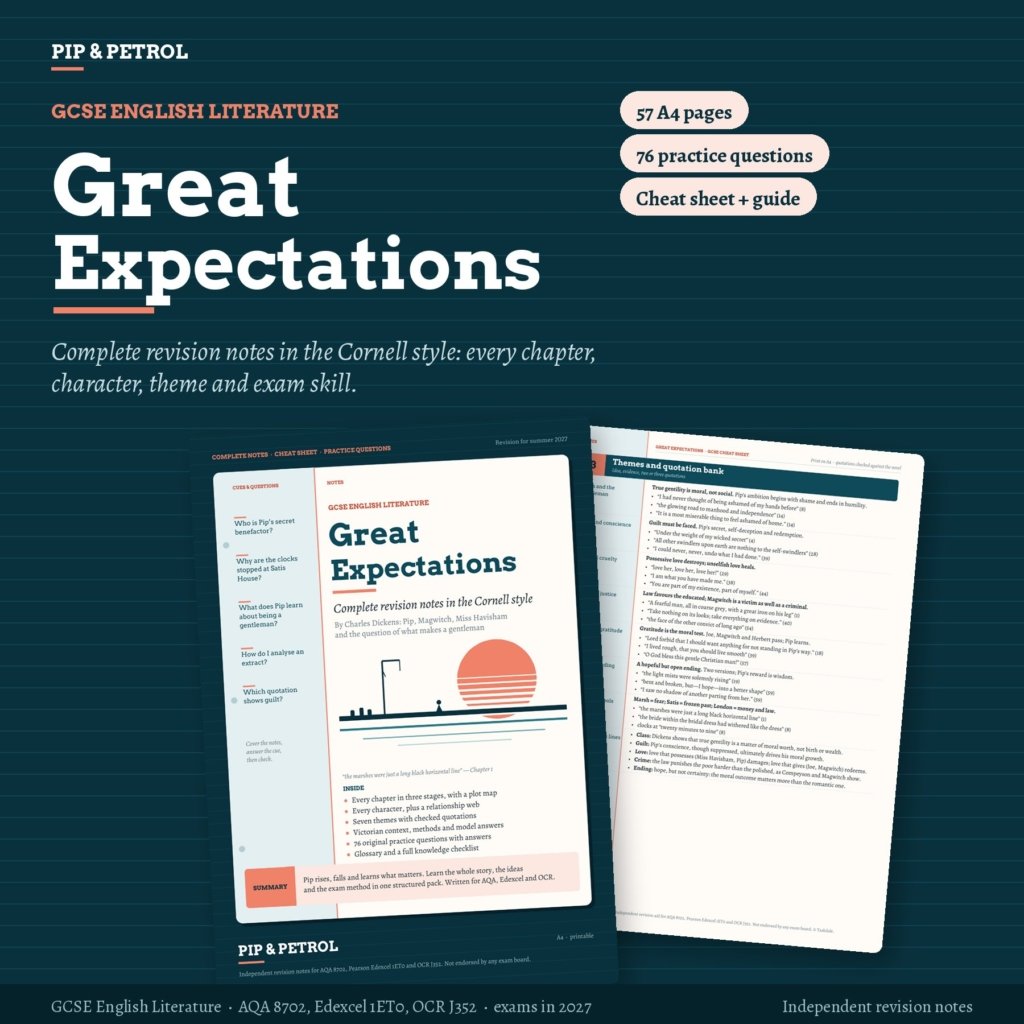
Great Expectations is one of the most popular 19th-century novels for GCSE English Literature, and it is also one of the longest. Students often find that they know the story but cannot turn that knowledge into marks under timed conditions. This guide explains how the exam is set, what examiners reward, how to organise your revision and which mistakes cost the most marks. A free sample of our full revision notes is included below.
Free Great Expectations GCSE Revision Notes Sample (PDF)
A 9-page sample from the real notes: cover, contents, two full topic sections (class and guilt), a cheat sheet page and practice questions, plus a closing page about the full pack.

Want everything unlocked?
The free file is a sample. The full version has every page, tab and feature, plus the user guide.
See the full versionWhich boards set Great Expectations?
Three of the main English boards include it on their lists of 19th-century novels: AQA (specification 8702), Pearson Edexcel (1ET0) and OCR (J352). WJEC Eduqas does not appear to offer it among its 19th-century prose texts, so if that is your board, check your teacher’s set-text list before you start. You study only the novel your school has chosen, and there is no choice of text on the day, so you must be ready for a question on any part of the book.
| Board | Where it appears | What the question looks like |
|---|---|---|
| AQA 8702 | Paper 1, Section B (30 marks) | One question: it starts from a printed extract and then asks you to look at the novel as a whole. |
| Edexcel 1ET0 | Paper 2, Section A | Two parts: an extract question and a separate whole-novel question, 20 marks each. |
| OCR J352 | Component 01, Section B | A choice of an extract-based question or an essay question. |
Timings and mark totals can change between series, so always check the front page of a past paper and your board’s current specification. These notes are independent and are written for summer 2027 exams.
What examiners are looking for
All three boards reward the same underlying skills, described through assessment objectives.
- A clear personal response (AO1). Answer the exact question, build an argument and support it with well-chosen quotations.
- Analysis of methods (AO2). Explain how Dickens uses language, form and structure, for example Pip’s retrospective narration, the settings of the marshes, Satis House and London, and recurring images.
- Context (AO3). Link ideas to the Victorian world: class and the idea of the gentleman, money, crime and punishment, and Dickens’s purposes. Context must explain something in the text; a pasted fact about the period earns little.
- Accurate writing (AO4). Spelling, punctuation and grammar are marked in some sections, depending on the board, so check your paper.
What to know about the novel
The story in three stages
Pip’s story falls into three parts: his childhood on the Kent marshes and his first hopes, his life in London as a young man of expectations, and the collapse of those hopes followed by his moral recovery. If you can narrate each stage in a few sentences and name two or three key moments in each, you can answer almost any question.
Characters
Prepare short profiles of Pip, Magwitch, Miss Havisham, Estella, Joe, Biddy, Jaggers, Wemmick, Mrs Joe and Orlick. For each, note what the character wants, how they change, which other characters they mirror or contrast with, and one or two quotations you can use more than once.
Themes
The most useful themes are ambition and class, guilt and conscience, love and cruelty, crime and justice, loyalty and gratitude, childhood, and identity and change. The strongest answers treat themes as ideas that develop across the book, not as lists of examples.
A revision timeline
- Six to eight weeks out: read or re-read the novel in sections, or listen to an audiobook, and write a one-paragraph summary of each stage. Make a timeline of key events.
- Five to six weeks out: build one page per main character and one per theme. Choose a small bank of about fifteen quotations that can be reused across topics.
- Three to four weeks out: study the contexts and the methods. Practise close reading on short extracts and write a paragraph after each one.
- Two weeks out: write timed answers under exam conditions. Plan an answer in five minutes, write for the time recommended on your paper and leave a few minutes to check it.
- The final week: recall the quotations without looking, rework weak answers and rest properly before the exam.
How to revise actively
Reading your notes again is the least effective way to learn. Cover the notes and answer questions from memory, then check and correct yourself. A Cornell-style page is built for this: write cue questions down the left, notes on the right, and use the cues for self-testing. Leave a gap of a few days before you retest a topic, because recalling something after a delay strengthens memory more than going over it straight away.
Common mistakes
- Retelling the plot. Examiners already know the story. Use events only as evidence for a point about ideas or methods.
- Quoting without analysing. A quotation needs comment on a particular word, image or effect.
- Ignoring the narrator. Older Pip tells the story about his younger self. His judgements and regrets shape how we respond to everything.
- Treating context as a separate paragraph. Weave it into your analysis, and only where it helps explain a point.
- Using only the beginning of the novel. Whole-novel questions reward evidence from different stages. Aim for at least one moment from each part of the book.
- Running out of time. Plan briefly and write in paragraphs that each make one clear point.
Where the full notes can help
If you want everything in one structured pack, the complete Pip & Petrol Great Expectations GCSE revision notes contain 57 A4 pages in a Cornell layout, a 5-page cheat sheet, a Word guide with 8-week and 2-week revision plans, and 76 original practice questions with answers. They cover every stage of the novel, the main characters, the themes, context, methods and exam technique, with two full model answers. You can see what is included here.
Frequently asked questions
Do I need to memorise lots of quotations?
You need a small, flexible bank rather than a huge list. Short quotations of a few words are easier to remember and often easier to analyse. Learn them by theme and by character so each one can serve several questions.
How much of the novel do I need to know for the extract question?
You must know the whole novel, because the second part of the task asks you to move beyond the extract. Know what happens before and after any likely passage.
What is the best way to use a past paper?
Do one timed question at a time rather than waiting for a whole paper. Then mark it against the assessment objectives, find your weakest one and fix that first. Examiner reports on your board’s website are free and useful.
Is the free sample the same as the full notes?
The sample is made up of real pages from the full notes: the cover, contents, two complete topics, a cheat sheet page and some practice questions. The full pack contains every topic.
Are these notes endorsed by an exam board?
No. They are independent. AQA, Pearson Edexcel, OCR and WJEC Eduqas are trade marks of their respective owners and are named only to describe the specifications. Always follow your teacher’s guidance and your board’s current documents.
