If you are searching for free GRE notes, you are probably trying to answer one question: how much math do I actually need, and how do I learn it fast? This guide answers that. It walks through the format of the Quantitative Reasoning section, every topic the test covers, a realistic study plan, and the mistakes that cost the most points.
What the GRE Quant Section Looks Like
The Quantitative Reasoning measure has two scored sections. Section 1 has 12 questions in 21 minutes. Section 2 has 15 questions in 26 minutes. That averages under two minutes per question. A basic on-screen calculator is provided, and scores run from 130 to 170.
Section 2 adapts. How hard it is depends on how you did in Section 1. So a tough second section usually means the first went well, which is something to remember when your confidence wobbles.
The four question types
- Quantitative Comparison: compare two quantities and choose from four fixed answers, including “cannot be determined.”
- Multiple choice, one answer: the familiar format.
- Multiple choice, one or more answers: select every correct option, with no partial credit.
- Numeric Entry: type the answer yourself.
Some questions share one table or graph in a Data Interpretation set.
Here is a free sample so you can see how these notes are written. It contains the full first chapter, with the format, the calculator advice, and the strategy habits.

Free GRE Quant Notes: Chapter 1 Sample (PDF)
The full first chapter: format, question types, calculator advice, and strategy.
Want everything unlocked?
Numerate GRE Quant Study Guide: Complete Notes with Practice Exam | Postgraduate
The free file is a sample. The full version has every page, tab and feature, plus the user guide.
See the full versionWhat the Test Covers
The content is high school math, nothing past a second algebra course. There is no trigonometry, no calculus, and no proofs. Four areas are tested.
Arithmetic
Integers, divisibility, primes, factors, remainders, fractions, decimals, percents, ratios, exponents, and roots. Percent change and successive percents show up often. So do tricks with the last digit of a power.
Algebra
Linear equations, systems, inequalities, quadratics, factoring, functions, coordinate geometry, and word problems. Many questions reward shortcuts, such as solving for an expression instead of a variable.
Geometry
Lines and angles, triangles (especially right triangles), polygons, circles, and three-dimensional solids. Memorize the Pythagorean triples and the two special right triangles and you will save real time.
Data Analysis
Mean, median, standard deviation, counting, probability, and reading tables and graphs. The reading is harder than the math, so check titles, units, and axes first.

Full version
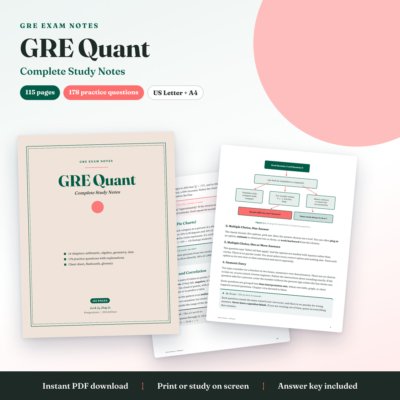
Numerate: GRE Quantitative Reasoning Complete Exam Notes
- 14 chapters covering every GRE Quant topic
- 178 practice questions with explanations
- 40-question practice exam, cheat sheet, flashcards
A Closer Look at the Topics
Number properties in practice
Number properties sound dull, but they produce some of the trickiest questions. You may be told that n is a positive integer and asked which of several expressions must be even. The safest method is to test small cases: n = 1, n = 2, and n = 3 usually reveal the pattern. Learn prime factorization as well. It gives you the number of factors of any integer (add one to each exponent and multiply), the greatest common factor (smaller exponents), and the least common multiple (larger exponents). For 72, which is 2 cubed times 3 squared, the factor count is 4 times 3, which is 12.
Percents and ratios
Percent questions on the GRE almost always come down to multipliers. A 20 percent increase multiplies by 1.2, and a 20 percent decrease multiplies by 0.8. Two successive changes multiply, so +20 percent followed by -20 percent leaves you at 96 percent of the start. Ratios work the same way: a ratio of 3 to 5 means 8 equal parts, and any total must be a multiple of 8. Rate problems depend on keeping units straight. For a round trip with equal distances, the average speed is total distance over total time, which is always less than the simple average of the two speeds.
Algebra shortcuts
Many algebra questions do not require you to find every variable. If 4x – 6 = 18 and the question asks for 2x – 3, divide the equation by 2 and you are done. If two equations are given and the question asks for x + y, try adding them before solving. Quadratics come up through factoring, the quadratic formula, and special patterns like the difference of squares. Knowing that 99 squared minus 1 equals 98 times 100 is the kind of thing that turns a minute of arithmetic into five seconds.
Geometry you must know cold
Memorize the 3-4-5, 5-12-13, 8-15-17, and 7-24-25 right triangles, along with the side ratios of the 45-45-90 triangle (1 : 1 : square root of 2) and the 30-60-90 triangle (1 : square root of 3 : 2). Know the circle formulas, how an inscribed angle relates to its arc, and how similar figures scale: lengths by k, areas by k squared, volumes by k cubed. Draw every figure yourself when none is given.
Statistics and probability
You will not be asked to run a hypothesis test. You will be asked to find a mean or median, compare standard deviations without computing them, and use the 68-95-99.7 rule for the normal distribution. Counting problems turn on whether order matters. Choosing three officers from eight people is a permutation (336 ways), while choosing a three-person committee is a combination (56 ways). For “at least one” probability, subtract the chance of none from 1.
How to Use Practice Questions
Treat every practice set as a diagnostic. After each set, sort your misses into three bins: concept gaps (you did not know the idea), method errors (you knew it but chose a slow path), and slips (you made an arithmetic or reading mistake). Concept gaps need a return to the notes. Method errors need a second look at the shortcuts. Slips improve with scratch-paper habits, like writing down what the question asks for before you solve.
Time yourself in the final two weeks. Do a full section of 12 or 15 questions in the real time limit, since pacing is a skill in its own right. Aim to finish easy questions in under a minute so that you have time left for the hard ones.
A Four-Week Study Plan
Week 1: arithmetic and fractions. Review number properties, percents, and ratios. Memorize squares to 15 and the benchmark fractions.
Week 2: algebra. Equations, inequalities, quadratics, and functions. Practice solving for expressions and plugging in numbers.
Week 3: geometry and data. Triangles, circles, solids, statistics, and probability. Draw every figure on scratch paper.
Week 4: timed practice. Take a timed set under test conditions, review every mistake, and sort errors into concept gaps, careless slips, and traps.
Mistakes That Cost the Most Points
- Skipping choice D. In Quantitative Comparison, test several values for any variable. If the answer changes, it is D.
- Answering a different question. Solving for x when the question asks about 2x is an easy way to lose a point.
- Averaging speeds. Average speed is total distance over total time.
- Adding percents. Successive percent changes multiply.
- Trusting a figure. Unless a figure is stated to be to scale, use only the labels.
- Leaving blanks. There is no penalty for wrong answers, so always guess.
Tips for Test Day
Estimate before you use the calculator, because a quick estimate catches keying errors. Mark long questions and come back to them. Spend a few seconds writing what the question asks for, then solve. And keep an even pace; the second section is meant to feel harder when you are doing well.
How to Practice Well
Do not just check whether you got a question right. For every miss, write one line about why. Over a few weeks, patterns appear, such as forgetting to flip an inequality or mixing up permutations and combinations, and those patterns are what you fix. Redo missed questions a week later without looking at the explanation.
Want every chapter, not just the sample?
Numerate: GRE Quantitative Reasoning Complete Exam Notes gives you 14 chapters covering every gre quant topic, plus the answer key and cheat sheet.
What the Full Version Adds
The free chapter covers the format and strategy. The complete guide goes through every math topic in 14 chapters, with worked examples, 178 practice questions with explanations, a 40-question practice exam, a cheat sheet, flashcards, and a glossary.
Frequently Asked Questions
How hard is the GRE math section?
The math itself is easy for many students, since it is high school level. The difficulty comes from the wording, the time limit, and the traps. Practice with explanations is the best way to deal with them.
Can I use a calculator?
Yes. A basic on-screen calculator is provided for the Quantitative Reasoning measure. Use it for tedious arithmetic and estimate first.
What score should I aim for?
It depends on the programs you are applying to. Check the typical scores for admitted students at your target schools, then work backward to set a study plan.
Is there a penalty for guessing?
No. Wrong answers do not reduce your score, so never leave a question blank.
How long should I study?
Many students spend four to eight weeks, depending on how rusty their math is. Short, regular sessions beat one long weekend session.
Full version
Numerate: GRE Quantitative Reasoning Complete Exam Notes
- 14 chapters covering every GRE Quant topic
- 178 practice questions with explanations
- 40-question practice exam, cheat sheet, flashcards
