Health assessment is often the first nursing course where you have to put your hands on a real person and explain what you find. It can feel like a lot: a new vocabulary, dozens of landmarks, grading scales for everything, and check-offs where an instructor watches every move. The good news is that the course is very predictable. The same sequence, the same normal findings and the same scales come up on every exam. This guide explains what the course covers, how exams test it, the numbers to memorize and a study plan.
What health assessment covers
Most US programs follow the same order:
- The health history and interview: communication, the parts of a complete history, symptom analysis and the review of systems
- Techniques, general survey and vital signs
- Pain and nutrition
- Each body system: skin, head and neck, eyes, ears, nose and throat, breasts, lungs, heart, peripheral vascular, abdomen, musculoskeletal, neurologic and genitourinary
- Lifespan variations and the head-to-toe exam, with documentation
If you want to see how our notes handle this, the first chapter is free. It covers subjective and objective data, types of assessment, therapeutic communication, symptom analysis with OLDCARTS, and every part of the health history, with 10 practice questions and explanations.

Free Health Assessment Notes: Chapter 1 Sample (PDF)
The full first chapter: subjective and objective data, types of assessment, the interview, OLDCARTS and every part of the health history, with 10 practice questions.

Want everything unlocked?
The free file is a sample. The full version has every page, tab and feature, plus the user guide.
See the full versionHow exams test you
Health assessment exams ask a few question types over and over:
- Sequence: which step comes first? The classic is the abdomen: inspect, auscultate, percuss, then palpate, because palpation can change bowel sounds.
- Technique: which part of the hand, which part of the stethoscope, which position? The diaphragm picks up high-pitched sounds such as S1 and S2 and normal breath sounds; the bell picks up low-pitched sounds such as S3, S4 and some murmurs.
- Normal versus abnormal: is this finding expected? Arcus senilis in an 80-year-old is expected. A unilateral, painless, hard breast mass is not.
- Priority: which finding should the nurse report first? Look for airway, breathing, circulation and sudden change.
- Lifespan: what is normal for an infant, a pregnant patient or an older adult?
Vital signs to memorize
- Pulse: 60 to 100 beats per minute in adults
- Respirations: 12 to 20 breaths per minute
- Oxygen saturation: 95% to 100% on room air for most adults
- Temperature: about 96.8 to 99.5 °F orally; rectal readings run about 0.7 to 1 °F higher
- Blood pressure: normal is below 120 systolic and below 80 diastolic. Elevated is 120 to 129 systolic with diastolic below 80. Stage 1 hypertension is 130 to 139 systolic or 80 to 89 diastolic. Stage 2 is 140 or higher systolic or 90 or higher diastolic.
A quick check on a common calculation: a pulse deficit is the apical rate minus the radial rate. An apical pulse of 92 with a radial pulse of 80 gives a deficit of 12.
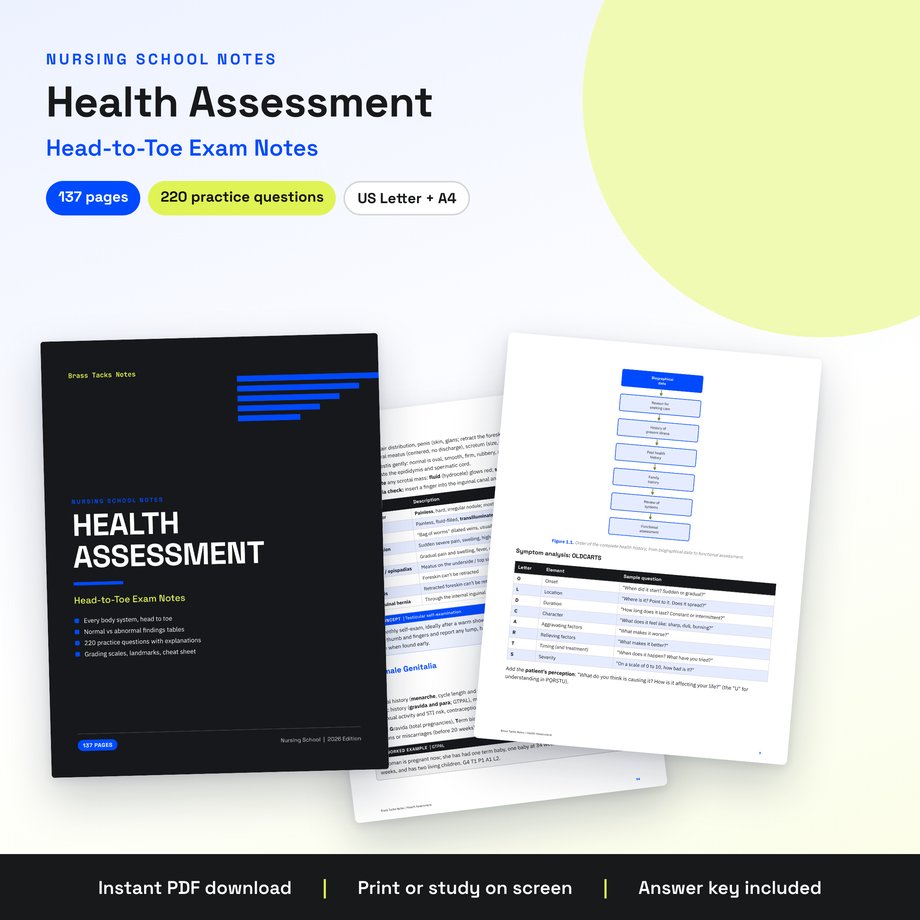
Full version
AssessKit: Health Assessment Notes for Nursing Students
- Every body system, head to toe
- 220 questions with explanations
- All grading scales and landmarks
The grading scales
Students lose easy points by mixing up scales. Learn them as a set:
- Pulses: 0 absent, 1+ diminished, 2+ normal, 3+ increased, 4+ bounding
- Deep tendon reflexes: 0 absent, 1+ diminished, 2+ normal, 3+ brisker than average, 4+ very brisk with clonus
- Muscle strength: 0 no contraction, 1 trace, 2 full movement with gravity eliminated, 3 full movement against gravity, 4 some resistance, 5 full resistance
- Pitting edema: 1+ about 2 mm, 2+ about 4 mm, 3+ about 6 mm, 4+ about 8 mm
- Glasgow Coma Scale: eye opening 1 to 4, verbal 1 to 5, motor 1 to 6, for a total of 3 to 15. A score of 8 or less signals a severely depressed level of consciousness.
- Murmurs: grade I is very faint; a thrill appears at grade IV and above
Notice that pulses and reflexes both make 2+ the normal value, while muscle strength makes 5 normal. That single fact answers several exam questions.
Landmarks that show up every time
- Heart sounds: aortic at the 2nd intercostal space, right sternal border; pulmonic at the 2nd intercostal space, left sternal border; Erb’s point at the 3rd, left sternal border; tricuspid at the 4th or 5th, left lower sternal border; mitral at the 5th intercostal space, left midclavicular line. Many students remember the order with “All Physicians Eat Too Much.”
- Lungs: the right lung has three lobes and the left has two. From the back you mostly hear the lower lobes, and the right middle lobe is best heard from the front and right side.
- Abdomen: the appendix sits in the right lower quadrant; the liver and gallbladder in the right upper quadrant; the spleen in the left upper quadrant.
Skin findings worth knowing
Use the ABCDE rule for a suspicious mole: asymmetry, border irregularity, color variation, diameter over 6 mm, and evolution or change. Check capillary refill (normally under 2 seconds in most adults) and skin turgor. Remember that pallor and cyanosis are easier to see in the conjunctivae, lips, nail beds and palms in people with darker skin. Pressure injury staging also appears on many exams, so learn the four stages plus unstageable and deep tissue injury.
A six-week study plan
Week 1: The interview, health history, techniques, general survey and vital signs.
Week 2: Pain, nutrition, skin, and head and neck, including lymph nodes and the thyroid.
Week 3: Eyes, ears, nose, mouth and throat, with the cranial nerves that test them.
Week 4: Thorax and lungs, heart and neck vessels, peripheral vascular system.
Week 5: Abdomen, musculoskeletal and neurologic systems, then breasts and genitourinary.
Week 6: Lifespan variations, the head-to-toe sequence and documentation, then full practice exams and daily cheat sheet review.
Tips for check-offs
- Practice out loud. Say each step as you do it. Instructors want to hear that you know why.
- Use the same order every time. A fixed sequence means you are less likely to miss a step when you are nervous.
- Explain before you touch. Tell the patient what you are doing, wash your hands and provide privacy.
- Compare side to side. Lungs, pulses, strength, reflexes and sensation are always compared right with left.
- Document what you found, not what you think. Write “2+ pitting edema bilateral ankles,” not “swollen legs.”
Common mistakes
- Palpating the abdomen before auscultating.
- Pulling the ear the wrong way. Pull the pinna up and back for adults, down and back for children under 3.
- Palpating both carotid arteries at the same time. Check one side at a time.
- Calling an expected age change abnormal. Presbyopia, arcus senilis and decreased skin turgor are common in older adults.
How to use practice questions
After each chapter, answer the end-of-chapter questions without notes, then read every explanation, including the ones you got right. Sort your misses by cause: a fact you did not know, a sequence you mixed up, or a priority question where you picked a true but less urgent answer. Priority misses are the most common in nursing courses, so practice asking “what could harm this patient first?” before picking an answer.
Want every chapter, not just the sample?
AssessKit: Health Assessment Notes for Nursing Students gives you every body system, head to toe, plus the answer key and cheat sheet.
FAQ
Is health assessment hard?
It is detailed rather than conceptually difficult. Students who practice the sequence on a partner and memorize the scales usually do well.
How is it different from fundamentals?
Fundamentals teaches basic nursing care and procedures. Health assessment teaches how to collect a history and perform a physical exam, and how to tell normal findings from abnormal ones.
Will this help with NCLEX?
Assessment is part of many NCLEX items, especially priority and abnormal-finding questions, so the same knowledge carries forward.
Get the complete notes
The free chapter shows the style. The full AssessKit guide covers all 16 chapters with 20 diagrams, 220 practice questions with explanations including a 60-question practice exam, a cheat sheet, 60 flashcards and a 98-term glossary, in US Letter and A4 PDF.
