The Chemical and Physical Foundations of Biological Systems section, usually called Chem/Phys or C/P, is the first section of the MCAT and the one many students fear most. It mixes physics, general chemistry, organic chemistry and biochemistry, sets them inside biological passages, and gives you no calculator. This guide explains the section’s format, what it tests, how to study it, and the mistakes that cost points. You can also download our free MCAT Chem/Phys notes: the full first chapter of our review.
The format
| Item | Detail |
|---|---|
| Questions | 59 |
| Time | 95 minutes |
| Structure | 10 passages (44 questions) + 15 discrete questions |
| Calculator | None; a periodic table is provided |
| Score | 118 to 132 |
That is about 1.6 minutes per question. Passages take longer; discretes should take about a minute.
Download the free chapter
Chapter 1 covers section strategy and the math you must do by hand: dimensional analysis, metric prefixes, scientific notation estimation, logarithms, trigonometry values, proportional reasoning, and the experimental design and statistics concepts the AAMC tests. It ends with a 10-question quiz:

Free MCAT Chem/Phys Notes: Chapter 1, Strategy and Math (PDF)
Chapter 1 in full: C/P format and skills, passage method, units, logs and estimation, and experimental design, with a 10-question quiz.

Want everything unlocked?
Quantum Ledger MCAT Chem/Phys Review Notes: Chemical and Physical Foundations Study Guide | Pre-Med
The free file is a sample. The full version has every page, tab and feature, plus the user guide.
See the full versionWhat C/P tests
By discipline (approximate)
| Discipline | Share |
|---|---|
| General chemistry | 30% |
| Introductory physics | 25% |
| First-semester biochemistry | 25% |
| Organic chemistry | 15% |
| Introductory biology | 5% |
By foundational concept
Foundational Concept 4 (about 40%) covers physical principles in living systems: motion and forces, energy, fluids and gas exchange, electricity and electrochemistry, light and sound, and atomic and nuclear structure.
Foundational Concept 5 (about 60%) covers chemical principles: water and solutions, bonding and molecular structure, separation and purification, biologically important molecules and their reactivity, and thermodynamics, kinetics and equilibrium.
By skill
| Skill | Share |
|---|---|
| Knowledge of scientific concepts | 35% |
| Scientific reasoning and problem solving | 45% |
| Research design and execution | 10% |
| Data-based and statistical reasoning | 10% |
Reasoning, not recall, is the biggest slice. Most questions ask you to apply a familiar equation to an unfamiliar system.
Full version
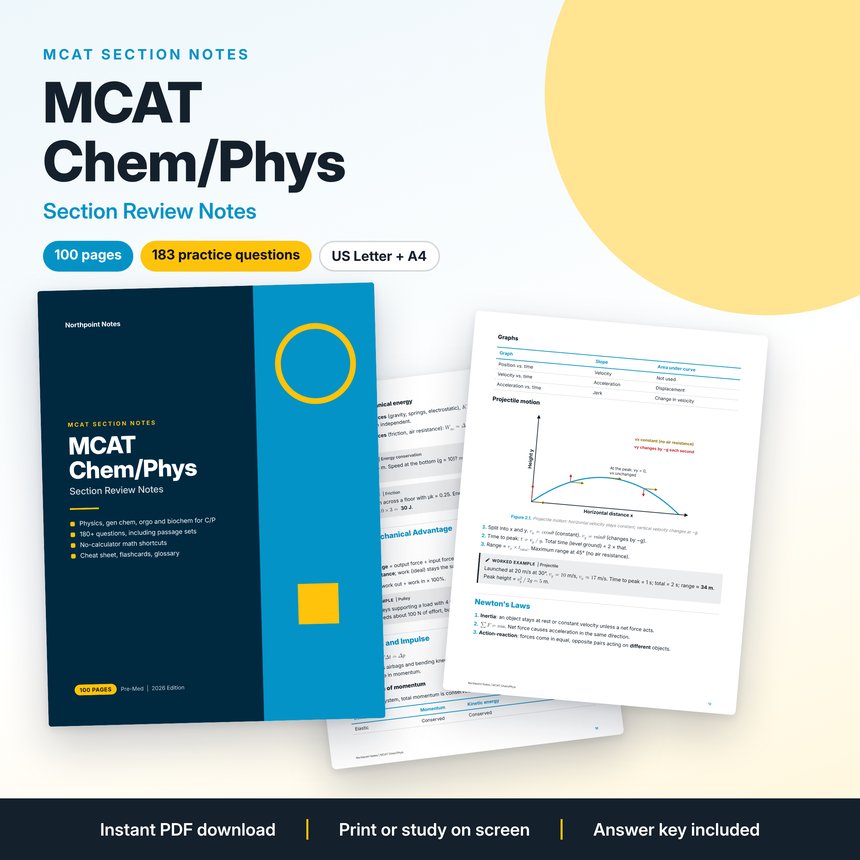
Quantum Ledger: MCAT Chem/Phys Section Review Notes
- 12 chapters mapped to the AAMC outline
- 183 questions with passage sets
- No-calculator math shortcuts
High-yield topics
- Fluids: continuity, Bernoulli and Poiseuille applied to blood flow (flow depends on radius to the fourth power).
- Electrochemistry: galvanic vs. electrolytic cells, ΔG° = −nFE°, and membrane potentials.
- Acids, bases and buffers: Henderson-Hasselbalch, titration curves and the bicarbonate buffer.
- Thermodynamics and kinetics: ΔG = ΔH − TΔS, catalysts and what they do not change, and Le Châtelier.
- Enzyme kinetics: Km, Vmax and the three types of reversible inhibition.
- Amino acids: charges at different pH values and the isoelectric point.
- Optics: the thin lens equation, sign conventions and vision correction.
- Lab techniques: extraction, chromatography, electrophoresis, IR and NMR.
How to study C/P
Phase 1: Content (4-6 weeks)
Work through one topic at a time. For every equation, learn its units and practice “what happens if this doubles” questions. Do every calculation by hand.
Phase 2: Application (3-4 weeks)
Do passage sets daily. After each set, sort your mistakes into content gaps, misreading the passage, or math errors, and fix the cause.
Phase 3: Full-length practice (final 3-4 weeks)
Take full-length practice exams under timed conditions and review every question, including those you got right for the wrong reason.
A sample week during content review
| Day | Focus |
|---|---|
| Monday | Physics topic (for example, fluids) plus 10 discrete questions |
| Tuesday | General chemistry topic (for example, buffers) plus one passage set |
| Wednesday | Biochemistry topic (for example, enzyme kinetics) plus one passage set |
| Thursday | Organic chemistry topic (for example, lab techniques) plus 10 discretes |
| Friday | Mixed passage sets under timed conditions |
| Saturday | Review every mistake from the week and rewrite the rules you missed |
| Sunday | Rest, or a light flashcard review |
Spacing topics across the week and mixing disciplines on Fridays trains you for the real section, where physics, chemistry and biochemistry passages arrive in any order. Keep an error log with three columns: the question, why you missed it, and the rule that fixes it. Reread the log every weekend, and retest yourself on those rules a week later.
No-calculator math tips
- Round to one or two significant figures before multiplying.
- Keep track of powers of ten separately from the leading digits.
- Memorize log 2 ≈ 0.30, log 3 ≈ 0.48, log 5 ≈ 0.70.
- For −log(a × 10⁻ⁿ), the answer is n − log a, so it lies between n − 1 and n.
- Use answer spacing: options are often far enough apart that a rough estimate picks the right one.
How to read a C/P passage
- Skim for the system in about two minutes: what is being studied, what is varied, what is measured.
- Label each paragraph in a few words so you can find details later.
- Read figures carefully: axis labels, units, linear or log scale, and which line is the control.
- Read each question stem first, then return only to the part of the passage you need.
- Predict an answer before looking at the options, then match.
- Spot pseudo-discretes: many passage questions only need outside knowledge, so answer them quickly.
Worked example: pH without a calculator
What is the pH of 0.01 M acetic acid (Ka ≈ 1.8 × 10⁻⁵)?
- For a weak acid, [H⁺] ≈ √(Ka × C) = √(1.8 × 10⁻⁷).
- Rewrite as √(18 × 10⁻⁸) ≈ 4.2 × 10⁻⁴.
- pH = 4 − log 4.2 ≈ 4 − 0.62 ≈ 3.4.
The same steps (rewrite to an even power of ten, take the square root, then use the log shortcut) work for most acid-base estimates on test day.
Common mistakes
- Forgetting kelvin in gas law and thermodynamics problems.
- Thinking catalysts change K or ΔG. They only lower activation energy.
- Confusing the signs of galvanic and electrolytic electrodes. Oxidation is always at the anode, but the anode’s sign flips.
- Using R/S to predict the direction of optical rotation. The two are unrelated.
- Mixing up competitive and noncompetitive inhibition. Competitive raises Km; noncompetitive lowers Vmax.
- Ignoring units in answer choices. A wrong unit often eliminates two options at once.
Frequently asked questions
How long should I spend on C/P content review?
Many students spend 4 to 8 weeks on content across all sections, with C/P often needing the most time for those who are rusty in physics.
Which equations should I memorize?
The kinematic equations, Newton’s second law, energy and work, momentum, fluid equations, the ideal gas law, Coulomb’s law, Ohm’s law, the thin lens equation, E = hf, ΔG = ΔH − TΔS, ΔG° = −RT ln K, Henderson-Hasselbalch and Michaelis-Menten.
Do I need to know biology for C/P?
Only a little directly (about 5%), but nearly every passage is set in a biological context such as blood flow, nerve signaling, enzymes or membranes. Knowing that context makes the physics and chemistry questions faster.
Is organic chemistry heavily tested?
It is about 15% of the section and focuses on functional groups, reactivity, stereochemistry and lab techniques rather than long syntheses.
Get the complete notes
The free download is Chapter 1. The full Quantum Ledger MCAT Chem/Phys review covers every content category in 12 chapters, with 13 labeled diagrams, 183 practice questions with explanations, a 50-question practice section with passages, a cheat sheet, flashcards and a glossary.
Want every chapter, not just the sample?
Quantum Ledger: MCAT Chem/Phys Section Review Notes gives you 12 chapters mapped to the aamc outline, plus the answer key and cheat sheet.
MCAT is a registered trademark of the Association of American Medical Colleges (AAMC), which is not affiliated with and does not endorse this product.
