
Revising for OCR GCSE Gateway Science Biology A (J247) is much easier when you know exactly what the exam tests and have a plan for covering it. This guide explains how the papers work, what each module asks of you, how to revise it and the mistakes that cost the most marks. At the end you can download a free sample of our revision notes, and see how the complete pack works.
Free OCR GCSE Biology A Revision Notes Sample (PDF)
A 10-page sample of the Dotted Plum notes: cover, contents, the DNA, protein synthesis and enzymes topic, a cheat sheet page and practice questions.

Want everything unlocked?
The free file is a sample. The full version has every page, tab and feature, plus the user guide.
See the full versionWhat is OCR Gateway Science Biology A?
Gateway Science Biology A is OCR’s GCSE (9-1) Biology specification, code J247. It is taken at the end of Year 11 by students who are studying biology as a separate science. It is different from the Twenty First Century Science (Biology B) specification, so check with your teacher which one you are entered for. There is no coursework: practical skills are tested in the written papers.
The content is organised into six teaching modules, B1 to B6, plus practical and maths skills. Each module is built from numbered statements such as B1.2g, and the exam questions come from those statements. A useful first step is to print the specification checklist and tick each point as you learn it.
How the exam is structured
There are four papers. Foundation Tier students sit Papers 1 and 2, and Higher Tier students sit Papers 3 and 4. Each paper lasts 1 hour 45 minutes, is worth 90 marks and contributes 50% of the qualification.
| Paper | Tier | Content | Time and marks |
|---|---|---|---|
| Paper 1 (J247/01) | Foundation | B1 to B3 and B7 | 1 hour 45 minutes, 90 marks |
| Paper 2 (J247/02) | Foundation | B4 to B6 and B7, with B1 to B3 assumed | 1 hour 45 minutes, 90 marks |
| Paper 3 (J247/03) | Higher | B1 to B3 and B7 | 1 hour 45 minutes, 90 marks |
| Paper 4 (J247/04) | Higher | B4 to B6 and B7, with B1 to B3 assumed | 1 hour 45 minutes, 90 marks |
Each paper has two sections. Section A has 15 multiple-choice questions worth one mark each. Section B contains structured questions, calculations and data questions, and includes one six-mark extended response. Calculators are allowed in all papers. Roughly 15% of the marks test practical skills and at least 10% test maths skills. The assessment objectives are weighted at about 40% knowledge and understanding (AO1), 40% applying knowledge (AO2) and 20% analysing, interpreting and evaluating (AO3).
What each module tests
B1 Cell level systems
This module underpins everything else. Expect microscope magnification calculations, comparing animal, plant and bacterial cells, the structure of DNA, protein synthesis, how enzymes work and how pH and temperature affect them, aerobic and anaerobic respiration, and photosynthesis with its limiting factors.
B2 Scaling up
Questions focus on diffusion, osmosis and active transport, mitosis and the cell cycle, stem cells, why large organisms need exchange surfaces, the heart, blood vessels and blood, and transport in plants including transpiration.
B3 Organism level systems
This covers the nervous system and reflex arc, the eye and brain, hormones and negative feedback, the menstrual cycle and contraception, plant hormones, and homeostasis, including blood glucose, diabetes, the kidney and ADH.
B4 Community level systems
Learn the carbon, water and nitrogen cycles, decomposition, abiotic and biotic factors, relationships between organisms, food chains and biomass pyramids, and how to calculate the efficiency of biomass transfer.
B5 Genes, inheritance and selection
Typical questions use Punnett squares and probability, ask about meiosis, variation and mutations, and require you to explain natural selection and evidence for evolution.
B6 Global challenges
This module applies biology to real problems: sampling methods, eutrophication, biodiversity, selective breeding and genetic engineering, pathogens and the immune system, vaccines, antibiotics, drug trials and non-communicable diseases.
Command words you must know
- State, give, name: a short answer with no explanation.
- Describe: say what happens or what something looks like; for a graph, describe the trend using data.
- Explain: give reasons, using words such as “because” and “so”.
- Suggest: apply your knowledge to an unfamiliar situation; there may be more than one acceptable answer.
- Calculate: work out a number and show your working and units.
- Compare: give similarities and differences, using words like “whereas” and “but”.
- Evaluate: weigh up evidence for and against, then reach a judgement.
How to revise: an 8-week timeline
- Week 1: cells, DNA and enzymes (B1.1 and B1.2).
- Week 2: respiration, photosynthesis, osmosis and mitosis (B1.3, B1.4 and B2.1).
- Week 3: exchange surfaces, circulation and plant transport (B2.2).
- Week 4: the nervous system and hormones (B3.1 and B3.2).
- Week 5: homeostasis and ecosystems (B3.3 and B4).
- Week 6: inheritance, genetics and evolution (B5).
- Week 7: environment, food security, practical and maths skills (B6.1, B6.2 and B7).
- Week 8: health and disease (B6.3), then timed papers and the topics you have ticked as weakest.
In each week, use four short sessions: read a topic, cover the page and write down what you remember, do exam-style questions, then mark them and tick your checklist. Short, spaced sessions work better than a single long cramming session. If you have only two weeks, work through one module a day and use a one-page cheat sheet to find gaps.
Six-mark questions: how to get Level 3
Each paper has a six-mark extended response, marked by level of response rather than ticks. A top-level answer is detailed, logical and covers every part of the question, with correct scientific terms and clear links between ideas. Spend two minutes planning: write the key words, decide the order, then write in paragraphs. Use the information in the question, and link each point with “because” or “so”. A good habit is to finish with a short conclusion that answers the question directly.
Practical and maths skills
You will not do a practical in the exam, but you must understand the eight practical activity groups: microscopy, food tests, sampling, enzyme rates, photosynthesis, human physiology and respiration, microbiology and transport in and out of cells. Be ready to identify variables, suggest improvements, plot and read graphs, calculate means ignoring anomalies, and use percentage change. Practise these maths skills in context, not just as isolated sums:
- Magnification: image size divided by actual size, with unit conversions between mm and µm.
- Rate of reaction: amount divided by time, or the gradient of a graph.
- Percentage change: change divided by the original value, multiplied by 100.
- Probability and ratios in genetic crosses.
- Population estimates from quadrats and capture-recapture.
Common mistakes that cost marks
- Saying enzymes are “killed”. They are denatured, because the shape of the active site has changed.
- Writing that respiration is breathing. Respiration releases energy in every living cell.
- Mixing up magnification (how many times bigger) with resolution (how much detail you can see).
- Saying vaccines contain antibodies. They contain antigens, so that your body makes antibodies and memory cells.
- Forgetting units, or giving the wrong number of significant figures.
- Saying organisms “adapt” or “try” to change. Natural selection acts on variation that already exists.
Frequently asked questions
How many marks is GCSE Biology worth overall?
You sit two papers of 90 marks each, so there are 180 marks in total for your tier.
Do I need to learn the Higher Tier content for Foundation?
The specification marks some statements as Higher Tier only. If you are entered for Foundation, ask your teacher which ones to prioritise, but learning the whole specification will help you understand the topics.
Are past papers allowed for revision?
Yes. Past papers are available on the exam board website. Use them for timed practice once you have covered the topics, and mark your answers strictly using the mark scheme.
When should I start revising?
Eight weeks gives a comfortable plan, but starting earlier with a few short sessions a week is even better.
Next steps
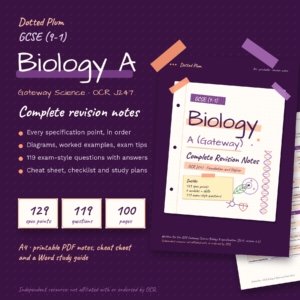
Download the free sample above to see the notebook-style notes, diagrams, worked examples and practice questions. When you are ready to cover the whole specification, the complete OCR GCSE Biology A (Gateway) revision pack contains 100 pages of notes, 119 practice questions with answers, a cheat sheet, a specification checklist and a study guide with an 8-week and a 2-week plan.
This article is independent and not endorsed by OCR. OCR is a registered trade mark of Oxford Cambridge and RSA Examinations. This product is independent and is not endorsed by OCR. See the full pack for details of what is included.
