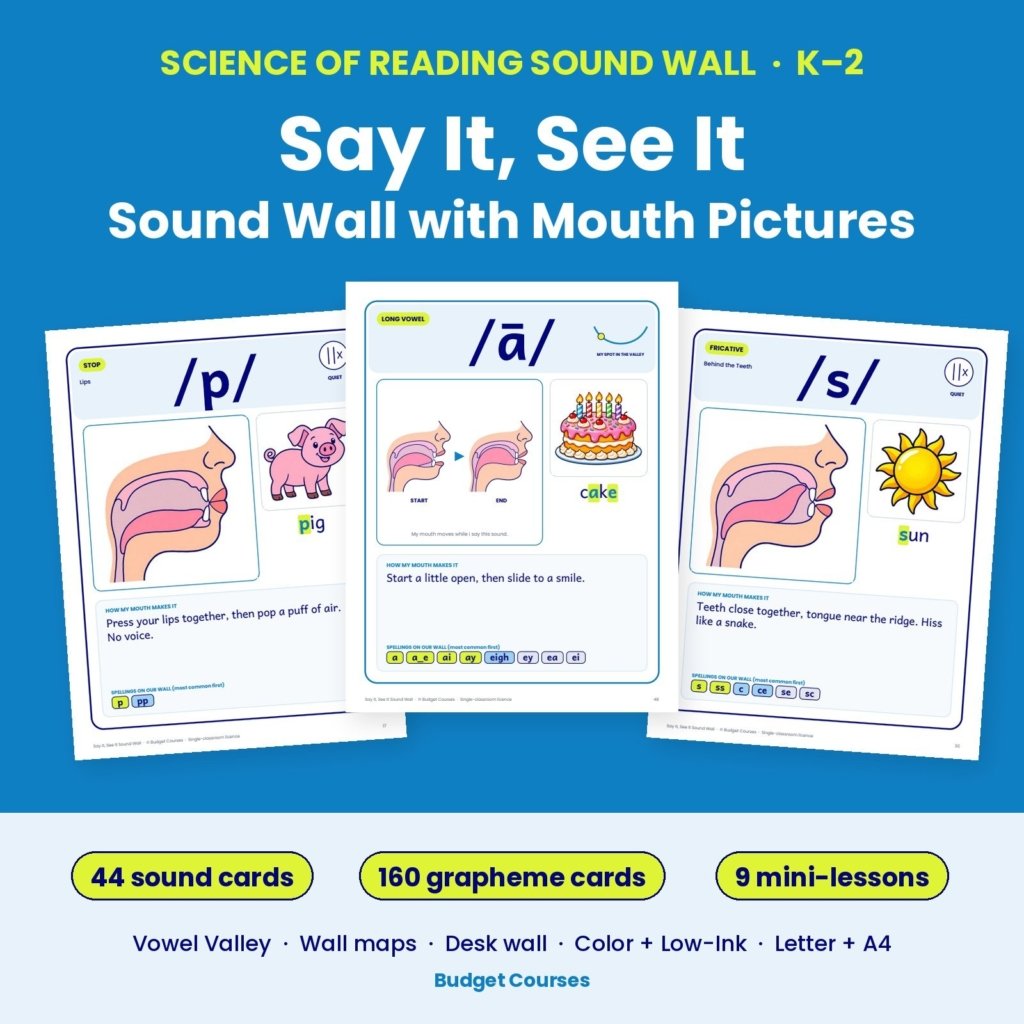
Looking for free sound wall printables you can put up this week? Good, because that’s exactly what this page gives you. Grab the free sampler below: three consonant cards with mouth pictures (/p/, /b/ and /m/), the Vowel Valley banner, two vowel cards, their grapheme cards and a student self-check page. Then keep reading for a plain-English guide to setting up a sound wall in a kindergarten, 1st grade or 2nd grade classroom.
Short version first. A sound wall is not a decoration. It’s a tool kids touch, point at and talk about every day. If it only gets looked at during phonics, it’s wallpaper.
Want all 44 sounds, not just 5?
The Say It, See It Sound Wall has every consonant and vowel card with mouth pictures, 160 grapheme cards, wall maps, 9 mini-lessons and a student desk wall.
Download the Free Sound Wall Printables
Pop in your email and the PDF downloads straight away. It prints on US Letter paper in full color. Print the sound cards on cardstock if you can; they last longer and look sharper on the wall.

Free Sound Wall Printables Sampler (PDF)
Start Here guide, sound wall overview, /p/ /b/ /m/ mouth-picture cards, the Vowel Valley banner, /ă/ and /ē/ vowel cards, 18 grapheme cards and a student self-check page. US Letter, color.
Want everything unlocked?
The free file is a sample. The full version has every page, tab and feature, plus the user guide.
See the full versionWhat’s in the free sound wall sampler
- Start Here guide with quick setup steps and a printing guide
- Sound wall overview page showing all 44 sounds, so you can see where your five fit
- 3 consonant sound cards with mouth pictures: /p/ pig, /b/ bat and /m/ mop
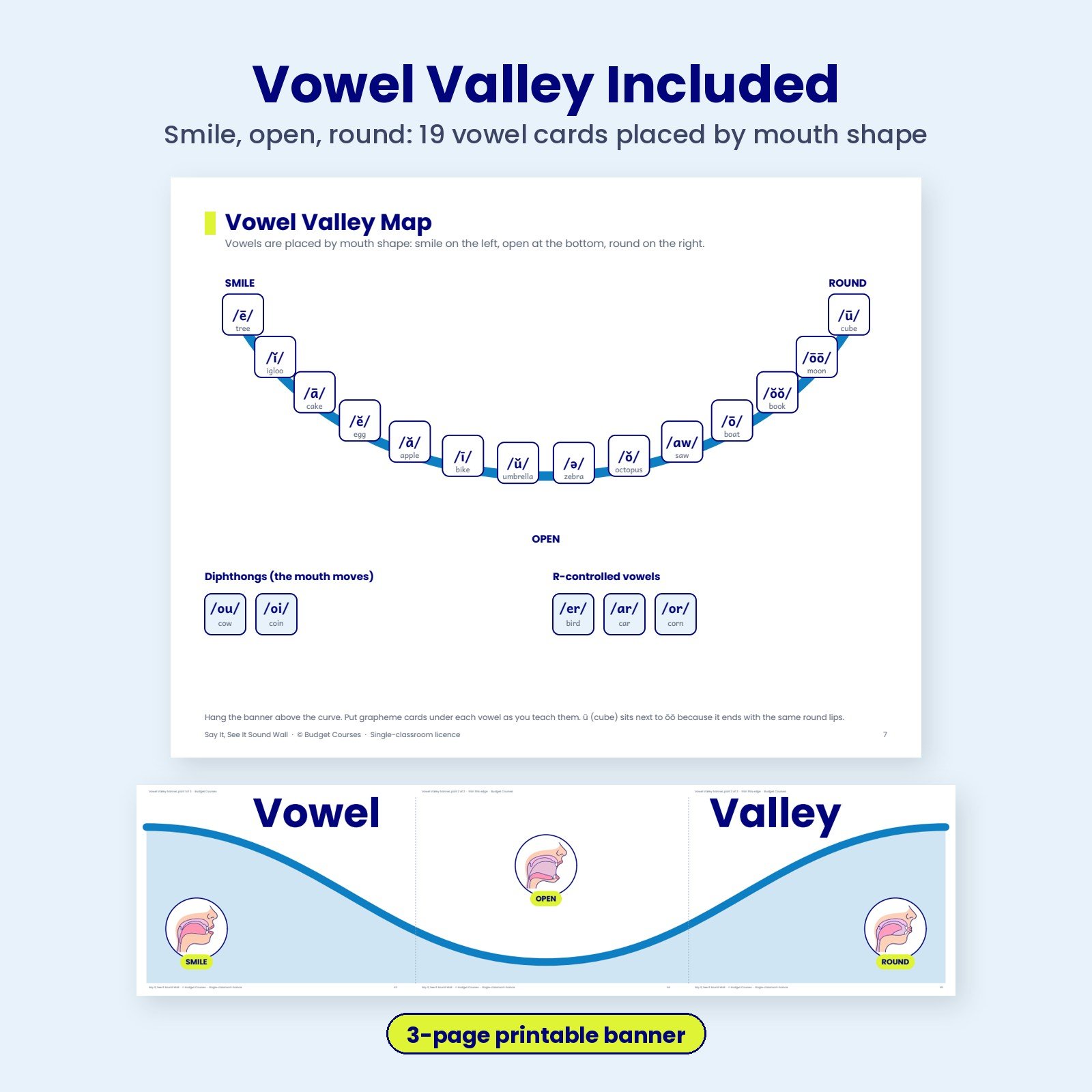
- Vowel Valley banner (three landscape pages you tape together)
- 2 vowel cards: short /ă/ (apple) and long /ē/ (tree)
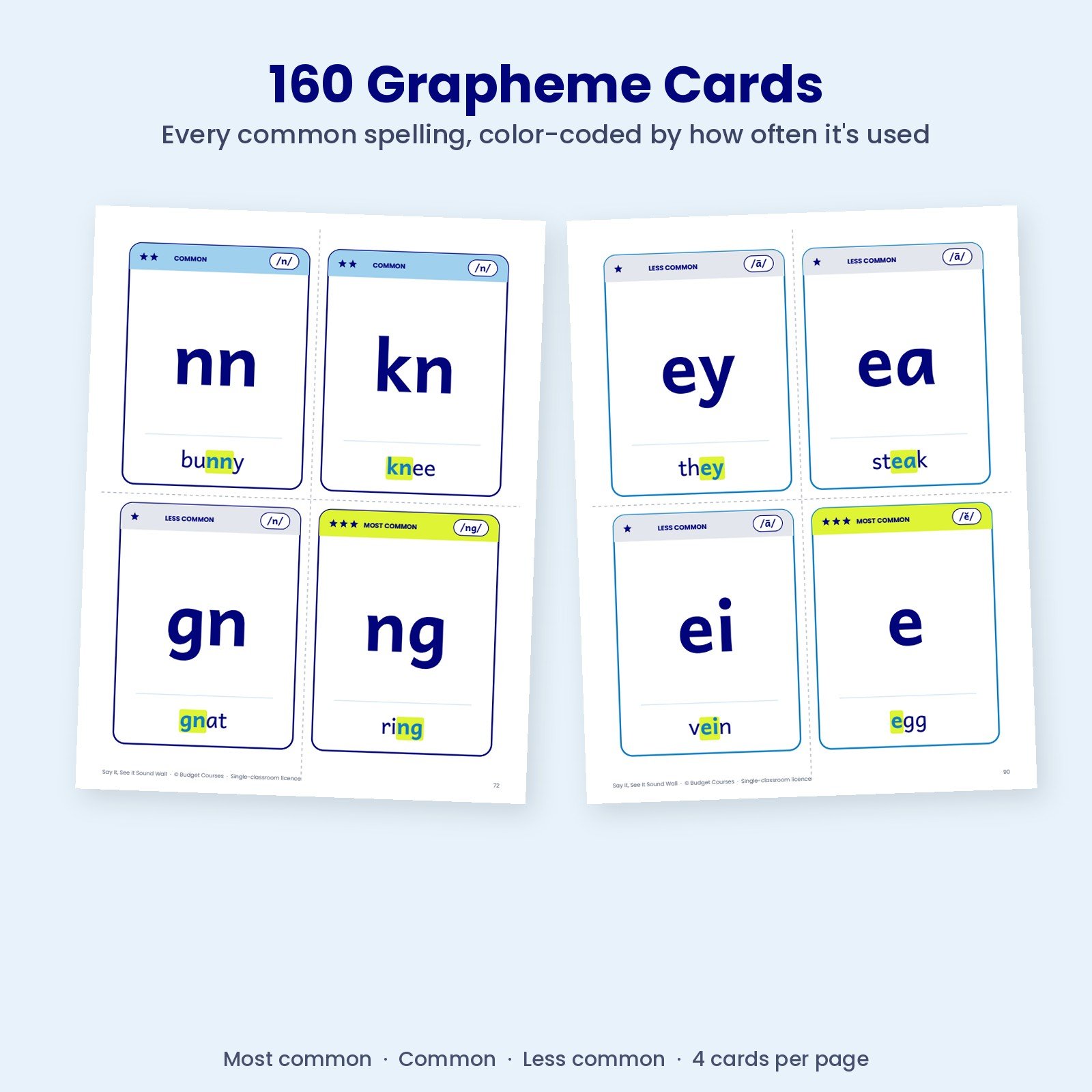
- 18 grapheme cards for those five sounds, color-coded by how common each spelling is
- “How Does My Mouth Move?” student self-check page
That’s about a tenth of the full set. It’s plenty to test the format with your class before you commit to a whole wall.
What is a sound wall, and how is it different from a word wall?
A word wall sorts words by their first letter. A to Z. It works fine once a child can already spell, but it asks beginners to start with the one thing they don’t know yet: the letters.
A sound wall starts somewhere kids are already strong. Speech. Every sound gets a card, and the cards are grouped by how the mouth makes them. A child who wants to write “cake” says /k/, feels the back of the tongue lift, finds /k/ on the wall and looks underneath. There they see c, k, ck, ch and que. The yellow card, the most common one, is the best first guess.
That shift matters because English spelling is messy. The 26 letters have to cover about 44 sounds. A sound wall shows that mess in an organized way instead of hiding it.
Why the mouth pictures matter so much
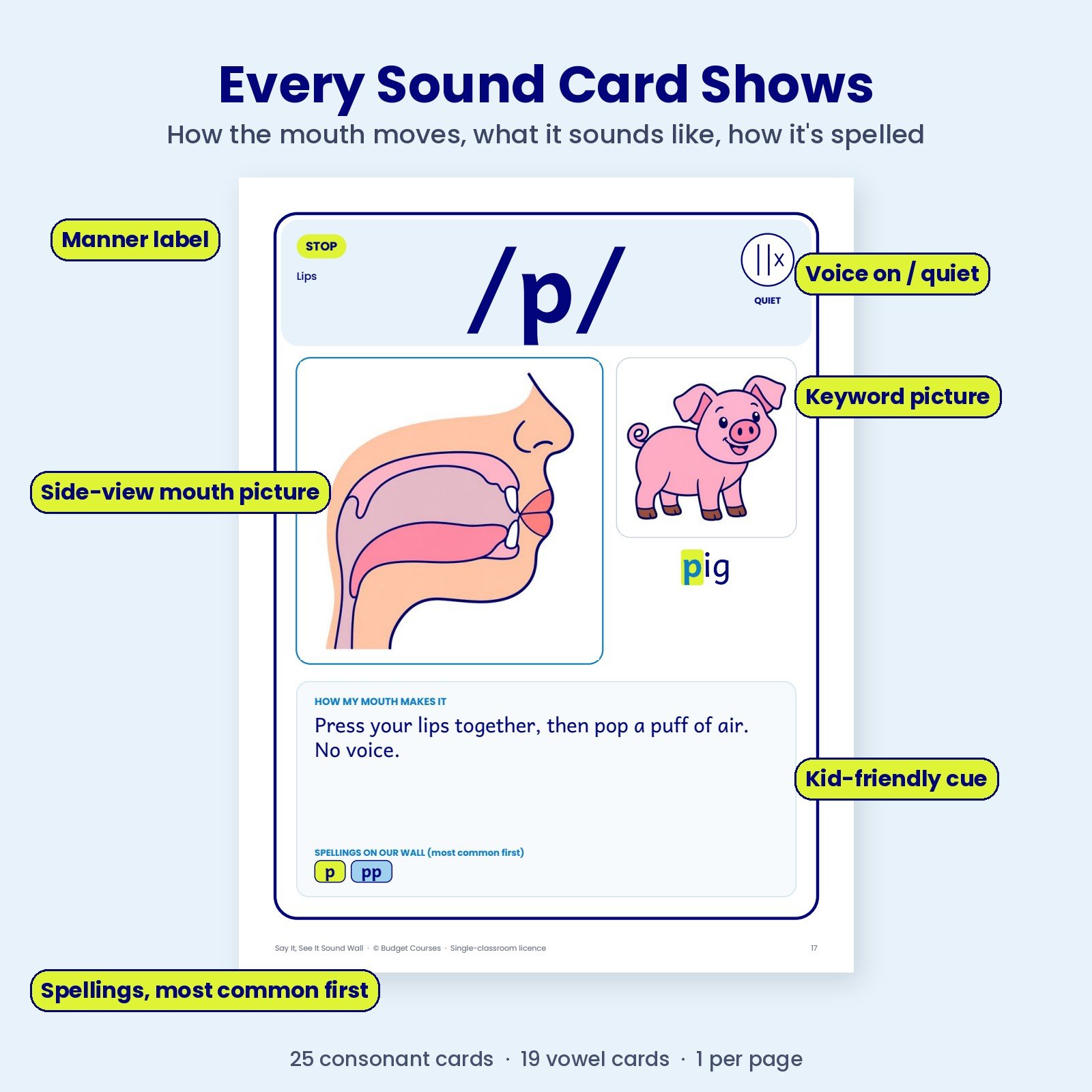
Young kids can’t see their own tongue. A side-view mouth picture shows them. Lips pressed together for /p/. Top teeth resting on the bottom lip for /f/. Tongue tip peeking between the teeth for /th/. Once they can picture it, they can copy it in a mirror, and once they can feel it, they can tell /f/ from /th/ when they write.
Good mouth pictures follow three rules:
- Same view every time. Every card in our set uses one side profile, one color palette and one line weight. Kids stop decoding the drawing and start reading the mouth.
- Partners match. /p/ and /b/ look exactly the same, because they are. The only difference is the voice, and the voice icon on the card shows that.
- Only what matters is shown. Lips, teeth, tongue, roof of the mouth. No faces, no photos, no clutter.
How to set up a sound wall in your classroom
You don’t need a huge wall. Plenty of teachers use the side of a filing cabinet, a whiteboard edge or a trifold board. Here’s the order that works.
1. Split the space in two
Consonants go on one side. Vowels go on the other, in the Vowel Valley. Keep them apart. Vowels behave differently and kids should feel that difference.
2. Lay out the consonant wall by manner and place
Across the top, hang the six manner headers: stops, nasals, fricatives, affricates, glides and liquids. Down the side, hang the place headers, from the lips at the top to the throat at the bottom. Each sound card goes where its manner and place meet. So /p/ sits under Stops, in the Lips row. /k/ sits under Stops, in the Back of the Mouth row.
Put quiet sounds and their voiced partners side by side: /p/ next to /b/, /t/ next to /d/, /f/ next to /v/. That one choice turns your wall into a voicing lesson.
3. Hang the Vowel Valley
Tape the banner into a long curve. Big smile on the left (/ē/ as in tree), mouth wide open at the bottom (/ŏ/ as in octopus), round lips on the right (/ōō/ as in moon). Every vowel card goes on the valley in that order. Diphthongs (/ou/, /oi/) and r-controlled vowels (/er/, /ar/, /or/) get their own little rows underneath.
4. Leave room underneath every card
Grapheme cards go below each sound. You’ll add more all year. A sound with one spelling, like /v/, needs very little space. /ā/ needs a lot. Plan for it now.
5. Only hang what you’ve taught
Empty headers are fine. A wall that grows in front of the kids gets used far more than one that appears overnight, fully stocked, in August.
Skip the cutting-and-guessing stage
The full Say It, See It Sound Wall comes with a consonant wall map, a Vowel Valley map and every header, so you know where all 44 cards go before you pick up the tape.
Sound wall kindergarten tips: introducing it in the first few weeks
Kindergarteners need the routine more than the wall. Start with the lips, because they can see them.
- Week 1: /p/, /b/ and /m/. Mirrors out every day. Hold a tissue in front of your mouth for /p/ and watch it move.
- Week 2: /t/ and /d/, then /k/ and /g/. Talk about the tongue “tapping” and “lifting”.
- Week 3: stretchy sounds like /f/, /s/ and /sh/. Kids love hissing like snakes and shushing the room.
- From there: follow your phonics program. UFLI, Fundations, Heggerty and similar programs already teach sounds in a sensible order, so let the wall follow them.
For 1st and 2nd grade, the sound wall classroom routine shifts toward spelling. Kids already know most sounds. What they need is the habit of checking the wall for the most likely spelling before they guess.
A 5-minute routine: Feel it, See it, Say it, Spell it
Use this every time you add a sound. It takes five minutes, tops.
- Feel it. Hand on the throat. “Is your voice on or off?” Hand in front of the mouth. “Does the air pop or flow?” Pinch the nose for nasal sounds and watch them stop.
- See it. Mirrors up. Compare your mouth with the mouth picture on the card.
- Say it. The sound three times, then the keyword. /f/ /f/ /f/, fish.
- Spell it. Show the grapheme cards underneath. Write the most common spelling first, in the air, then on paper.
Teachers who do this daily for a month usually notice something odd. Kids start stopping mid-word during writing, mouthing a sound, and glancing at the wall. That’s the whole point.
Common sound wall mistakes (and easy fixes)
- Putting everything up at once. It looks impressive and nobody uses it. Add cards as you teach them.
- Sorting vowels A to Z. That’s a word wall habit. Vowels belong on the valley, by mouth shape.
- Using photos of real mouths. They vary too much. One consistent illustrated style is easier for kids to read.
- Hanging it too high. If kids can’t touch it, they won’t. Keep the grapheme cards at eye level for your shortest student.
- Never pointing at it. Model it out loud: “I hear /k/ at the start of cake. Let me check the wall. Most of the time it’s c.”
What the paid version adds
The free sampler gives you five sounds. The complete Say It, See It Sound Wall gives you the whole thing:
- All 44 illustrated sound cards: 25 consonants and 19 vowels, every one with a side-view mouth picture and keyword picture
- 160 grapheme cards, color-coded most common, common and less common
- 6 manner section headers and 7 place row headers
- Consonant wall map and Vowel Valley map showing exactly where each card goes
- A teacher guide with a 6-week rollout plan and weekly routine
- 9 scripted mini-lessons, each with a cut-and-glue sound sort and answer key
- A student desk sound wall on one page, plus a 2-page take-home folder
- 8 mirror-work cue cards
- Editable fillable cards for extra sounds and spellings
- US Letter and A4, each in color and low-ink versions, plus a Word user guide
Ready for the full wall?
44 sound cards with mouth pictures, 160 grapheme cards, wall maps, lessons and student tools. Print it tonight.
Sound wall printables FAQ
Are these sound wall printables really free?
Yes. Enter your email and the sampler downloads. No payment details, no trial.
What grade is this sound wall for?
Kindergarten to 2nd grade mostly. Reading interventionists also use it with older kids who missed early phonics.
Does it work with UFLI or Fundations?
Yes. It uses the standard 44 phonemes and common spellings, so you can hang cards in the same order your program teaches them.
What is a vowel valley?
A way of arranging vowel cards by mouth shape. It starts with a smile (/ē/), drops to wide open (/ŏ/) and climbs back up to round lips (/ōō/). Drawn out, it looks like a valley.
Do I need the mouth pictures, or can I just use letters?
You can use letters, but the mouth pictures are what make a sound wall a sound wall. They connect what kids hear to what they feel, and that’s what helps spelling stick.
Can I print the sampler in black and white?
The free file is color, but it prints fine in grayscale. The full set includes dedicated low-ink versions of every page.
