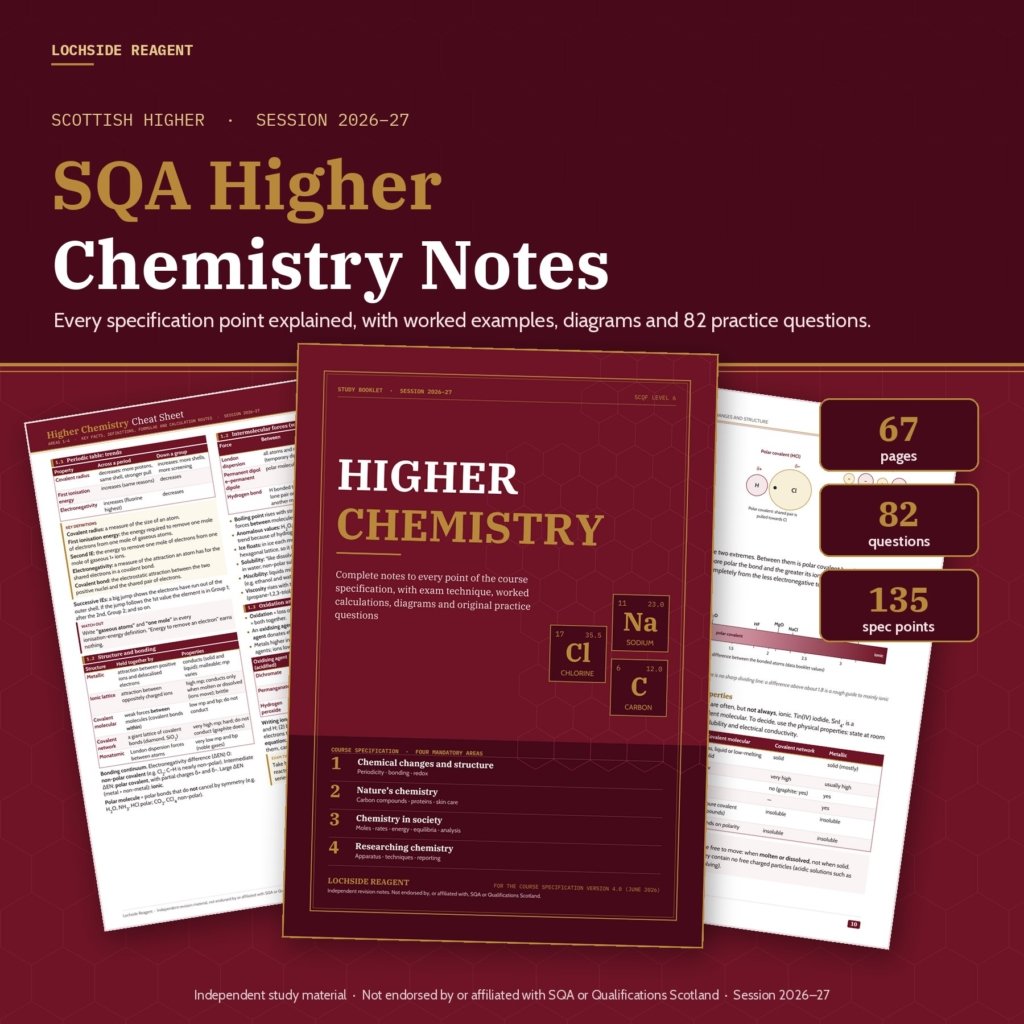
Higher Chemistry rewards pupils who understand why things happen and can say it precisely. If you are preparing for the Scottish Higher in session 2026-27, this guide explains what the exam looks like, what is tested, and how to revise it in a way that actually sticks. Use the free sample below to see how our notes are laid out.
Free SQA Higher Chemistry Revision Notes Sample (PDF)
A nine-page extract from the complete notes: cover, contents, three pages on structure and bonding, a cheat-sheet page and practice questions with mark-scheme answers.
Want everything unlocked?
The free file is a sample. The full version has every page, tab and feature, plus the user guide.
See the full versionWhat is Higher Chemistry?
Higher Chemistry is a Scottish Credit and Qualifications Framework (SCQF) level 6 course, usually studied in S5 or S6. It builds on National 5 Chemistry and is a common requirement for university courses in medicine, dentistry, veterinary science, pharmacy, biological sciences, chemistry and engineering. The qualification is now administered by Qualifications Scotland, which took over the awarding functions that SQA previously carried out, so you will see both names on older and newer materials.
The four areas of the course
| Area | Main ideas |
|---|---|
| 1. Chemical changes and structure | Periodic table trends, bonding and structure, intermolecular forces, oxidising and reducing agents |
| 2. Nature’s chemistry | Organic chemistry: alcohols, acids, esters, fats and oils, soaps, proteins, oxidation, terpenes, free radicals |
| 3. Chemistry in society | Calculations, yield, atom economy, rates, enthalpy, equilibrium, chromatography, titrations |
| 4. Researching chemistry | Apparatus, practical techniques, reporting experimental work, the assignment |
How the exam works in 2026-27
From session 2026-27 the two papers used in earlier years are replaced by a single question paper. The course assessment has two parts:
- Question paper: 100 marks in 2 hours 30 minutes. Section 1 is an objective (multiple-choice) test worth 20 marks. Section 2 is worth 80 marks of restricted and extended response questions.
- Assignment: an individual piece of investigative work marked out of 20 and scaled to 25. You collect your own data and write a report under supervision.
A data booklet is provided in the exam. It contains values such as electronegativities, ionisation energies, bond enthalpies and the electrochemical series, plus relevant formulae. Learn how to use it quickly; you do not need to memorise the numbers. Because arrangements can change, always check the current course specification and your teacher’s guidance. Older past papers are still very useful for practice on the content, but remember that their layout is different.
What examiners are testing
Most marks reward knowledge and understanding: definitions, structures, reactions and explanations. The rest reward skills: handling data, drawing conclusions, evaluating procedures and applying chemistry in unfamiliar situations. In practice that means:
- Writing precise definitions (for example, first ionisation energy needs “one mole”, “gaseous atoms” and “electrons”).
- Explaining trends and properties with the right chain of reasoning: structure, then bonding, then property.
- Calculating accurately and showing every step, with units.
- Naming, drawing and recognising organic compounds and their reactions.
- Describing experiments, drawing apparatus and evaluating results.
A step-by-step revision method
- Start with the specification. List every point and rate your confidence as red, amber or green. This turns “revise chemistry” into a manageable list.
- Learn actively. Read a section, close the page, and write down everything you can recall. Then fix the gaps in a different colour.
- Practise by topic. After each section, answer questions on that topic only, and mark them strictly against a mark scheme.
- Space it out. Return to each topic a week later and again a month later. Spaced recall beats re-reading.
- Move to mixed, timed practice. In the final weeks, do whole sets of questions in exam conditions, about 1.5 minutes per mark.
Revision timeline
| Time left | Focus |
|---|---|
| 8 weeks | One or two topics a week in specification order. Learn definitions and key structures. Start questions straight away. |
| 4 weeks | Weak topics first. Do calculation practice every other day. Draw potential energy diagrams, apparatus and structural formulae from memory. |
| 2 weeks | Timed question sets. Use a one-page summary of each Area. Revisit red and amber points. |
| Final week | Light, focused revision: definitions, common mistakes, formulae and the data booklet. Sleep and rest matter. |
Common mistakes that cost marks
- Boiling means breaking covalent bonds. It does not. When a molecular substance boils, the weak forces between molecules are overcome.
- Vague rate explanations. Saying “more collisions” for a temperature rise is not enough. More particles have energy greater than or equal to the activation energy.
- Equilibrium confusion. At dynamic equilibrium the concentrations are constant, not equal, and the forward and reverse rates are equal.
- Catalysts and yield. A catalyst speeds up reaching equilibrium but does not change its position.
- Wrong average titre. Average only the concordant titres, which agree to within 0.2 cm³.
- Heating the wrong mass. In the enthalpy calculation the mass is the water heated, in kilograms.
- Tertiary alcohols. They are not oxidised by acidified dichromate or hot copper(II) oxide.
- Charge errors in ion-electron equations. Always check atoms and charge on both sides.
Exam technique in the room
Do the 20 objective marks first, aiming for about 25 minutes. For written questions, read the mark allocation and give one distinct, correct point per mark. In “explain” questions use the word “because” and link cause to effect. In calculations, set out the balanced equation, the moles, the ratio and the answer with units on separate lines so that you can pick up method marks even if the final answer is wrong. Attempt the open-ended questions: they are marked on the quality of the chemistry in your answer as a whole, and a sensible partial answer can still earn marks.
Revising the assignment
The assignment is completed with your school, but a little preparation helps. Choose an investigation with a clear measurable outcome, take enough repeat readings, present your results in a table with units, and draw a graph with a line of best fit where appropriate. Your evaluation should say what limited the reliability of your results and how you would improve them. Your teacher will explain the exact rules and how much support is allowed.
How our notes help
The Lochside Reagent SQA Higher Chemistry revision notes follow the specification in order. All 135 numbered points are tagged in the margin and listed in a checklist, so you can see what you have covered. The 67-page booklet includes worked examples for every calculation type, 36 figures, exam tips, 82 original practice questions with full answers, a glossary and a timing plan. The set also includes a four-page Cheat Sheet and a User Guide with printable 8-week and 2-week plans. You can see the full details on the product page.
Frequently asked questions
When is the Higher Chemistry exam?
Higher exams take place in the spring and early summer exam diet. Dates are published each year by Qualifications Scotland, so check the official timetable and your school calendar.
How is Higher Chemistry graded?
Your grade, A to D, is based on your combined marks from the question paper and the scaled assignment. Your teacher can explain the grade boundaries as they apply to your year.
Do I need to learn the data booklet?
No, but you need to know what is in it and how to use it. Practise finding values and formulae quickly, and always use the values in your own copy.
Can I use older past papers?
Yes, they are good practice for the content and for exam-style wording. Be aware that the paper structure for 2026-27 is different, with a single paper instead of two.
Is the free sample the full course?
No. It is a short extract so you can judge the layout and style. The full set covers the whole specification.
Lochside Reagent materials are independent and are not endorsed by, or affiliated with, SQA or Qualifications Scotland. Always check the current course specification and assessment arrangements on the awarding body’s website.
