
Higher English can feel like three subjects in one: reading unseen non-fiction, analysing a Scottish text and writing an argued critical essay. This guide explains what the exam asks, how marks are awarded and how to revise each part, with a free sample at the end of the introduction.
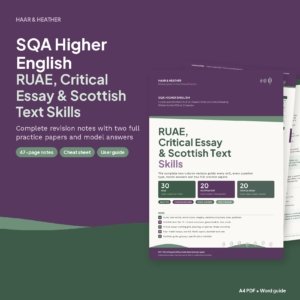
Free SQA Higher English Revision Notes Sample (PDF)
A 10-page extract: cover, contents, RUAE word choice, imagery and sentence structure pages, a cheat sheet page and practice questions with answers.
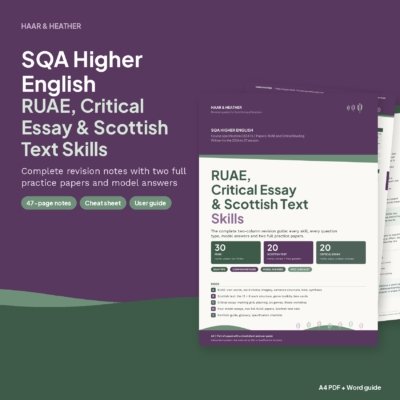
Want everything unlocked?
The free file is a sample. The full version has every page, tab and feature, plus the user guide.
See the full versionIf you want every skill, two full practice papers and model essays in one place, see the complete Higher English notes.
The structure of Higher English
The course (SQA code C824 76) is assessed through two exam papers, a writing portfolio and a spoken language performance. The grade, from A to D, comes from 100 marks plus achieving the spoken language component.
| Component | Marks | Time | Weight |
|---|---|---|---|
| RUAE paper | 30 | 1 hour 30 minutes | 30% |
| Critical Reading paper | 40 | 1 hour 45 minutes | 40% |
| Portfolio (writing) | 15, scaled to 30 | Draft in class, up to 4 hours | 30% |
| Spoken language | Pass or fail | Untimed | Compulsory |
Paper 1: Reading for Understanding, Analysis and Evaluation
You read two unseen non-fiction passages on a linked theme. In the published specimen, passage 1 has eight questions worth 25 marks and the final question, worth 5 marks, uses both passages. Question types fall into three groups.
- Understanding: identify or explain ideas in your own words. Copying key words from the passage earns nothing.
- Analysis: explain how word choice, imagery, sentence structure and tone create meaning. Four-mark questions are marked as 2 + 2, 2 + 1 + 1 or 1 + 1 + 1 + 1.
- Synthesis: identify three areas on which the writers agree, with evidence from both passages.
How analysis marks work
A detailed or insightful comment with a quotation or reference earns 2 marks, a basic comment earns 1, and a quotation with no comment earns 0. So the key habit is simple: quote one precise word, say what it suggests, and link that to the writer’s idea.
Common RUAE mistakes
- Lifting words from the passage in own-words questions
- Naming a technique (“this is a metaphor”) without explaining its effect
- Commenting on whole sentences instead of one or two words
- Writing about differences in the final question instead of agreement
- Answering one half of a two-part question, such as imagery but not sentence structure
Paper 2: Critical Reading
Section 1: Scottish text (20 marks)
You answer on one text from drama, prose or poetry. According to SQA’s June 2026 notice, the initial analysis questions carry 12 marks and the final question carries 8: up to 2 marks for the point of commonality, 2 for the extract and 4 for the rest of the text. Check the SQA website for the latest position, particularly if you are using older past papers where the final question was worth 10.
The best preparation is to know the whole text, not just a few quotations. Build a profile of key concerns, key moments, techniques and the ending. Examiners comment that pre-learned answers which ignore the question score poorly.
Section 2: Critical essay (20 marks)
You choose one question from a range covering drama, prose fiction, prose non-fiction, poetry, film and television drama and language. The genre must be different from your Scottish text, and you cannot use the same text twice. The essay is marked holistically on knowledge and understanding, analysis and evaluation, with technical accuracy expected. Many essays land in the middle bands because they retell the story or list quotations. To move up, build a line of argument, analyse techniques and judge how well the text achieves its purpose.
How to revise: an eight-week timeline
- Weeks 1 and 2: practise own-words answers, word choice and imagery on short passages from quality journalism.
- Week 3: sentence structure and tone. Write one analysis paragraph a day.
- Week 4: the final synthesis question, then a full timed RUAE paper.
- Weeks 5 and 6: Scottish text. Build your text profile and plan final-question answers around five themes.
- Week 7: two timed critical essays in two genres. Mark them against the grid.
- Week 8: weakest areas, quick recall quizzes, one timed paper of each type.
Revision habits that work
- Time everything. Both papers are won or lost on pace.
- Keep a mistake log. Write one line for every lost mark and review it weekly.
- Plan essays. Five minutes of planning prevents drifting from the question.
- Read widely. Newspaper columns and magazine features are ideal RUAE practice.
- Practise retrieval. Close the book and write what you remember.
Command words and what they mean
Questions tell you what to do, so underline the command word and the focus. Identify means name or state briefly. Explain means show cause and effect, giving the reason as well as the fact. Analyse means identify language features and discuss how they relate to the ideas of the text. Evaluate means make a judgement about how effective something is and justify it. Many lost marks come from missing the focus, for example analysing language when the question asks about the writer’s tone.
A simple annotation routine for unseen passages
- Read the headline and first paragraph to find the main idea.
- Note the writer’s purpose and attitude in the margin.
- Box the turning points: but, however, yet, although.
- Underline striking words and mark punctuation or sentence features.
- Read the questions, then return to the lines named in each one.
Practise this on a newspaper column every few days. Within a fortnight the routine becomes automatic, and you will spot features faster under exam pressure.
Frequently asked questions
Do I need to learn quotations?
Quotations are not required for the Scottish text final question; accurate reference and analysis can earn full credit. Short, precise quotations are still the clearest way to analyse language.
How long should a critical essay be?
There is no fixed length. In about 45 minutes, many strong essays run to roughly 700 to 1,100 words, but depth matters more than length.
Can I write on a poem in both sections?
No. The genres must differ, so if you answer on poetry in Section 1, choose another genre for the essay.
What is a good timing plan for RUAE?
Try about 10 minutes reading, around 2.4 minutes per mark for questions 1 to 8, and 15 minutes for the final question. Adjust after timed practice.
Does the portfolio count a lot?
Yes: it is worth 30% of the grade, so give it proper redrafting time.
Ready to go further? Get the full Higher English notes with practice papers, model answers, a cheat sheet and a specification checklist.
Independent guidance, not endorsed by SQA or Qualifications Scotland. SQA is a registered trade mark of the Scottish Qualifications Authority.
