The STAAR Algebra I end-of-course test is 50 questions. It does not care how you feel about math. It cares whether you can read a problem, pick the right tool, and avoid a silly slip. Here is what is on it, how the points are spread out, and a plan to get ready. There is also a free chapter from our notes at the end of the first section.
What the Test Is Built From
| Fact | Detail |
|---|---|
| Questions | 50 |
| Total points | 59 |
| 1-point questions | 41 |
| 2-point questions | 9, not multiple choice |
Most questions are multiple choice. Others ask you to type a number, choose more than one answer, or work with a graph. The 2-point items are the non-multiple-choice ones, so practice them.
Your result lands in one of four levels: Did Not Meet, Approaches, Meets, or Masters Grade Level. Your school or district can tell you what each level means for you.
Want to see how our notes teach the basics? Grab the free chapter first. It covers the blueprint, the attack plan, and how to use a calculator.

Free STAAR Algebra I EOC Notes: Chapter 1 Sample (PDF)
The opening chapter: test blueprint, five reporting categories, your attack plan, and how to use the calculator.

Want everything unlocked?
The free file is a sample. The full version has every page, tab and feature, plus the user guide.
See the full versionThe Five Reporting Categories
| Category | Topic | Questions |
|---|---|---|
| 1 | Number and Algebraic Methods | 9 to 11 |
| 2 | Describing and Graphing Linear Functions, Equations, and Inequalities | 10 to 12 |
| 3 | Writing and Solving Linear Functions, Equations, and Inequalities | 12 to 14 |
| 4 | Quadratic Functions and Equations | 9 to 11 |
| 5 | Exponential Functions and Equations | 5 to 7 |
Add up Categories 2 and 3 and you see that lines and linear thinking are about half the test. Quadratics take another big chunk, and exponentials take the smallest slice. Readiness standards, the biggest skills of the course, account for roughly 55 to 70 percent of the points.
What to Study in Each Category
Category 1: Number and Algebraic Methods
Expect polynomial work, factoring, radicals, exponent laws, and function ideas such as domain, range, and sequences. Factoring trinomials is a Readiness skill, so practice it until it is automatic. For x^2 + bx + c, find two numbers that multiply to c and add to b. For a leading coefficient other than 1, use the ac method and group.
Category 2: Describing and Graphing Linear Functions
Know slope as rate of change, how to graph a line, how to graph inequalities, and how to read a scatterplot. In a story, slope is the rate and the y-intercept is the starting value. For inequalities, use a dashed line for strict signs and a solid line for “or equal to,” then test a point.
Category 3: Writing and Solving Linear Functions
This is the biggest category. You will write equations from tables, graphs, and stories, solve equations and inequalities, and solve systems. Choose substitution when a variable is alone and elimination when the equations line up in standard form. Always check the ordered pair in both equations.
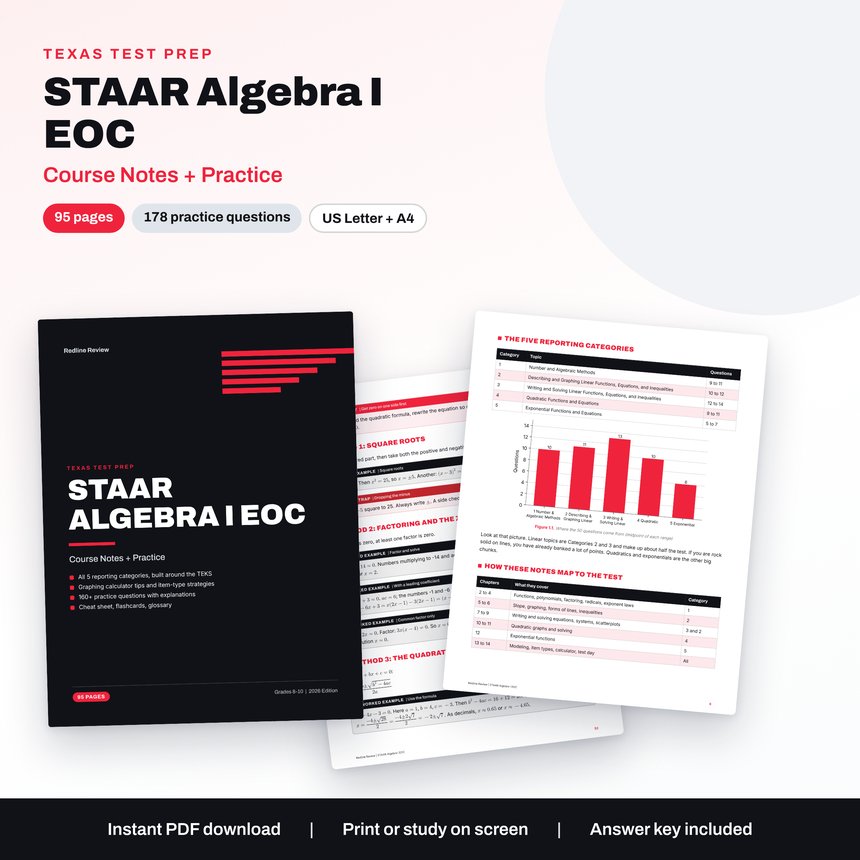
Full version
Isolate It: Texas STAAR Algebra I EOC Complete Exam Notes
- All 5 reporting categories explained
- 178 practice questions with explanations
- 40-question practice test
Category 4: Quadratic Functions and Equations
Know the parts of a parabola: vertex, axis of symmetry, zeros, and y-intercept. Use x = -b/(2a) to find the axis. Solve quadratics by factoring, square roots, or the quadratic formula. Watch the sign trap in vertex form: (x – 3)^2 shifts the graph right, not left.
Category 5: Exponential Functions and Equations
Learn the form y = a(b)^x. The value a is the start, and b is the growth or decay factor. A 6 percent increase has factor 1.06. A 15 percent decrease has factor 0.85. In a table, constant ratios mean exponential, and constant differences mean linear.
A Simple 8-Week Study Plan
| Week | Focus |
|---|---|
| 1 | The test, functions, domain, and range |
| 2 | Polynomials, factoring, and exponent laws |
| 3 | Slope, graphing, and writing linear equations |
| 4 | Solving equations, inequalities, and systems |
| 5 | Scatterplots and lines of best fit; start quadratics |
| 6 | Quadratic graphs and solving; exponentials |
| 7 | Word problems, item types, and mixed practice |
| 8 | Full practice test, mistake list, cheat sheet |
Study four or five days a week for 30 to 45 minutes. Do each skill by hand first, then check it with your graphing calculator. After every quiz, write down why each miss happened: careless, concept, or misread. That mistake list tells you exactly what to fix.
Want every chapter, not just the sample?
Isolate It: Texas STAAR Algebra I EOC Complete Exam Notes gives you all 5 reporting categories explained, plus the answer key and cheat sheet.
Common Mistakes to Avoid
- Answering the wrong question. You solve for x, but the question asks for 2x + 1. Circle the target first.
- Forgetting to flip the sign. Dividing or multiplying an inequality by a negative reverses it.
- Dropping a sign when subtracting polynomials. Change every term, not just the first.
- Giving only half of a system. The solution is an ordered pair.
- Ignoring rounding instructions. Typed answers must follow the rule exactly.
- Not practicing with the calculator. Use the same model you will use on test day.
Reading Word Problems Without Losing Points
Word problems are where many students lose easy points. A short routine fixes most of it. Read the problem once for the story and once for the question. Underline the thing they want. Write what each variable means, such as t for hours and C for cost. Then decide which kind of model fits. A flat fee plus a rate is linear. A launched object or an area is quadratic. A percent growth or decay is exponential.
Next, build the equation and solve it. Finally, check that the answer makes sense. Time cannot be negative, a count of people must be a whole number, and a price should not be a million dollars. That last check takes five seconds and catches the silliest mistakes.
Using a Calculator Wisely
Texas allows a graphing calculator on the Algebra I EOC, and a reference sheet is provided. Check with your school about the calculator you will use. Good uses include finding the intersection of two lines, the zeros and vertex of a parabola, and the line of best fit for a data set. Do not use it as a crutch for factoring or simple arithmetic. If you cannot see your graph, the window is probably the problem.
How to Use Your Free Chapter
Read the chapter once, then answer the nine questions at the end without looking. Read every explanation, even for questions you got right. Then write down your test date and count backward to see how many weeks you have. A simple plan beats a big one you never follow.
Test-Week Checklist
- Take one full practice test at least a week before the exam and score it honestly.
- Sort every miss by chapter and by reason, then reteach the two weakest chapters.
- Redo missed questions without notes two days later.
- Gather your approved calculator, fresh batteries, and anything else your school lets you bring.
- Sleep well, eat breakfast, and arrive early. A calm start protects the points you already know how to earn.
Frequently Asked Questions
How many questions are on the STAAR Algebra I EOC?
There are 50 questions worth 59 points in all.
Can I use a calculator?
Yes, a graphing calculator is allowed on the Algebra I EOC. Ask your school which models are permitted.
What topics matter most?
Linear functions and equations make up about half the test, and Readiness standards carry roughly 55 to 70 percent of the points. Start with factoring, writing and graphing lines, systems, graphing quadratics, and writing exponential models.
Is STAAR going away?
Texas passed a law in 2025 that replaces STAAR with new tests beginning in the 2027-28 school year, and Algebra I is still tested. The Algebra I math you learn now stays the same.
How long should I study?
Eight weeks at 30 to 45 minutes a day, four or five days a week, is a good plan for many students. Take a practice test first to see where you stand.
Where to Go from Here
If you like the free chapter, the full Isolate It notes cover every reporting category in 14 chapters: 178 practice questions with explanations, a 40-question practice test, a cheat sheet, 55 flashcards, and a glossary. Work through them in order, keep your mistake list, and walk into the test with a plan.
