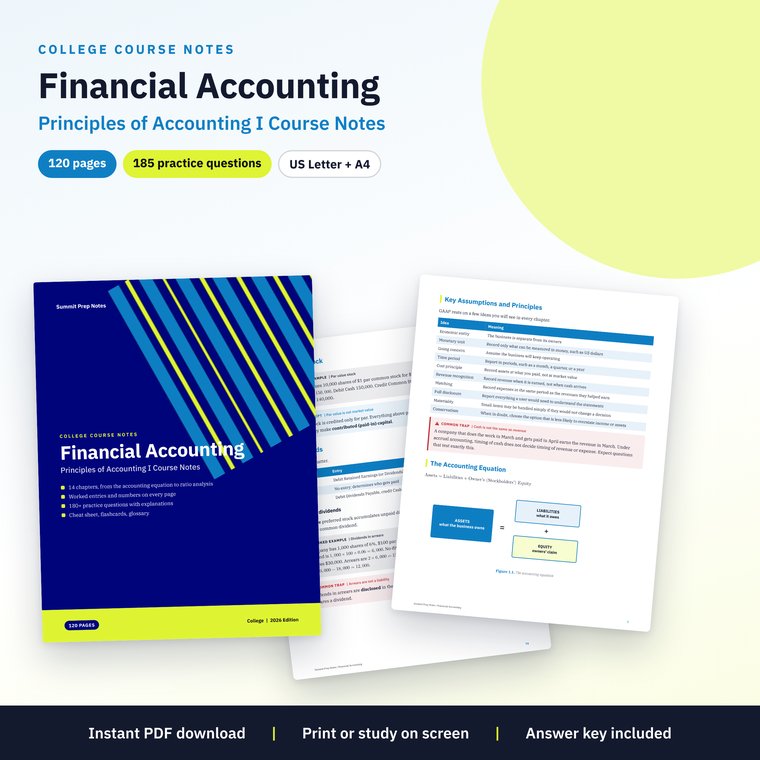


A Financial Accounting Study Guide for the Whole First Semester
Trial Balance is a complete financial accounting study guide for students in Principles of Accounting I. It follows the standard textbook sequence, from the accounting equation to ratio analysis, and shows every journal entry, schedule, and formula with real numbers so you can see exactly how each topic works.
The tone is a steady coach. Each chapter gives you the rule, a worked example, a strategy note, and a quiz. By the end you can analyze a transaction, adjust the books, build the statements, and read the results.
Who It Is For
- College students taking Financial Accounting or Principles of Accounting I
- Students who feel lost in a long textbook and want a clearer second explanation
- Students preparing for midterms and finals who need practice with explained answers
- Tutors and self-learners who want a structured review of the standard course
What the Course Covers
Courses differ in emphasis, so match the chapters to your syllabus. This guide covers the topics most first-semester courses include.
| Area | Topics |
|---|---|
| Foundations | GAAP, assumptions, the accounting equation, financial statements |
| The cycle | Debits and credits, journals, ledgers, trial balance, adjusting entries, closing |
| Merchandising | Purchases, sales, discounts, freight, multi-step income statement |
| Assets | Inventory methods, cash controls, bank reconciliation, receivables, plant assets |
| Liabilities | Payroll, warranties, contingencies, bonds, notes |
| Equity | Stock, dividends, treasury stock, retained earnings |
| Reporting | Statement of cash flows, ratios, horizontal and vertical analysis |
What Is Inside
Fourteen chapters
- Accounting Foundations
- Analyzing and Recording Transactions
- Adjusting Entries and the Accrual Basis
- Financial Statements and the Closing Process
- Merchandising Operations
- Inventory and Cost of Goods Sold
- Cash and Internal Control
- Receivables and Bad Debts
- Plant Assets, Natural Resources, and Intangibles
- Current Liabilities and Payroll
- Long-Term Liabilities: Bonds and Notes
- Stockholders’ Equity
- The Statement of Cash Flows
- Financial Statement Analysis
Built-in practice and review
- 185 practice questions in total, each with an explanation
- Ten questions at the end of every chapter
- A 45-question practice exam that mixes every chapter
- A last-minute cheat sheet with formulas and entries
- 54 flashcards and a glossary with more than 90 terms
- 18 diagrams, including the accounting cycle, T-account, bank reconciliation, and cost flow charts
Main Benefits
One company, the full cycle. Chapters 2 to 4 follow worked examples from the first transaction through the adjusted trial balance, the four statements, and the closing entries, so you see how the pieces fit.
Numbers you can follow. Depreciation tables, FIFO and LIFO comparisons, bank reconciliations, and cash flow statements are all worked out line by line.
Trap boxes for common mistakes. Contra accounts, dividends versus expenses, the direction of discounts and premiums, and cash flow signs are called out where students slip.
Strategy notes. Short coaching tips explain how to approach each type of problem on an exam.
Ratio analysis made simple. Chapter 14 groups every ratio under five questions: liquidity, efficiency, profitability, solvency, and market.
Files You Receive
- Complete study notes as a PDF in US Letter size
- The same notes as a PDF in A4 size
- A printable cheat sheet PDF
- A DOCX user guide with a study plan and tips
Any PDF reader opens the notes. The DOCX guide opens in Word or Google Docs.
How It Works
- Buy and download the files instantly after checkout.
- Read Chapter 1, then follow the chapters in order alongside your class.
- Write each worked entry by hand before reading the answer.
- Take each chapter quiz without notes, then read every explanation.
- Before an exam, take the practice exam and review with the cheat sheet and flashcards.
Printing and Customizing
Print the whole guide or only the pages you need. On screen you can highlight, annotate, and add notes. Please keep the files for your own use.
Digital Download Information
This is a digital product. Nothing is shipped. You get instant access to the files after your purchase, and you can download them again as often as you like.
Good Ways to Use This Guide
- During the semester: read each chapter after the matching class and do the quiz that week.
- Before a midterm or final: take the practice exam, review every explanation, and drill the flashcards.
- When you are stuck on entries: go back to Chapter 2 and redo the T-account exercises.
- Tutoring: use the quizzes as homework and the worked examples as a teaching script.
Frequently Asked Questions
Does this match my textbook?
It follows the standard first-semester sequence. Instructors and books vary, so match the chapters to your syllabus.
Is it US GAAP?
Yes. It teaches the US GAAP concepts used in introductory financial accounting courses.
Does it cover managerial accounting?
No. This guide is for financial accounting only.
Are the answers explained?
Yes. Every question has a short explanation in the Answer Key.
Do I need a calculator?
A basic calculator is enough for the practice questions.
Is it affiliated with a college or publisher?
No. This is an independent study resource and is not affiliated with or endorsed by any college, textbook publisher, or accounting standards body. Accounting standards and course requirements can change, so confirm details with your instructor.
Try a Free Sample First
Not sure yet? Download a free chapter of these Financial Accounting notes and see the layout, the diagrams and the practice questions for yourself.
This guide is an independent study resource. It is not affiliated with or endorsed by any college, textbook publisher, or accounting standards body.




Reviews
There are no reviews yet.