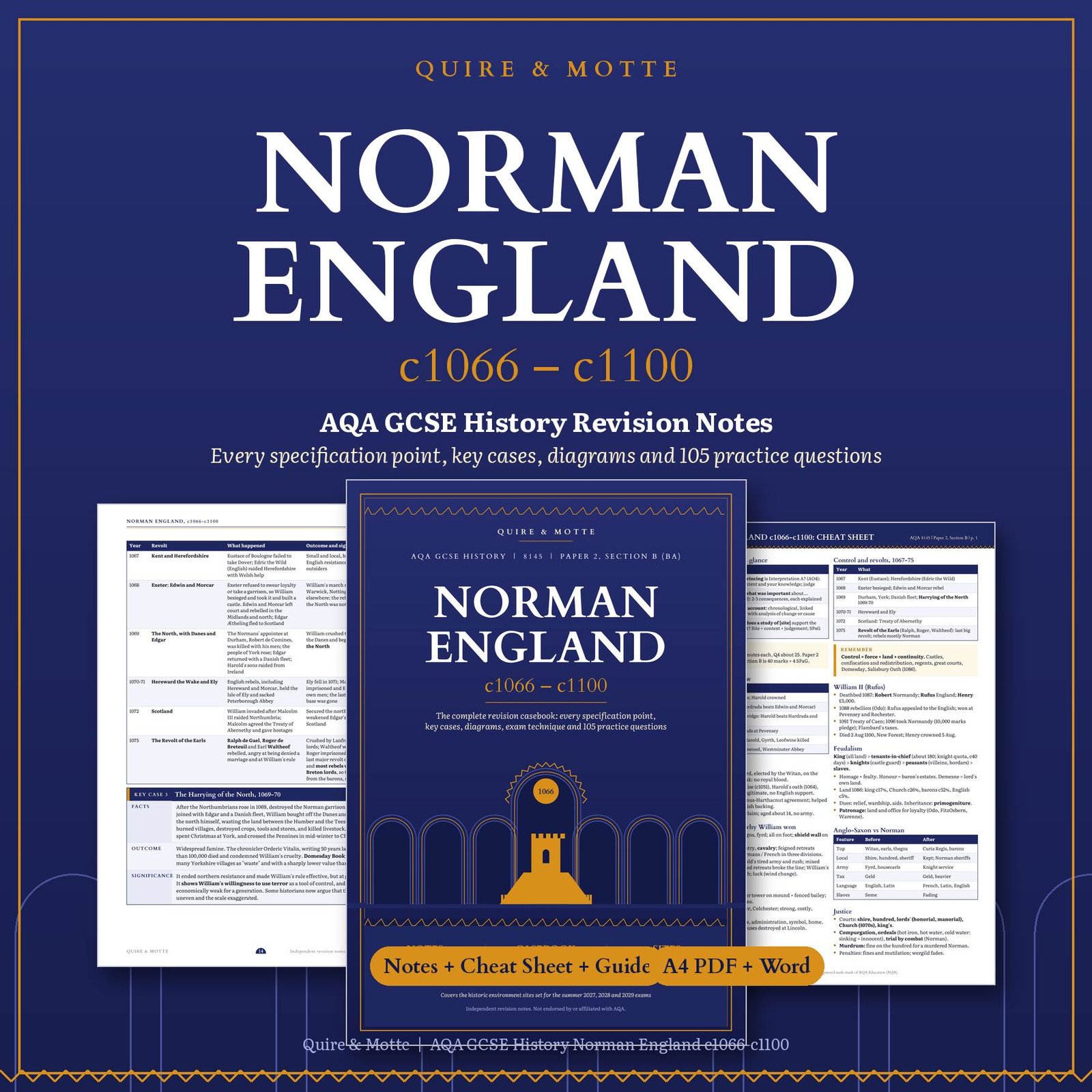



Norman England is a gift of a topic for students who revise it properly, and a trap for those who only skim it. Quire & Motte AQA GCSE History Norman England Revision Notes is a complete, casebook-style revision course for the AQA GCSE History (8145) option on Norman England, c1066-c1100. It takes you from the claimants to the throne in 1066 through to the Church, castles, Domesday Book and the historic environment, in the order of the specification, with every point explained in plain, accurate English.
Instead of long, undifferentiated chapters, the notes use a casebook method. Each key event or development is set out in a boxed case with three parts: the facts, the outcome and the significance. That is exactly how examiners expect you to think when you explain why something mattered, so the layout trains the skill as well as the knowledge.
What is covered
The notes follow the four parts of the Norman England option, and every content point in the specification is mapped to a page in the built-in checklist.
Part one: The Normans, conquest and control
- Anglo-Saxon England before 1066, the death of Edward the Confessor and the four claimants: Harold Godwinson, William of Normandy, Harald Hardrada and Edgar Aetheling
- Stamford Bridge, the march south and the Battle of Hastings, with a plan of the battlefield, the tactics of both sides and the reasons William won
- Castles, from motte-and-bailey to stone keeps, and their role in control of the country
- Revolts from 1068 to 1075, the Harrying of the North and the Revolt of the Earls, and how William dealt with each
- The reign of William II, including the quarrels with the barons and the Church
Part two: Life under the Normans
- Feudalism, landholding, patronage and military service, with a diagram of the feudal pyramid
- Government, the king’s household, law and order, and Norman justice
- The Domesday Book: why it was made, how it was compiled and what it tells us
- Towns, villages and the countryside, the Forest Laws and the changing position of the English
Part three: The Norman Church and monasticism
- Lanfranc and the reform of the English Church, church building and church courts
- Relations between Church and state, the Pope, William II and Anselm, and the Investiture Controversy
- Monastic life, learning and the move from English to Latin and French culture
Part four: The historic environment
- A site-study toolkit you can apply to any site, with the three sites named for the exam years covered: the Battle of Hastings (2027), the White Tower (2028) and Castle Acre Priory (2029)
What is included
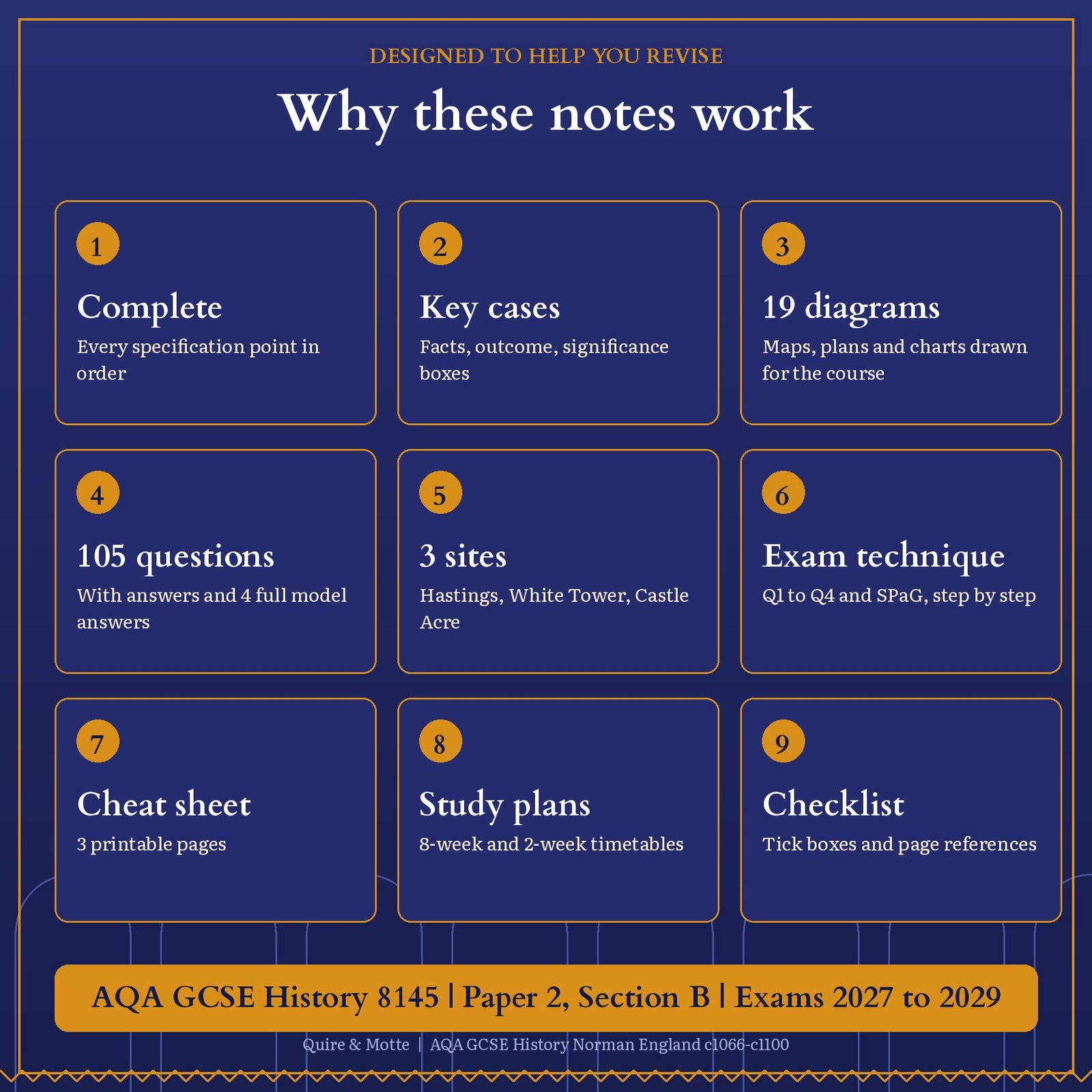
- Complete Notes (PDF, A4, 61 pages): every specification point, key case boxes, 19 diagrams, maps and charts, exam technique for all four question types, a timeline, a who’s who, a glossary and a specification checklist
- Cheat Sheet (PDF, 3 pages): a dense, printable summary of dates, claimants, battles, castles, revolts, feudalism and the Church for the final week
- User Guide (Word document): an eight-week plan, a two-week crash plan, printing tips, advice on using the checklist and a short FAQ
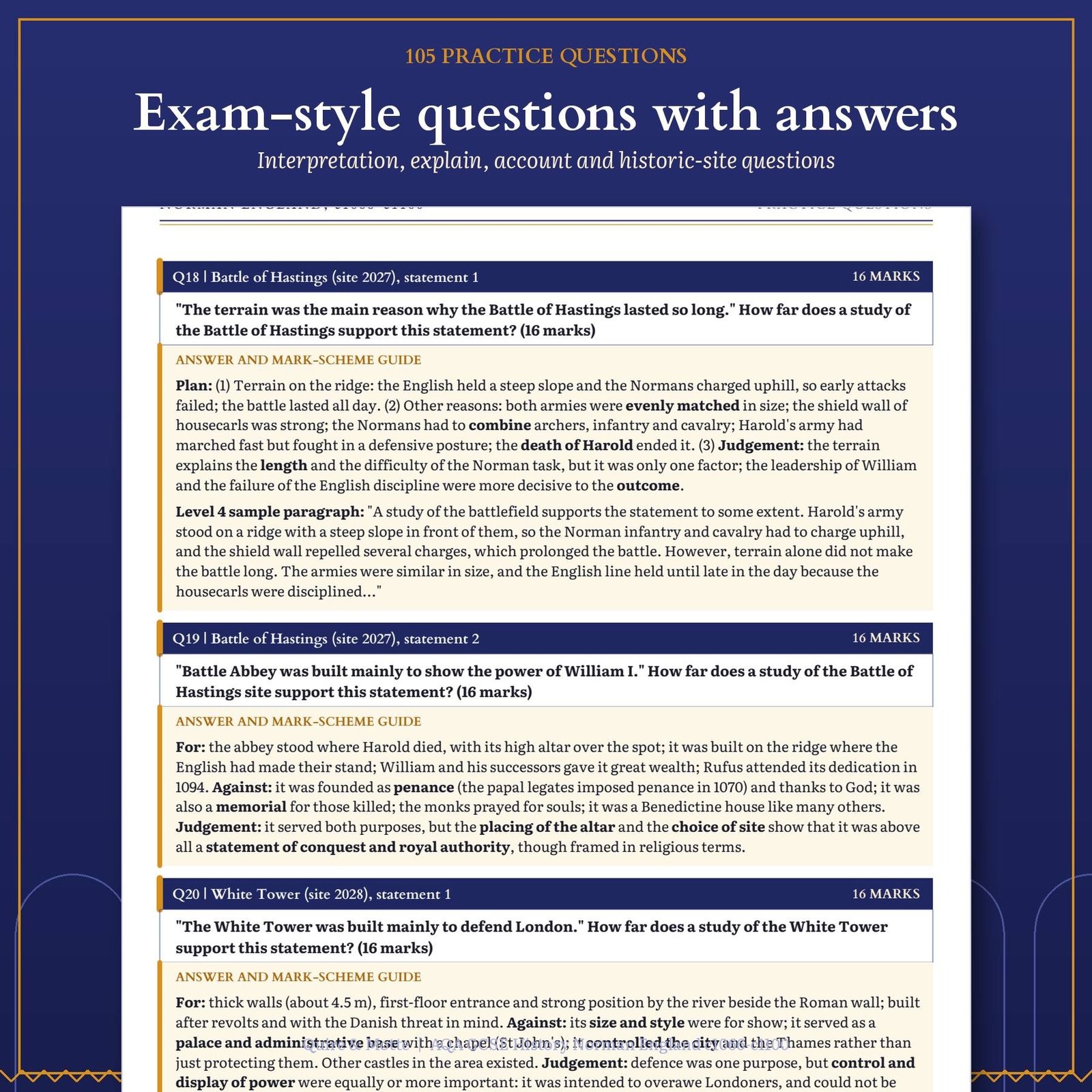
- 105 practice questions with answers: 80 quick-fire questions and 25 exam-style questions across the four question types, plus four extra full model answers
- Free sample: a short extract from the real notes is available from our website so you can check the style before you buy
Design and features
The notes are designed as an academic casebook, with serif type, small-caps headings and an indigo and amber palette that stays readable when printed. Key cases appear in boxes, and tips, common mistakes and mnemonics are called out so you can spot them at a glance. The 19 diagrams include a plan of the Battle of Hastings, the feudal pyramid, castle designs, a calendar of the revolts, the structure of the Church and a plan of the White Tower.
Uncertain figures are marked with words such as “about” and “estimates vary”, a habit worth copying in your own answers.
How to use it
- Read the exam overview and technique sections first, so you know what each question rewards.
- Work through the parts in order, reading one key case at a time and then covering the page and writing it from memory.
- Use the quick-fire questions to test recall, and the exam-style questions to practise full answers.
- Tick the specification checklist three times: once when you have read a point, once when you can recall it and once when you can use it in an answer.
- In the last week, switch to the cheat sheet and the timeline, and re-do any question you got wrong.
Who it is for
These notes suit Year 10 and Year 11 students taking AQA GCSE History with the Norman England option, students who have lost track of the detail in lessons, learners who want a clear route to higher grades, and parents or tutors who need a structured, accurate course to work from.
Frequently asked questions
Is this the right option for my class?
It covers Norman England, c1066-c1100, the British depth study (with the historic environment) that sits in Paper 2, Section B of AQA GCSE History (8145). Check with your teacher that this is the option your school has chosen.
Which historic environment sites are covered?
The site changes from year to year. The notes cover the Battle of Hastings for 2027, the White Tower for 2028 and Castle Acre Priory for 2029, along with a toolkit that works for any site.
Are these past papers?
No. All questions, answers and sources are original and written for this course. They follow the style and mark allocation of the real paper but are not taken from it.
Can I print the notes?
Yes. The PDFs are A4 and designed to print clearly in colour or in black and white. The User Guide gives printing tips, including how to print the cheat sheet double-sided.
Are the notes enough for a top grade?
They cover all of the specification content and the exam technique needed, but a top grade also depends on practice. Use the questions, ask your teacher to mark your longer answers, and keep returning to the checklist.
Disclaimer
AQA is a registered trade mark of AQA Education (AQA). This product is independent and is not endorsed by AQA, nor affiliated with or approved by it. It was written with reference to the published AQA GCSE History (8145) specification and covers the historic environment sites set for the summer 2027, 2028 and 2029 examinations. Always check the current specification and your teacher’s guidance for any changes.


Reviews
There are no reviews yet.