A Human Body Systems Unit for 4th, 5th and 6th Grade
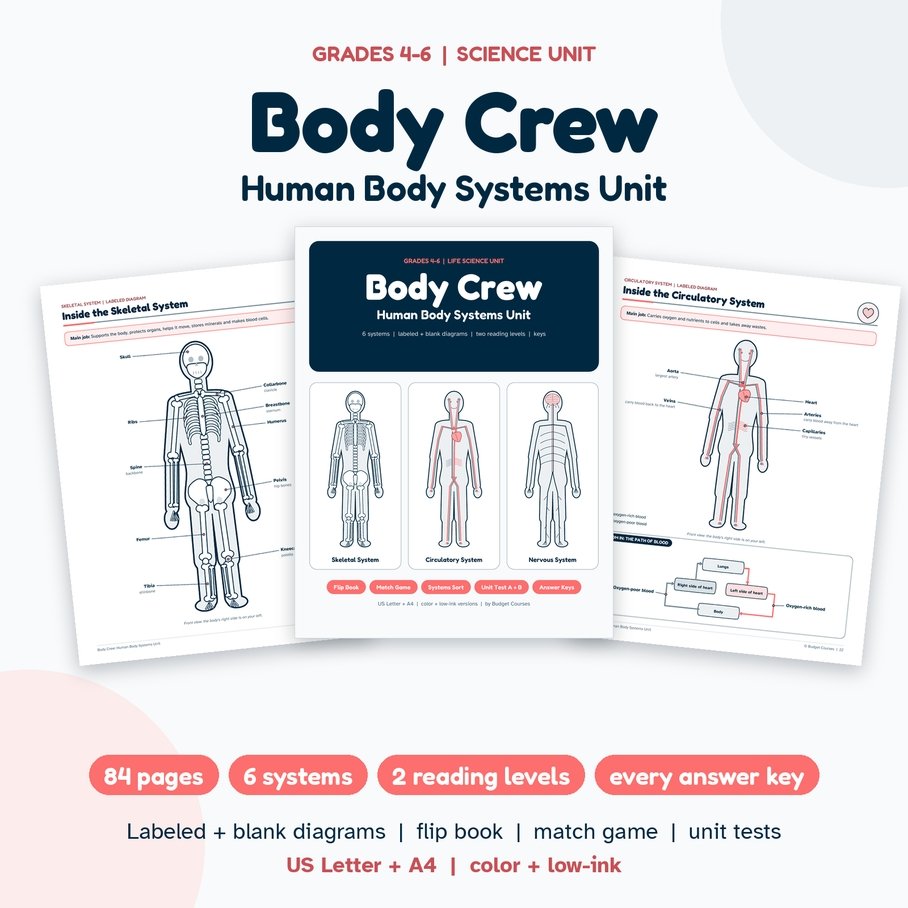
Body Crew is a ten-day human body systems unit that takes students from cells and tissues to the way six organ systems keep a body running. It covers the skeletal, muscular, circulatory, respiratory, digestive and nervous systems with two reading levels, clean labeled diagrams, a hands-on Pulse Lab, a layered flip book, review games and two versions of a unit test. All 84 pages print straight from the PDF, and every page students write on has an answer key.
The reproductive system is not included, so the unit fits elementary classrooms without permission letters.
What Your Students Will Learn
- How cells, tissues, organs and organ systems fit together
- The skeletal system: 206 adult bones, joints, ligaments, bone marrow and how bones protect organs
- The muscular system: skeletal, smooth and cardiac muscle, tendons, and why muscles work in opposing pairs
- The circulatory system: arteries, veins, capillaries, the four-chambered heart and the blood path heart, lungs, heart, body
- The respiratory system: the path of air, the diaphragm and gas exchange in the alveoli
- The digestive system: mechanical and chemical digestion, villi, and the jobs of the liver, gallbladder and pancreas
- The nervous system: brain, spinal cord, nerves, neurons, the cerebrum, cerebellum and brain stem, and reflexes
- How the systems work together, using real moments like running a race or catching a ball
What Is Included
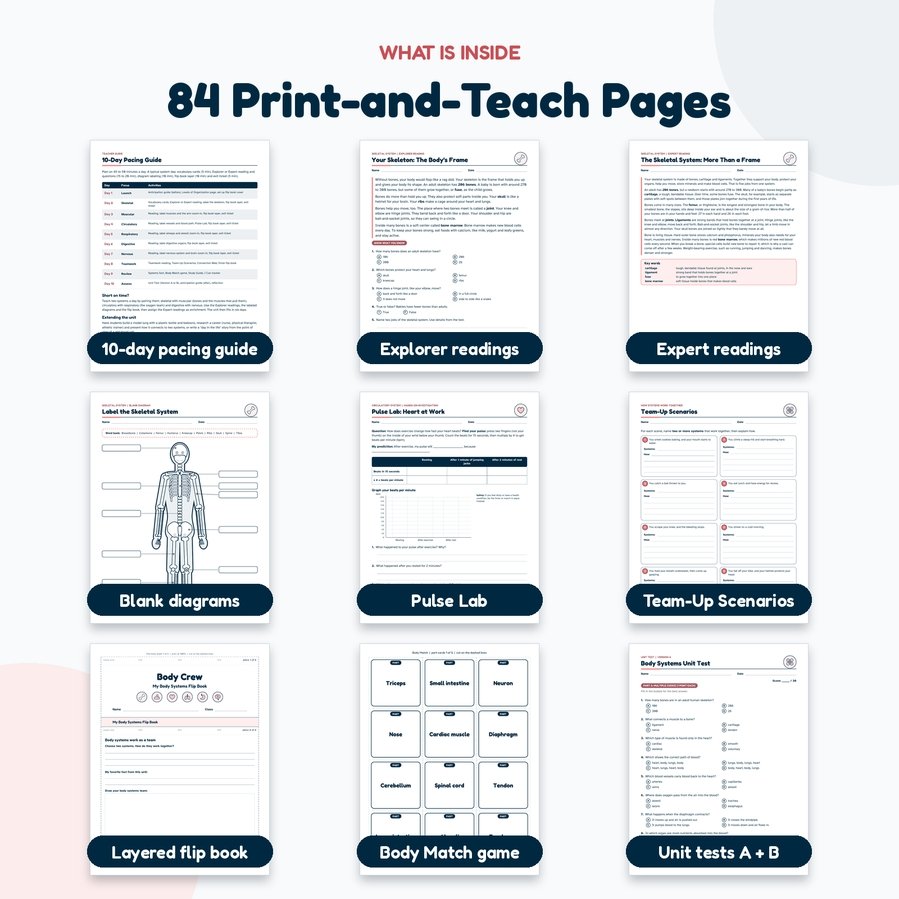
Teacher pages
- Welcome page, unit overview and standards connections (NGSS 4-LS1-1, 4-LS1-2, MS-LS1-3, MS-LS1-8 and CCSS informational reading)
- 10-day pacing guide with a 6-day option
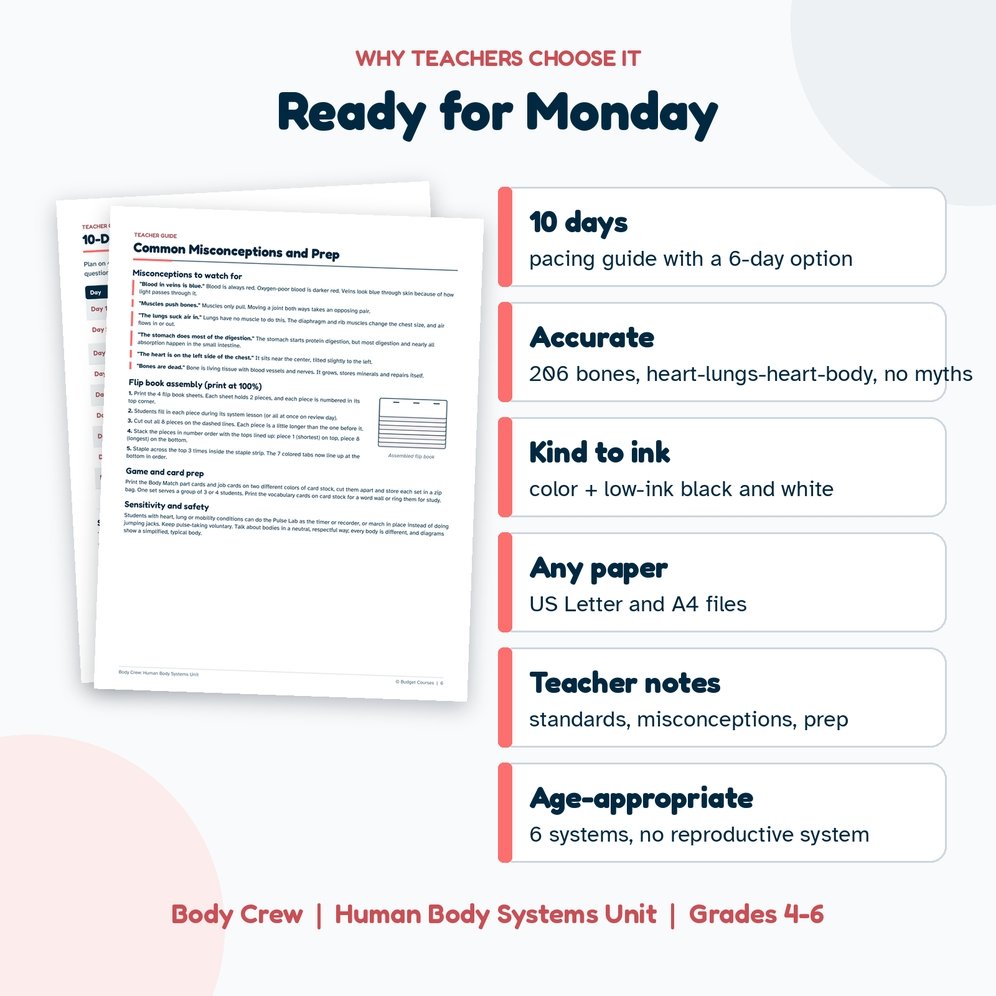
- Common misconceptions (blood in veins is blue, muscles push, the lungs suck air in) with clear corrections
- Flip book assembly steps, card prep tips and sensitivity notes
Student pages
- Anticipation guide (Body Myth or Fact?) to use before and after the unit
- Levels of Organization page with a staircase diagram and practice
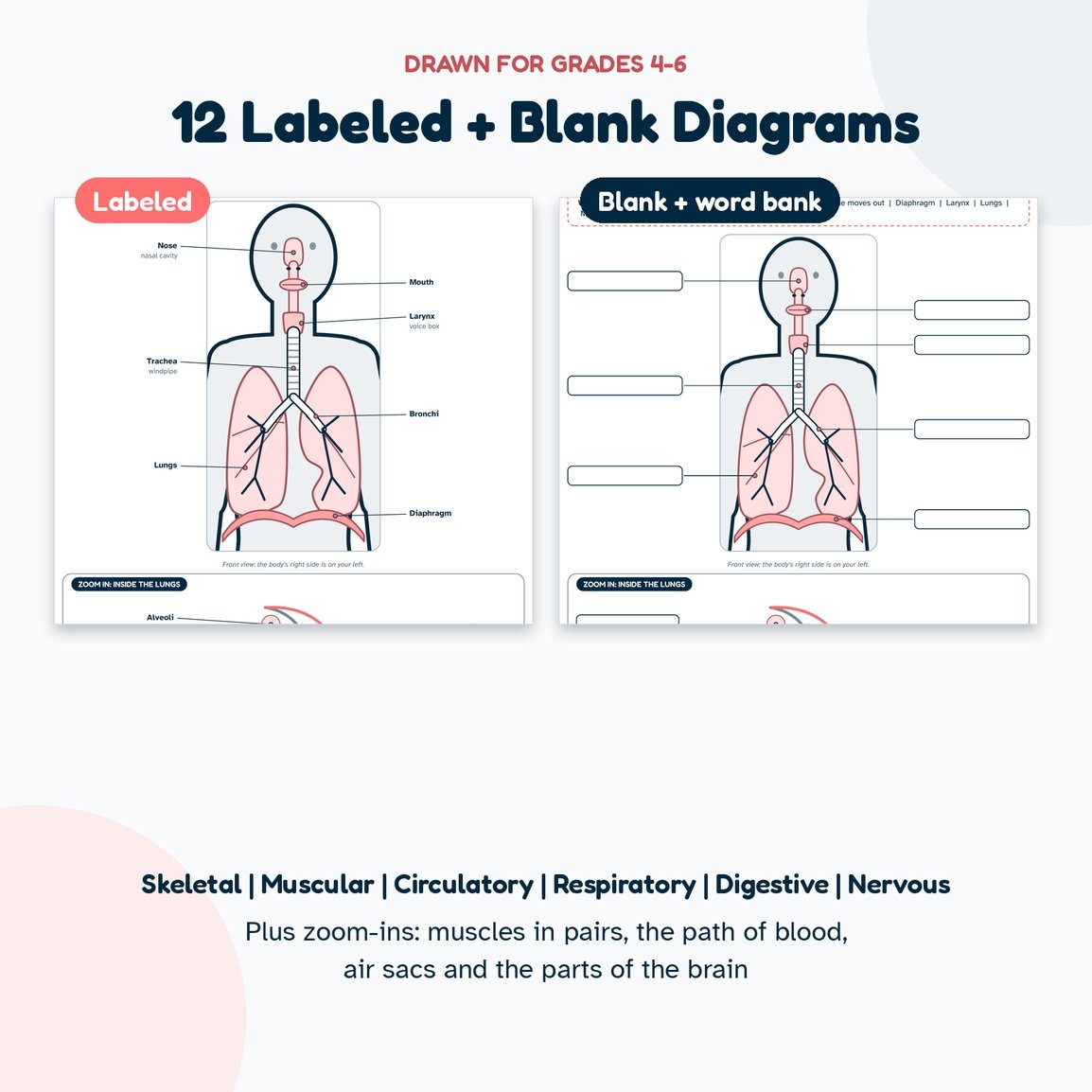
- For each of the 6 systems: an Explorer reading with questions, an Expert reading with a key words box, Expert questions with a challenge, a labeled diagram and a blank diagram with a word bank
- Zoom-in insets: muscles working in pairs, the path of blood, the air sacs in the lungs and the parts of the brain
- Pulse Lab with a data table and bar graph
- Teamwork Inside You reading, 8 Team-Up Scenarios and a Connection Web
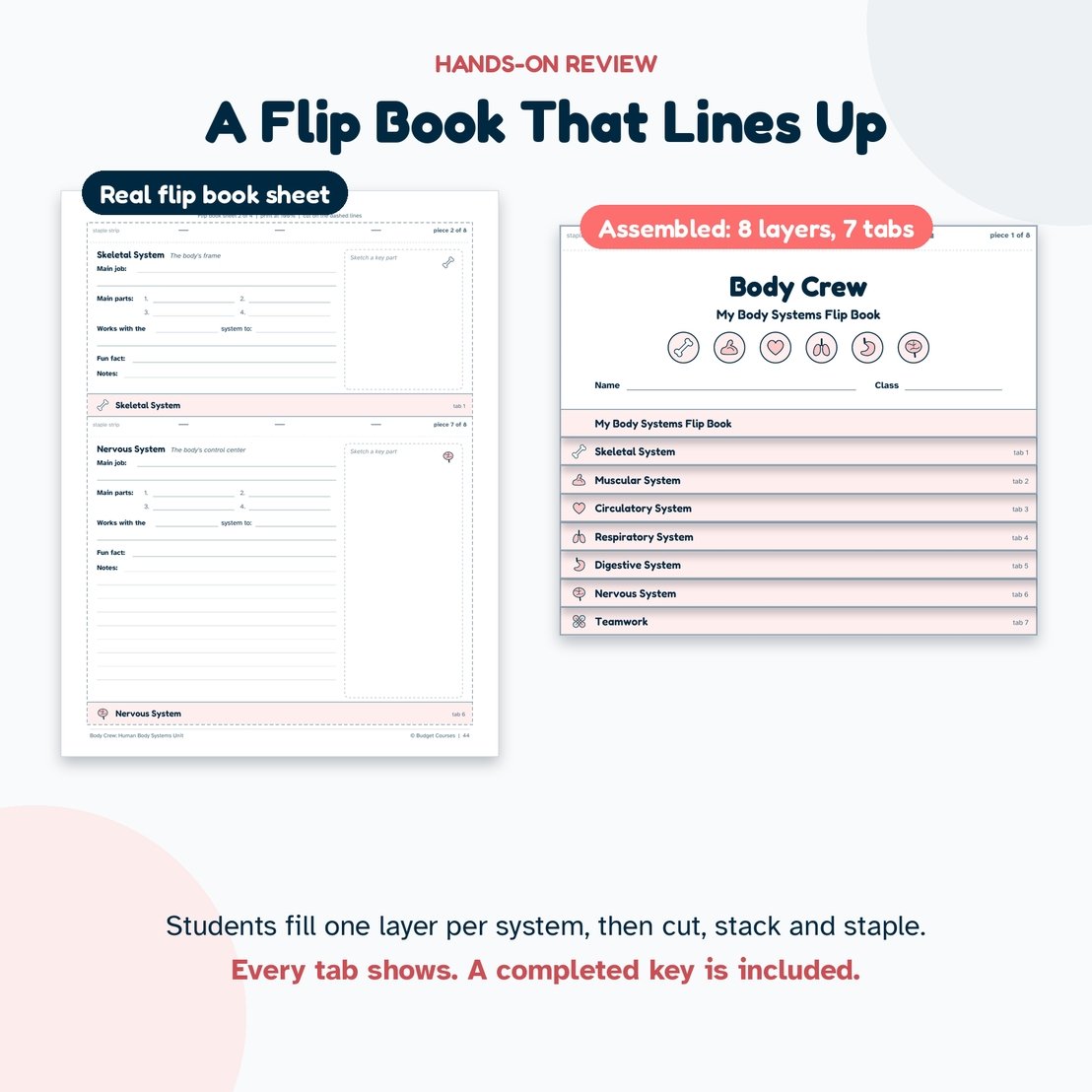
- Layered flip book: 8 pieces on 4 sheets, with tabs that line up when stacked
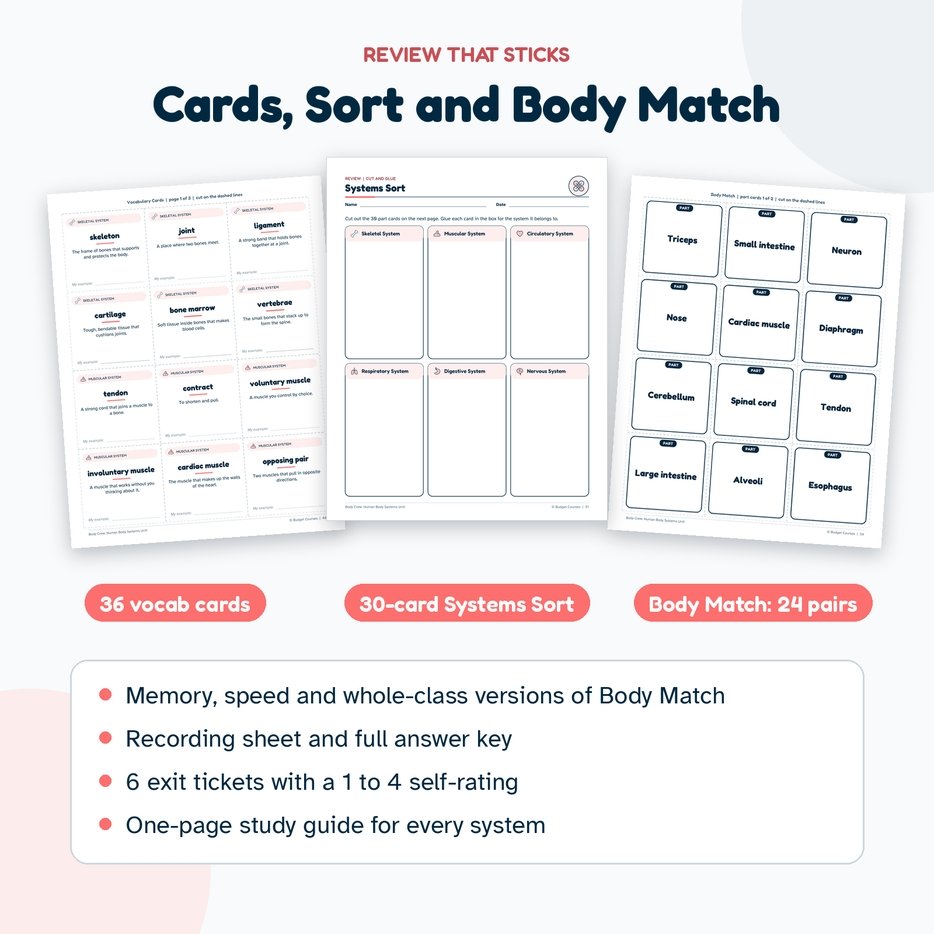
- One-page study guide, 36 vocabulary cards and a 30-card Systems Sort
- Body Match review game: 24 part cards, 24 job cards, three ways to play and a recording sheet
- 6 exit tickets and an I Can tracker
Assessment and keys
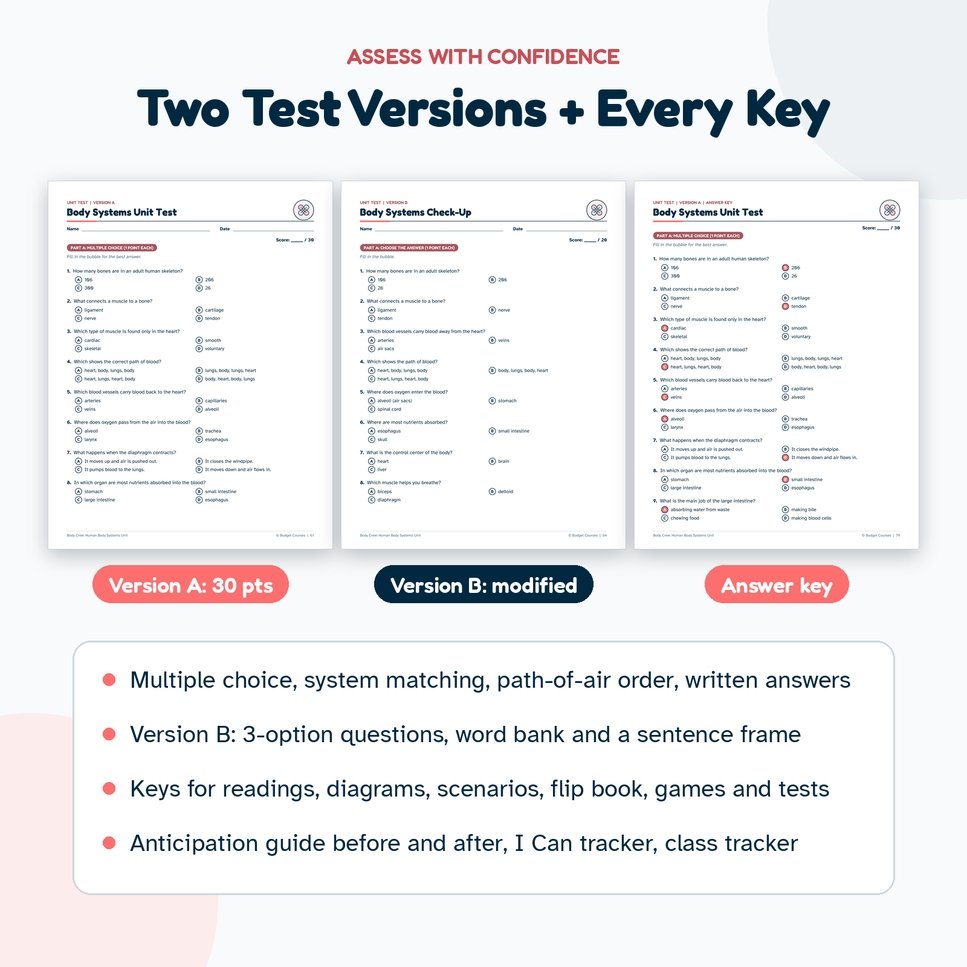
- Unit Test Version A (30 points): multiple choice, system matching, path-of-air order and written answers
- Unit Test Version B (20 points): a modified check-up with 3-option questions, a word bank and a sentence frame
- Class progress tracker
- Answer keys for every reading, scenario, sort, game, flip book piece and test
Why Teachers Choose Body Crew
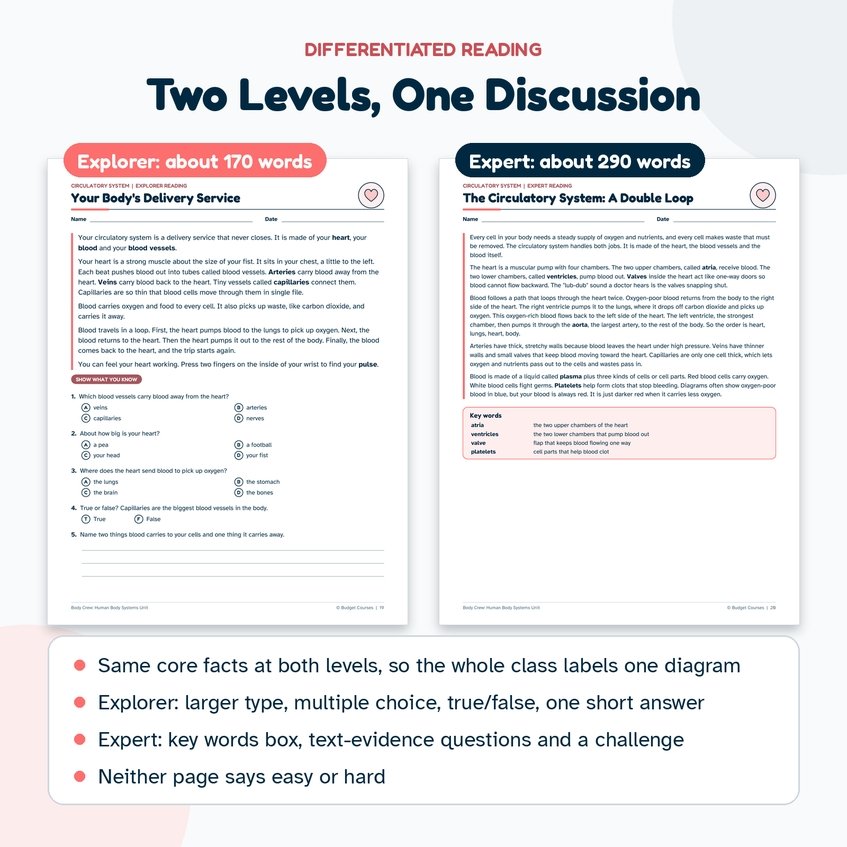
Two levels, one lesson. The Explorer reading for each system runs about 170 words in larger type. The Expert reading runs about 270 to 310 words with text-evidence questions. Both teach the same core facts, so the whole class can label one diagram and talk about one system together. Neither page is marked easy or hard.
Diagrams made for this age. Every body systems diagram was drawn for grades 4 to 6: simple, clear and scientifically sound. The heart sits slightly to the body’s left, the left lung is smaller, the liver and stomach are on the correct sides, and the readings explain that blood is never blue even though diagrams use blue for oxygen-poor blood.
A flip book that actually works. Each piece is exactly one tab longer than the one before it, so when students stack and staple them, all seven tabs show in order. A completed flip book is included as a model.
How It Works
- Day 1: run the anticipation guide and the Levels of Organization page.
- Days 2 to 7: teach one system a day with vocabulary cards, a reading, the diagram, a flip book layer and an exit ticket.
- Day 8: put it together with the Teamwork lesson, scenarios and Connection Web.
- Day 9: review with the Systems Sort, Body Match and the study guide.
- Day 10: give Version A or Version B of the test and repeat the anticipation guide.
File Formats and Software
- 4 PDF files: US Letter color, A4 color, US Letter low-ink and A4 low-ink
- DOCX user guide with printing tips, troubleshooting and FAQ
- Opens in Adobe Acrobat Reader (free) or any PDF reader; the guide opens in Microsoft Word or LibreOffice
- Clickable contents page and bookmarks for quick navigation on screen
Customization
The PDFs are print-ready rather than editable. You choose the reading level for each student, teach the systems in any order, print only the pages you need and pick Version A or B of the test. The low-ink version keeps every diagram readable in black and white.
Digital download
This is a digital product. You get instant access to the files after checkout and can download them as often as you need. Nothing is shipped.
Use Cases
- A 5th grade teacher teaching structure and function who needs a full life science unit by Monday
- A 4th grade class with a wide reading range, using Explorer pages for some students and Expert pages for others
- A 6th grade life science review before a body systems or cells unit
- Homeschool families who want a human body unit with answer keys and a clear plan
- A substitute day: the readings and exit tickets work with no extra prep
FAQ
Which body systems are covered?
Skeletal, muscular, circulatory, respiratory, digestive and nervous, plus a lesson on how they work together.
Is the reproductive system included?
No. It is left out so the unit suits elementary classrooms.
What grade is this human body unit for?
Grades 4 to 6. Explorer readings suit 4th grade and students who need support; Expert readings suit 5th and 6th grade.
Are answer keys included?
Yes. Every page students write on has a key, including a completed flip book.
Is it digital or printable?
It is a printable PDF unit. You can project pages on a screen, but it is not an interactive digital activity.
How long does the unit take?
About ten 45 to 50 minute lessons, or six days if you pair systems.
Can I share it with other teachers?
The license covers one teacher and their students. Colleagues need their own copy or an additional license.




Reviews
There are no reviews yet.