




GCSE Combined Science Trilogy Physics revision notes that follow the specification point by point
These are complete revision notes for the Physics papers (Paper 5 and Paper 6) of GCSE Combined Science: Trilogy. They are written to match the content of the AQA 8464 specification, in specification order, so every heading carries its reference (for example 6.2.1.4) and nothing you need to know is missed. The notes work for both Foundation and Higher tier: Higher-only content is clearly flagged, so Foundation students can skip it and Higher students can see it at a glance.
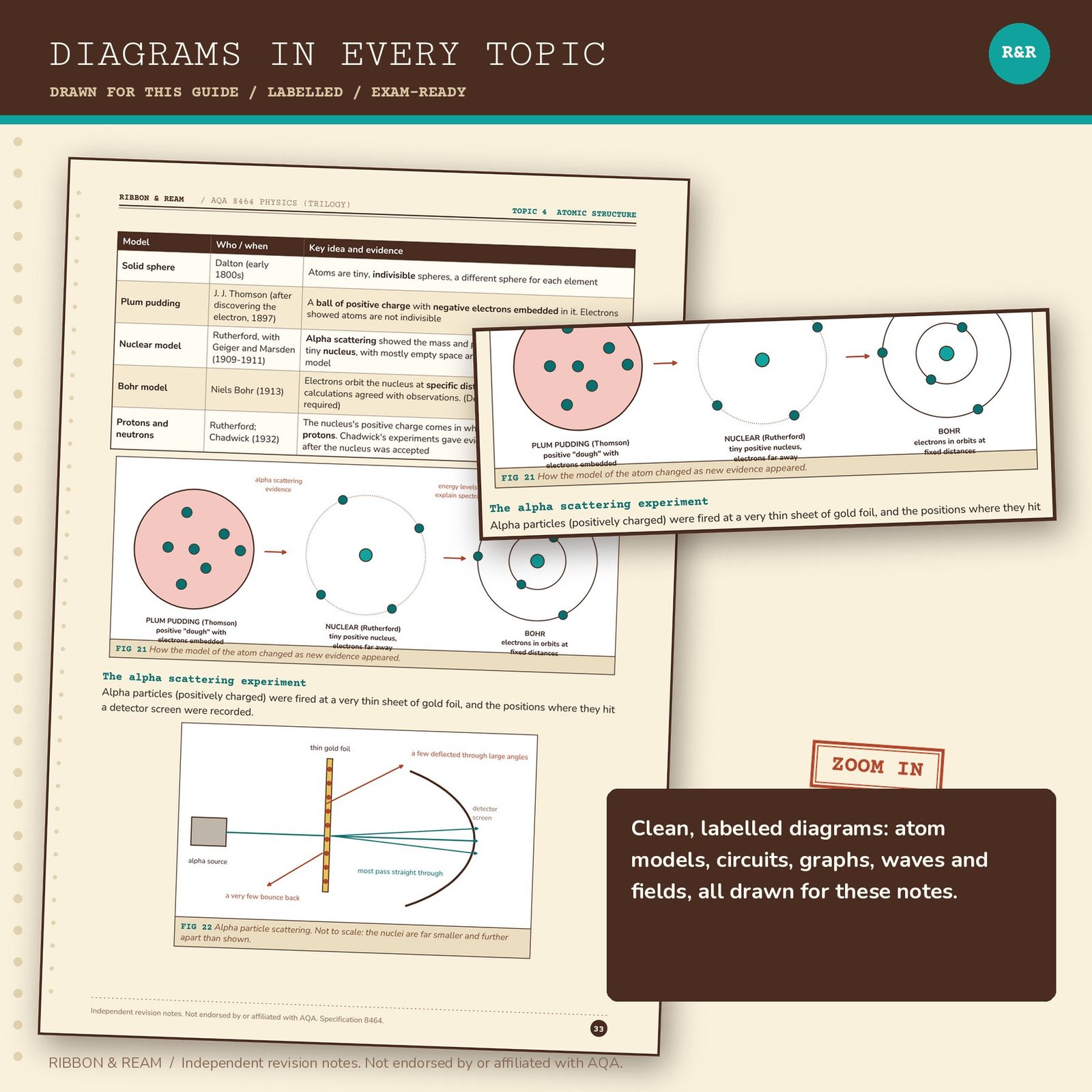
Everything is explained in plain English, with labelled diagrams, step-by-step worked examples, required practical summaries and 111 original exam-style questions with full worked answers. The design is a retro typewriter look: a warm cream page, typewriter headings and stamp-style labels, so key facts, exam tips and common mistakes jump out as you revise.
What is covered
Paper 5 (Physics 1)
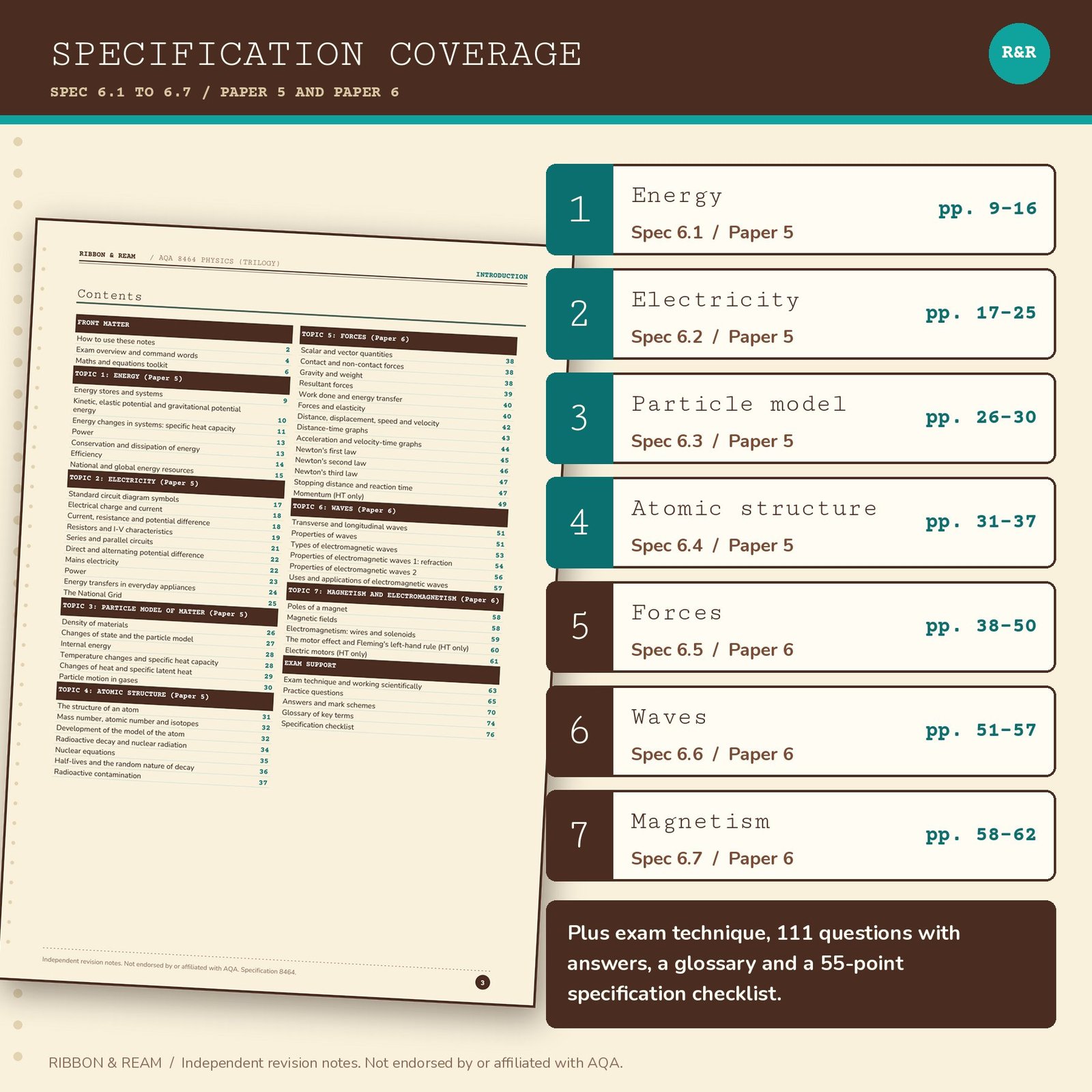
- Energy (6.1): energy stores and systems, kinetic, elastic and gravitational potential energy, specific heat capacity, power, conservation and dissipation, efficiency, national and global energy resources.
- Electricity (6.2): circuit symbols, charge, current, potential difference and resistance, I-V characteristics of resistors, filament lamps, diodes, thermistors and LDRs, series and parallel circuits, mains electricity, power, energy transfers and the National Grid.
- Particle model of matter (6.3): density, changes of state, internal energy, specific latent heat, and gas pressure.
- Atomic structure (6.4): the structure of the atom, isotopes, the development of the atomic model, alpha, beta and gamma radiation, nuclear equations, half-life and radioactive contamination.
Paper 6 (Physics 2)
- Forces (6.5): scalars and vectors, contact and non-contact forces, resultant forces, work done, springs and elasticity, speed, velocity and acceleration, distance-time and velocity-time graphs, Newton’s three laws, terminal velocity, stopping distance and (Higher tier) momentum.
- Waves (6.6): transverse and longitudinal waves, wave speed, the electromagnetic spectrum, refraction, and uses and dangers of EM waves, with the infrared required practical.
- Magnetism and electromagnetism (6.7): magnetic poles and fields, electromagnets and solenoids, and (Higher tier) the motor effect, Fleming’s left-hand rule and electric motors.
All eight physics required practicals are included, with the method, the key results and the evaluation points examiners look for.
What is included in your download
- Complete Notes (PDF, A4, 77 pages): every topic, worked examples, diagrams, exam technique chapter, 111 practice questions (325 marks), full answers, a glossary of key terms and a specification checklist with page references.
- Cheat Sheet (PDF, A4, 6 pages): the equations and units, circuit and energy facts, radiation and half-life, forces and motion, waves and magnetism, plus the required practicals and exam tips, ready to print.
- User Guide (DOCX): how to use each file, an 8-week and a 2-week revision plan, printing tips, how to use the checklist and a short FAQ.
- Free sample: a 10-page extract is available separately so you can see the style before you buy.
Design and features
- Index-card boxes for key facts, exam tips and common mistakes, each with its own stamp-style label.
- Over 45 labelled diagrams drawn for these notes: circuits, I-V graphs, heating curves, atom models, motion graphs, wave diagrams and magnetic fields.
- 30+ worked examples using a consistent method (formula, units, substitute, evaluate) so you build good exam habits.
- Maths toolkit: a full list of equations you must learn and those you must be able to use, SI prefixes, rearranging and graph skills.
- 6-mark answer guidance and model answers for extended-response questions.
- Specification checklist with three tick boxes per point (first read, practice done, exam ready) and page references.
- Clear body text on a warm cream page, designed to be easy on the eyes on screen and in print.
How to use these notes
Use the three-pass method. First understand: read one section at a time and try each worked example before reading the answer. Then practise: do the practice questions for that topic and mark them honestly using the answers section. Finally recall: a few days later, use the cheat sheet and checklist to write the equations and key facts from memory. The User Guide gives you a week-by-week plan if you have eight weeks, and a day-by-day plan if you only have two.
Who it is for
These notes suit GCSE students in Years 10 and 11 taking Combined Science: Trilogy, whether you are aiming for a grade 4-4 or pushing for 7-7 and above. They are also useful for parents and tutors looking for a structured way to support revision. They are not for Separate Physics (specification 8463), which has additional content.
Frequently asked questions
Is this for Foundation or Higher tier?
Both. The notes cover the same topics for both tiers and flag the content that is for Higher tier only.
Are the practice questions from past papers?
No. All 111 questions are original, written in the style of the exam, with full worked answers. Use them alongside past papers from your school or the exam board.
Do I need to learn the equations?
Some equations are given in the exam and some you must recall. The notes and cheat sheet show clearly which is which.
Can I print it?
Yes. Everything is A4 and designed to print. The User Guide has printing tips.
Does it cover the Biology and Chemistry papers?
No. This product covers the Physics papers only (Paper 5 and Paper 6).
What format are the files?
The notes and cheat sheet are PDFs. The User Guide is a Word document (DOCX).
Disclaimer
These are independent revision materials written to match the AQA GCSE Combined Science: Trilogy (8464) specification, Physics papers, first assessed in 2018. They are not endorsed by or affiliated with AQA. Always check the latest specification and sample papers on the exam board website and follow your teacher’s advice.



Reviews
There are no reviews yet.