
An Intro Marketing Study Guide in Plain Language
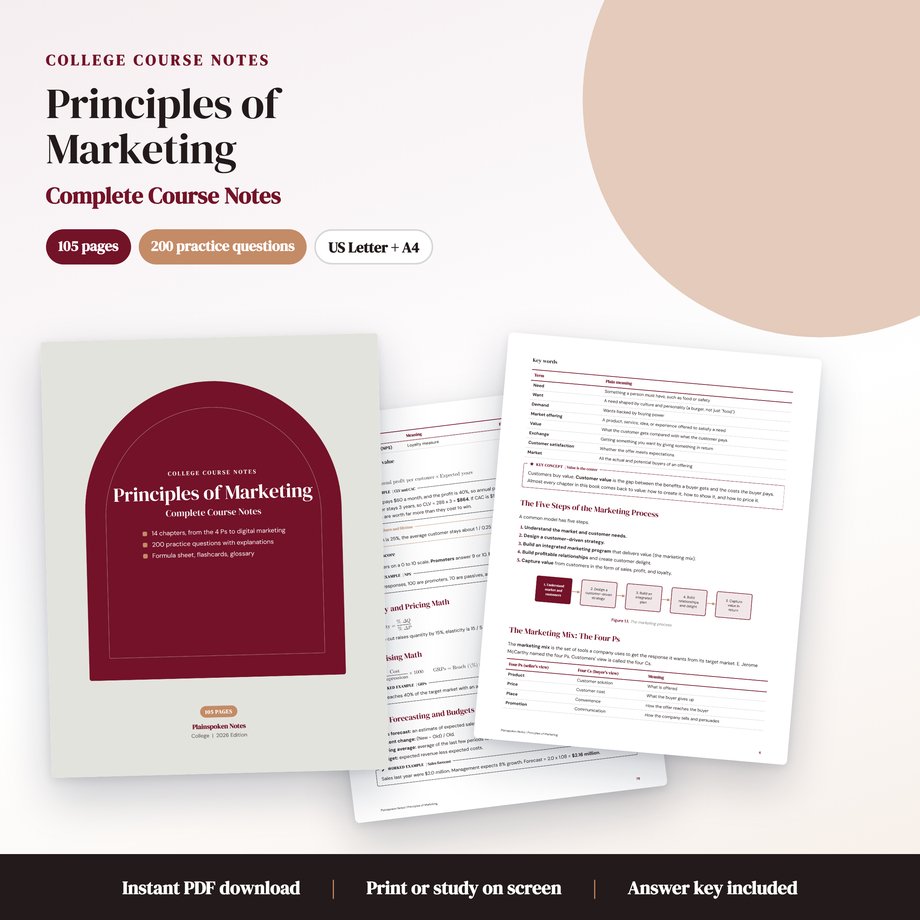
Plainmark is a complete principles of marketing study guide for college and university students in an introductory marketing course. It follows the order most textbooks use: what marketing is, the environment and strategy, buyers, research, segmentation and positioning, the four Ps, communication, digital marketing, and the math. Every term is defined the first time it appears, and every chapter ends with a quiz that explains each answer.
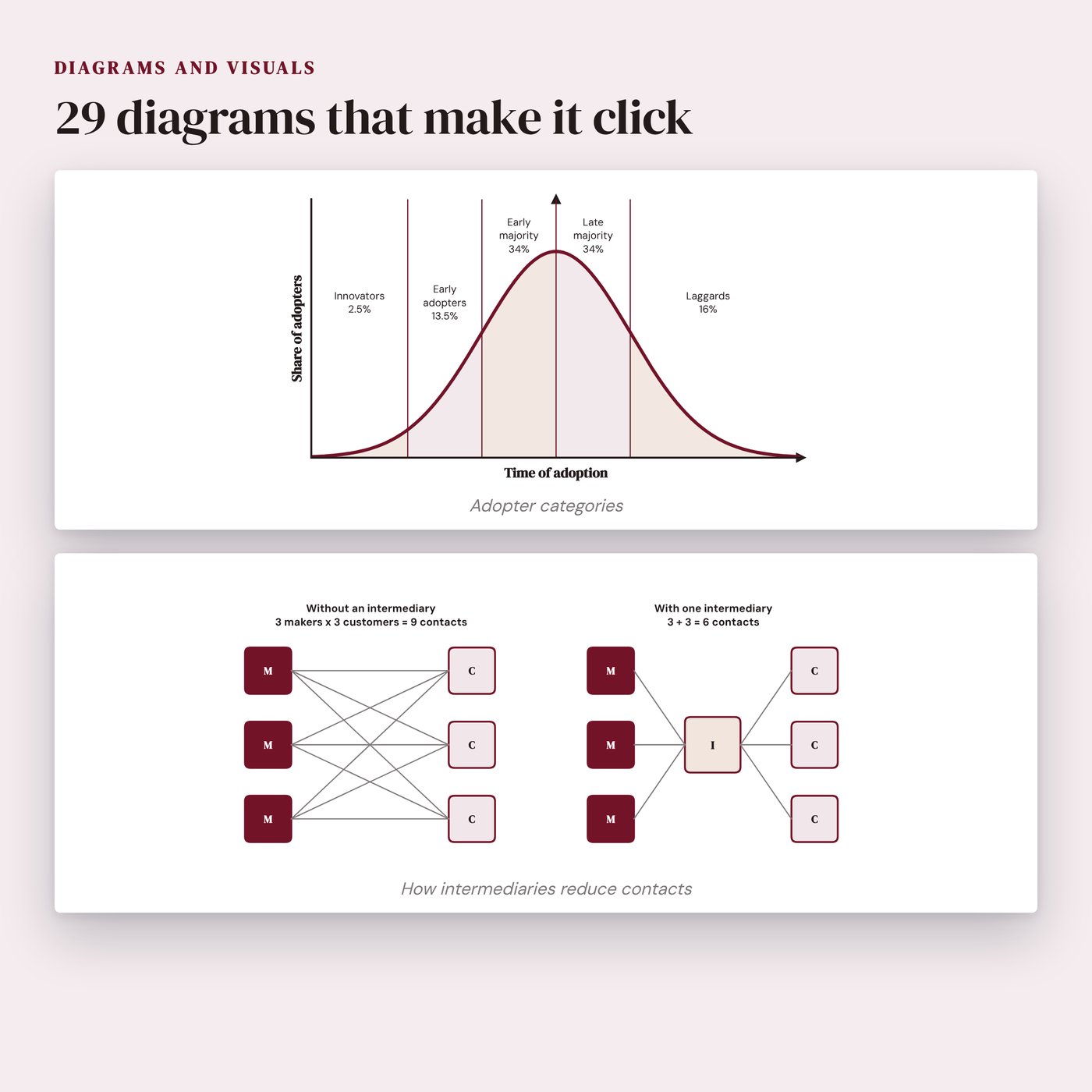
Marketing exams ask for two things. First, you have to know the vocabulary and the models: the BCG matrix, the Ansoff grid, the product life cycle, AIDA, and the four Ps. Second, you have to apply them to a short business story. These notes teach both. Each model comes with a diagram, a plain example, and a trap box that points out the mistake students make on exams.
Who It Is For
- College and university students taking Principles of Marketing or Introduction to Marketing
- Business majors who need a fast review before a midterm or final
- Students whose textbook is long and who want one organized set of notes
- Self-learners who want the core ideas of marketing explained simply
- Tutors and teaching assistants who need a clear outline of the course
What You Learn
The big picture (Chapters 1 to 3)
What marketing is, the five-step marketing process, the four Ps, and the five marketing orientations. Then the marketing environment, SWOT analysis, ethics, and social responsibility. Then strategy: levels of planning, the BCG matrix, the Ansoff grid, Porter’s generic strategies, and the parts of a marketing plan.
Buyers and markets (Chapters 4 and 5)
How consumers decide: cultural, social, personal, and psychological influences, Maslow’s hierarchy, the four types of buying behavior, and the five-step decision process. Then business markets: derived demand, the buying center, buying situations, and the main ways to enter a global market.
Research and targeting (Chapters 6 and 7)
The research process, primary and secondary data, sampling, and how to read numbers. Then segmentation, targeting, and positioning, with the bases for segmenting, the requirements for a good segment, and perceptual maps.
The marketing mix (Chapters 8 to 12)
Products, services, and brands. New product development and the product life cycle. Pricing, from demand and elasticity to skimming and penetration. Distribution channels and retailing. Integrated marketing communications, including advertising, sales promotion, personal selling, public relations, and push and pull strategies.
Digital marketing and metrics (Chapters 13 and 14)
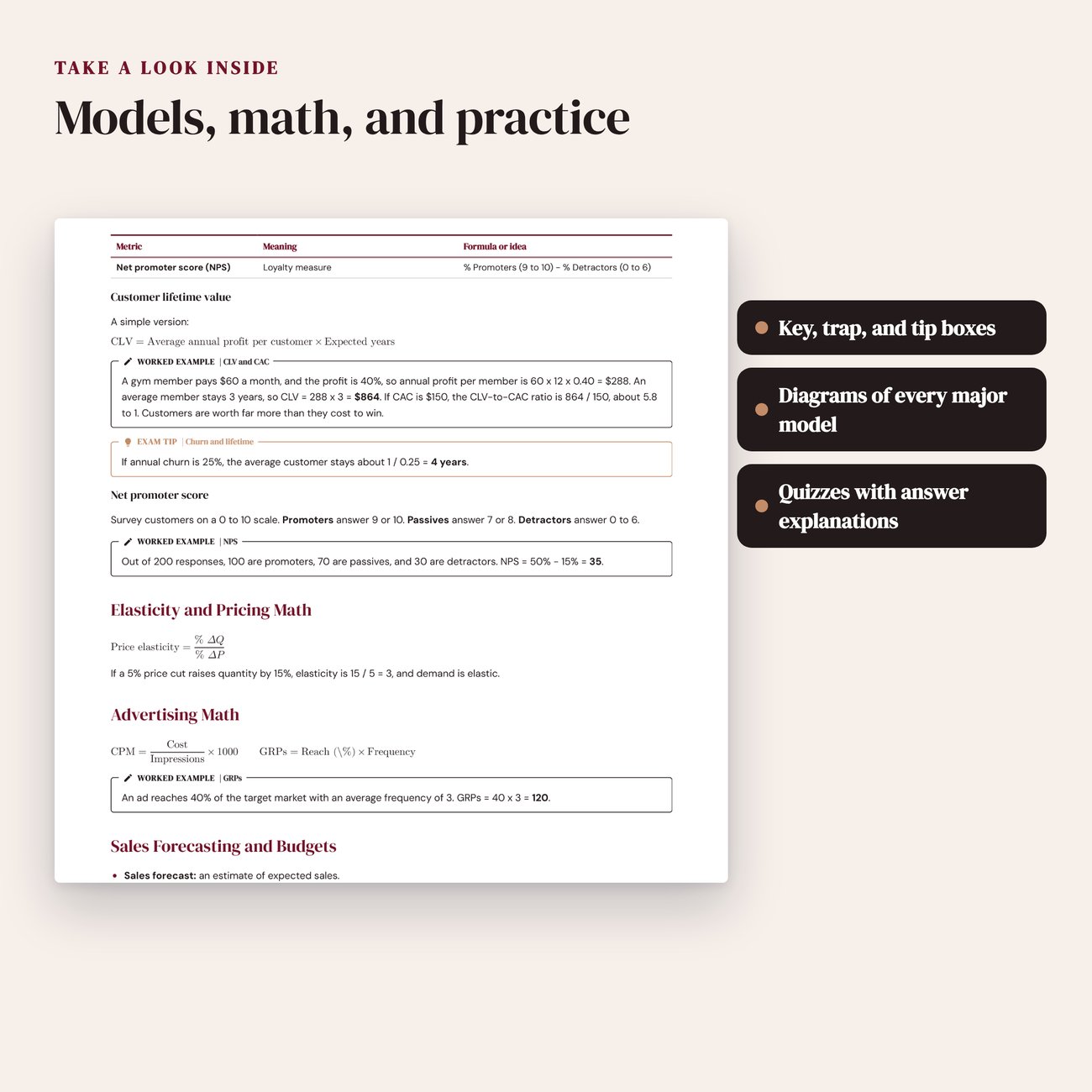
SEO, paid search, social media, email, content, and the marketing funnel. Then the math: market share, markup, margin, break-even, ROI, CPM, customer lifetime value, and net promoter score, each with a worked example.
What Is Included
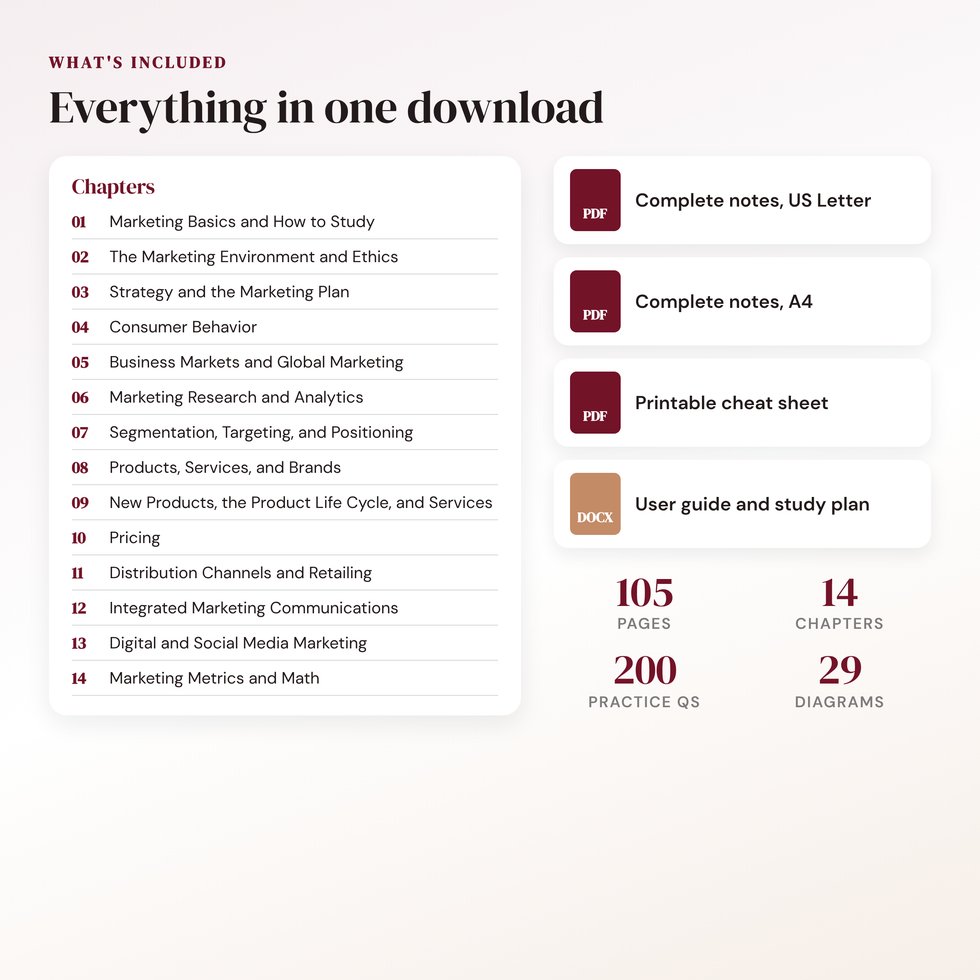
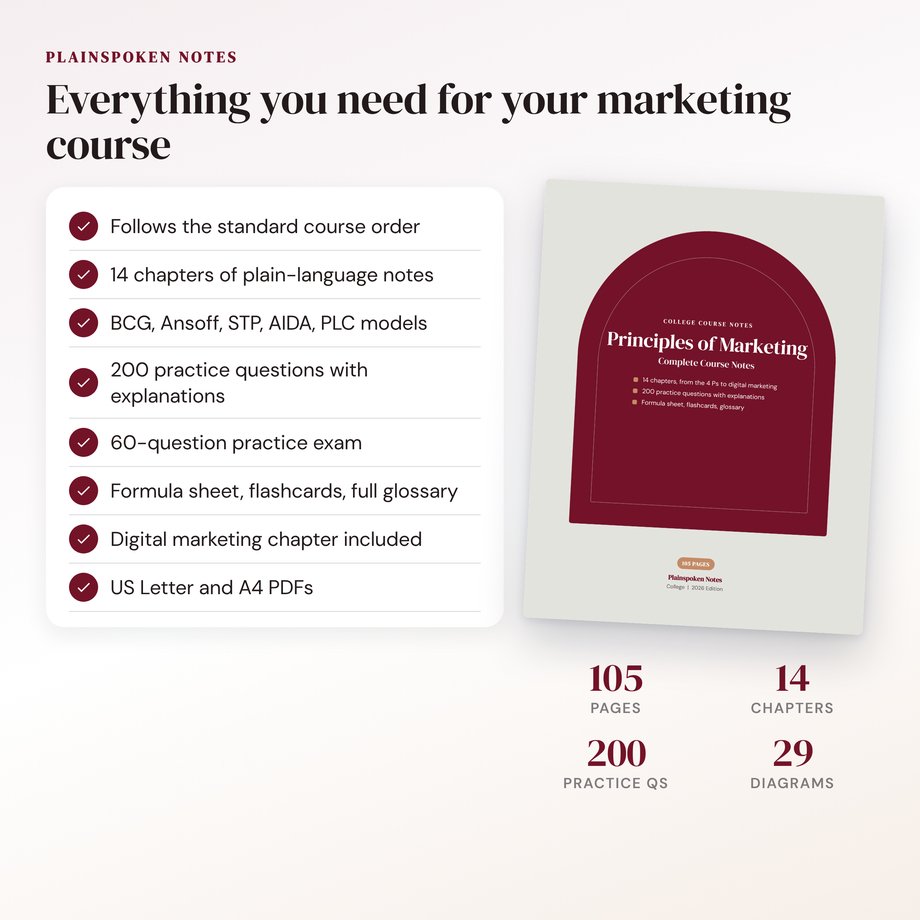
- Study guide PDF in US Letter and A4 sizes (14 chapters plus back matter, 105 pages in US Letter)
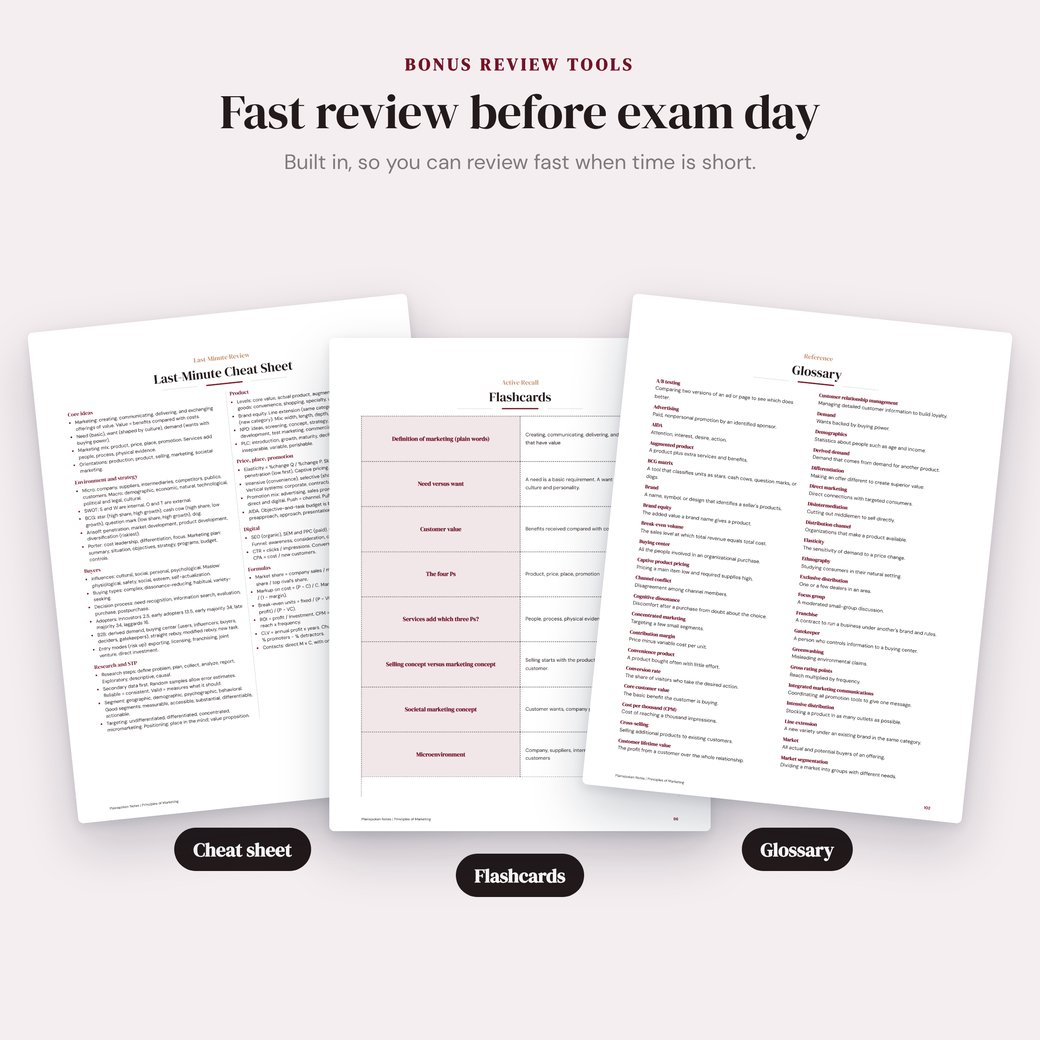
- Cheat sheet PDF with the models, definitions, and a formula sheet
- DOCX user guide with a study plan and answers to common questions
- 200 practice questions with explanations: chapter quizzes plus a 60-question practice exam
- 29 diagrams including matrices, curves, funnels, and flow charts
- Flashcards (52 cards) and a glossary of 74 terms
How It Works
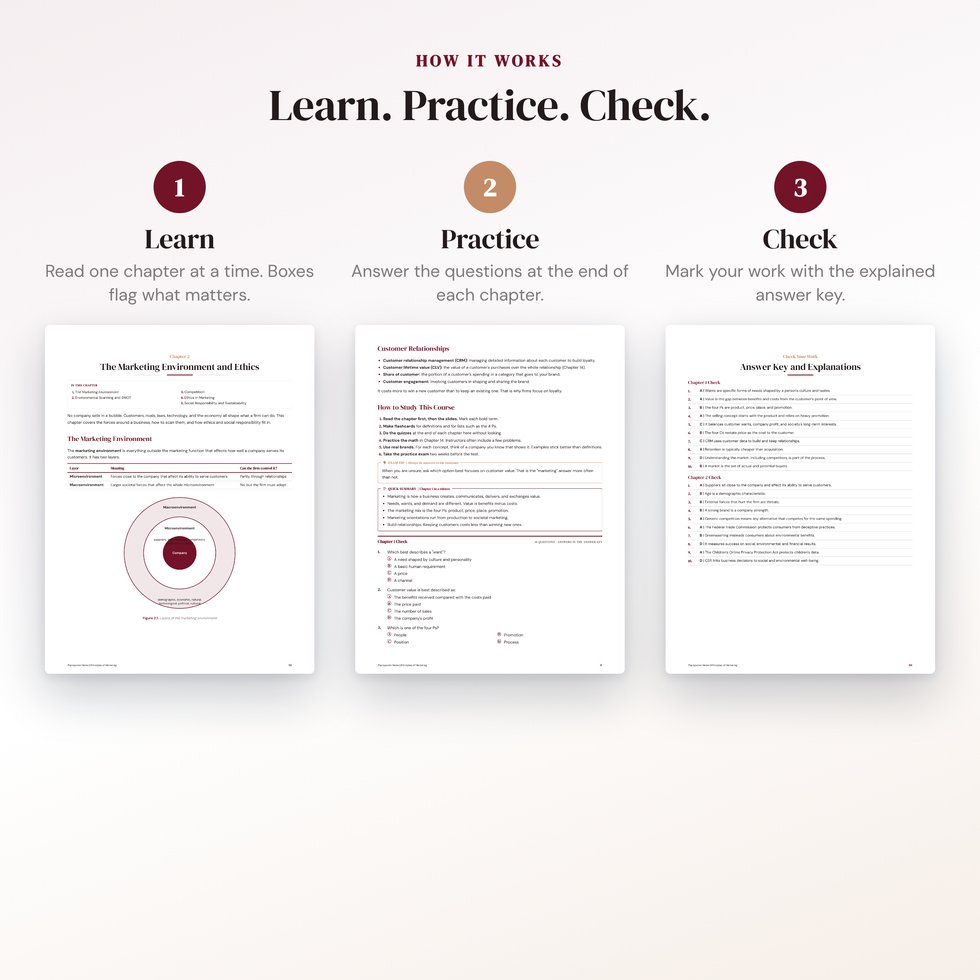
- Read one chapter at a time. Boxes flag key ideas, traps, tips, and worked examples.
- Answer the chapter quiz without looking, then read every explanation, including the ones you got right.
- Make flashcards for any term you missed, and test yourself out loud.
- Work the math problems in Chapter 14 by hand until the formulas feel natural.
- In the last two weeks before an exam, take the 60-question practice exam, then review misses with the cheat sheet and formula sheet.
File Formats and Software
The guide and cheat sheet are PDF files that open on any computer, tablet, or phone. The user guide is a DOCX file that opens in Microsoft Word, Google Docs, or similar apps. Both US Letter and A4 versions of the study guide are included.
Customization and Printing
Print the whole guide or only the chapters you need. Many students print the cheat sheet and formula sheet and keep the rest on screen. Highlight and add notes in any PDF app.
Digital Download Details
This is an instant digital download. No physical item is shipped. You can download the files again whenever you need them.
Good to Know
Courses differ. Your textbook and instructor decide which terms, models, and formulas appear on your exam, so compare this guide with your syllabus. These notes are independent study material and are not tied to any one textbook or publisher.
Frequently Asked Questions
Will this match my textbook?
It follows the common order and terms used in most introductory marketing textbooks. Check your syllabus for any model or term your instructor stresses.
Is there math on the exam?
Many courses include some. Chapter 14 and the formula sheet cover market share, markup, margin, break-even, ROI, CPM, customer lifetime value, and net promoter score, with worked examples.
Does it cover digital marketing?
Yes. Chapter 13 covers SEO, paid search, social media, content, email, and the funnel, along with the basic digital metrics.
Are the practice questions multiple choice?
Yes. Every question has four options and a written explanation. Some courses also use short answer questions, and the same thinking applies.
How many practice questions are there?
There are 200 in total: 140 in the chapter quizzes and 60 in the practice exam.
Is this the same as the CLEP exam?
No. This is a college course study guide. If you plan to take a credit-by-exam test, check that test’s published outline as well.
Can I print it?
Yes. Both US Letter and A4 PDFs are included for personal printing.
Try a Free Sample First
Not sure yet? Download a free chapter of these Principles of Marketing notes and see the layout, the diagrams and the practice questions for yourself.


Reviews
There are no reviews yet.