





A stock market lesson your students will actually remember
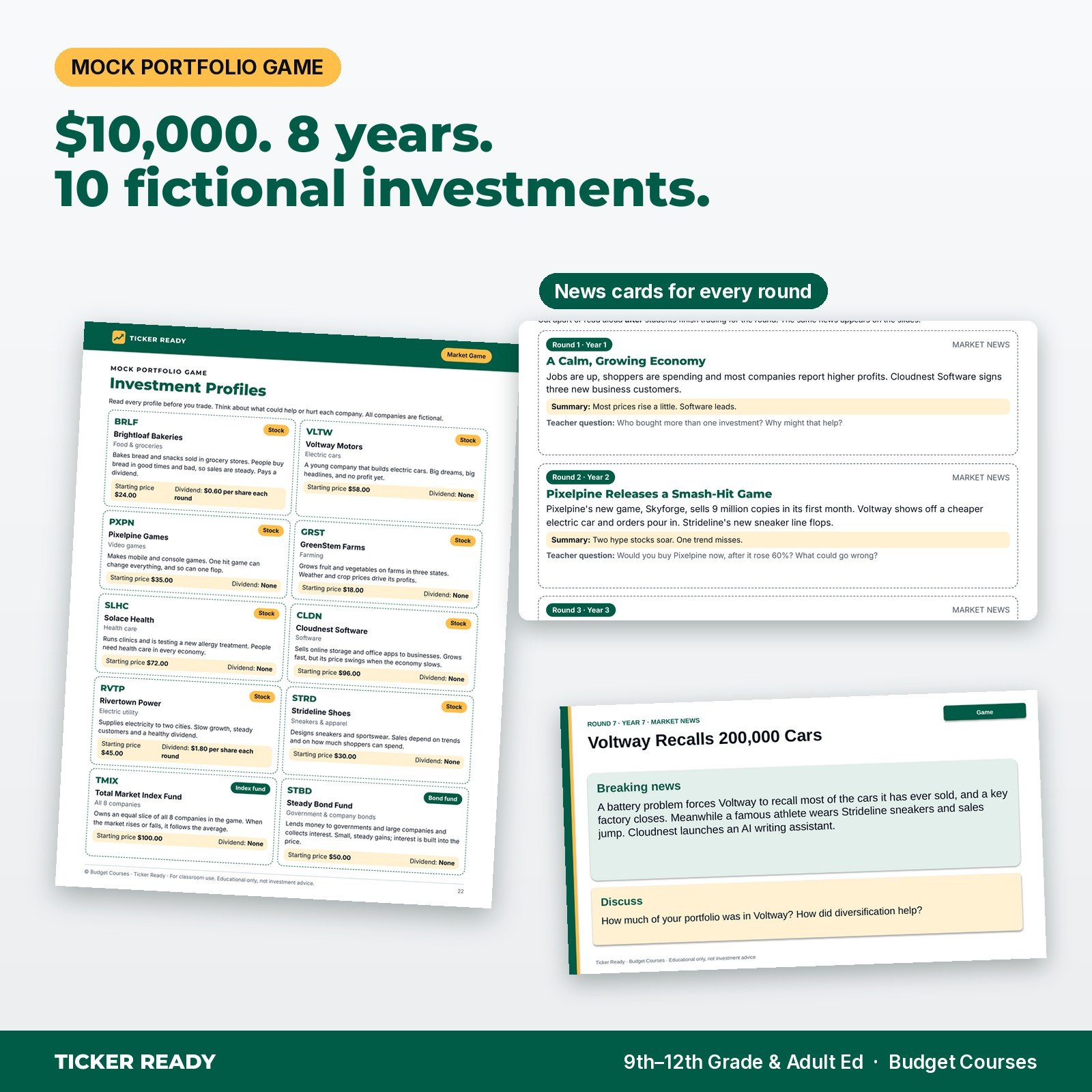
Ticker Ready is a complete, no-prep stock market lesson and investing unit for 9th to 12th grade and adult education. Six short lessons explain how the stock market works in plain language. Then a mock portfolio game hands every student $10,000 in virtual cash and walks the class through 8 fictional years of booms, a drought, rising interest rates, a recession, a recovery and a car recall. By the end, students have felt what diversification does, not just read about it.
Every company, ticker, price and headline in the game is fictional. That keeps the lesson neutral, gives every class the same numbers, and means the answer keys always match.
What students learn
- What a stock is, why companies sell shares, and how shareholders earn money through price gains and dividends
- How bonds, mutual funds, index funds and ETFs differ, and why fees matter
- How risk and return travel together, and how time horizon changes the right choice
- How diversification softens losses, with a Bad-Year Test that proves it with real math
- Compound growth and the Rule of 72, including an early starter vs. late starter comparison
- How to read a stock quote (change, volume, 52-week range, market cap, P/E, dividend yield) and a price chart
- How to spot investment scams, hype and pump-and-dump schemes
What is included
44-page teaching packet (PDF, US Letter and A4)
- Teacher notes, learning objectives, a 5-day pacing guide, a 2-day fast track and a 1-day sub plan
- Standards connections to the Investing area of the National Standards for Personal Financial Education
- Investing Word Bank with 24 terms
- Six readings, each with an activity: guided notes, gains and dividends practice, a compare-and-sort, the Bad-Year Test, a compound growth worksheet, quote cards, a price chart and a red-flag scenario sort
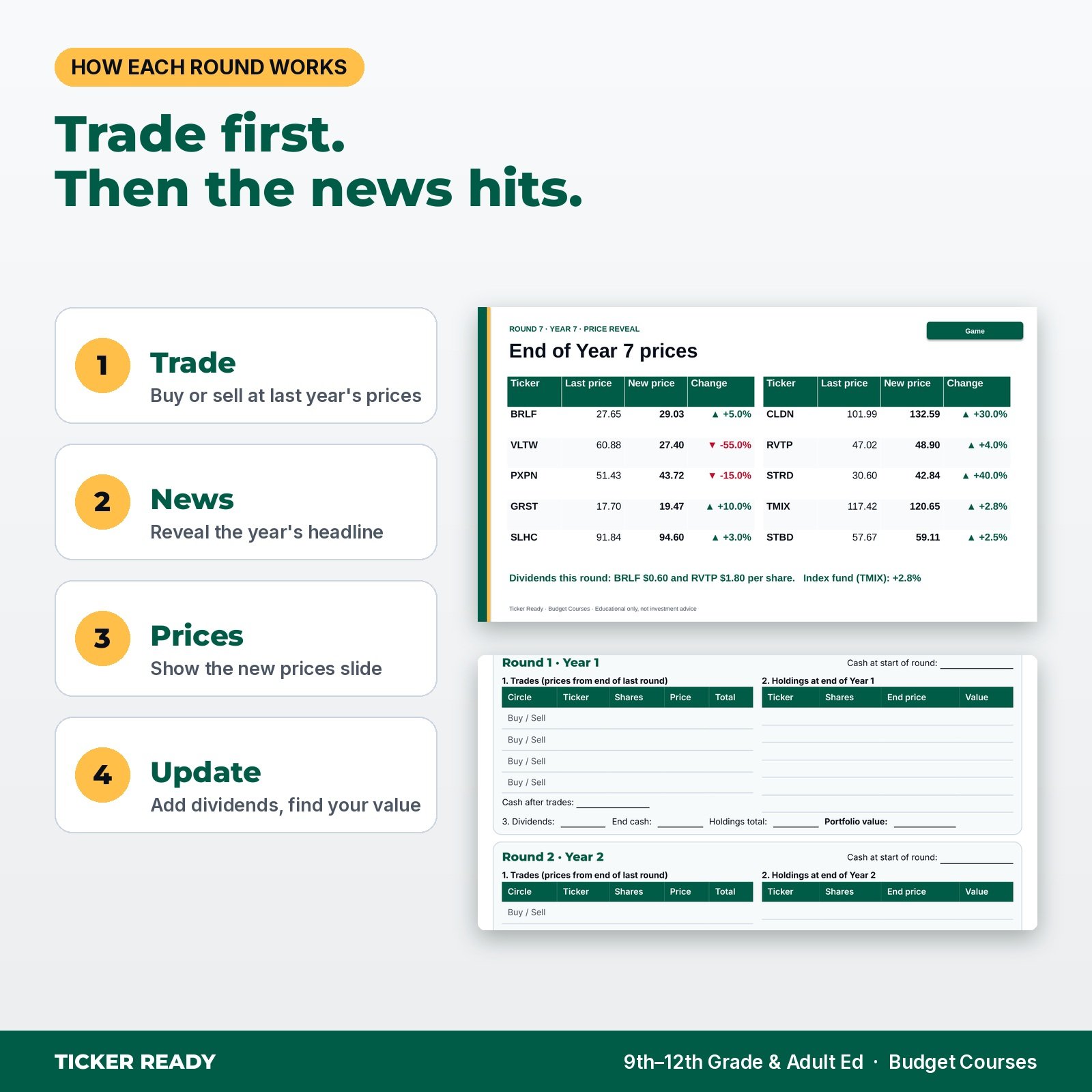
- Mock portfolio game: teacher run sheet with a round cheat sheet, student rules with a worked example, 10 investment profile cards, 8 news cards, a market price board, round trackers, a scoreboard with growth graph, a debrief with five sample investors, and a reflection
- Assessment: vocabulary check, 20-question unit quiz, six exit tickets and a 24-point rubric
- Answer keys for every page, plus an investor certificate
41 editable teacher slides (PPTX)
Slides follow the packet in order, with speaker notes on every slide. The game section has a news slide and a price reveal slide for each of the 8 rounds, so running the stock market game takes no extra prep. Tables and charts are native PowerPoint objects you can edit.
Excel game tracker (student and teacher editions)
Students type their buys and sells; the workbook calculates trade costs, cash, dividends, holdings and portfolio value for every round. A dashboard shows value, gain or loss, return, investments held, largest holding and a chart of the student vs. Index Ivan, a player who bought the index fund and never traded. A status row flags spending more cash than you have, selling shares you do not own, or missing prices. It also includes a compound growth calculator with a “cost of waiting” result, a class leaderboard for up to 40 students, one currency setting and an optional trading fee. Formulas are locked with no password, and inputs are open.
User guide (DOCX)
Step-by-step setup, how to run each round, how every workbook sheet works, troubleshooting and FAQs.
How the mock portfolio game works
- Trade. Students buy or sell whole shares at last year’s prices.
- News. You reveal the year’s headline, such as “Voltway Recalls 200,000 Cars.”
- Prices. Show the price reveal slide or read from the price board.
- Update. Students add dividends and find their new portfolio value on paper or in Excel.
Each round takes about 8 to 10 minutes. The debrief compares five sample players. All-In Ava put $10,000 into one exciting stock and ended near $5,200. Index Ivan held the index fund and ended near $13,000. Panic Pete sold after the recession and missed the recovery. It is a stock market simulation for students that makes the case for diversification on its own.
Who it is for
- High school personal finance, economics, consumer math, business and CTE teachers
- Adult education, GED, transition and workforce programs teaching money skills
- Homeschool families and adult learners who want a structured investing lesson
- Teachers who need a reliable financial literacy sub plan
Classroom uses
- A one-week investing unit in a personal finance course
- Daily 10-minute stock market game warm-ups spread over two weeks
- A financial literacy lesson for an adult ed class planning for retirement at work
- An economics lesson on financial markets, interest rates and recessions
- A sub day using Lesson 1 and its answer key
File formats and requirements
- PDF packet in US Letter and A4, fonts embedded, with clickable contents. Prints well in color or grayscale.
- PPTX slides in 16:9, a standard PowerPoint file. Tested in LibreOffice Impress.
- XLSX workbooks. Built for Microsoft Excel and tested in LibreOffice Calc. No macros.
- DOCX user guide.
Google Slides and Google Sheets were not tested, so we do not promise they convert perfectly.
Customizing
Edit any slide text, swap discussion questions or skip lessons. In the workbook, choose your currency symbol, change the starting cash, add a trading fee, or edit prices on the Market sheet to write your own market story. Printable pages use dollars because the game prices are fixed.
Digital download
This is an instant digital download. You receive six files: two PDFs, one PPTX, two XLSX workbooks and one DOCX guide. Nothing physical is shipped. Downloads do not expire.
FAQ
Is this stock market lesson investment advice?
No. It is an educational resource about how markets work. All companies in the game are fictional.
Do students need computers for the stock market game?
No. The whole game runs on paper with the round trackers. The Excel tracker is optional.
How long does the investing unit take?
About five 45 to 55 minute periods. The pacing guide also has a two-day and a one-day option.
Are answer keys included?
Yes, for every worksheet, the quiz, the quote and chart practice and the game debrief.
Does it cover index funds and ETFs?
Yes. Lesson 2 compares stocks, bonds, mutual funds, index funds and ETFs, and the game includes an index fund and a bond fund.
Can I use it with adult education students?
Yes. The readings are written in plain language, and the guide includes tips for linking the lessons to workplace retirement plans and scam awareness.
Can students play in teams?
Yes. Teams of two or three share one portfolio and must agree on every trade.
License: one teacher, for use with their own students. Please do not share or post publicly. Educational only, not financial or investment advice.



Reviews
There are no reviews yet.