


Unusual Careers Reading Passages and Career Exploration Activities for High School and Adult Ed
Ask a class to name ten careers and you will hear doctor, teacher, lawyer and YouTuber. Hand them a reading about a golf ball diver who crawls along the bottom of a muddy pond next to alligators, and the room wakes up. Odd Jobs Out uses that “wait, that’s a real job?” moment to teach real career exploration skills. These career exploration activities pair 18 original informational reading passages with vocabulary, comprehension, text evidence and an honest reflection question: would you do it?
Every reading is about a real job that is dangerous, messy or surprising. Students learn what the work involves, where it happens, how people train for it and which skills it takes. Then they compare jobs, research a new one with an official source and present it in a gallery walk. It is a complete career exploration unit for 9th–12th grade and Adult Education that you can print and teach today.
What makes these career exploration reading passages different
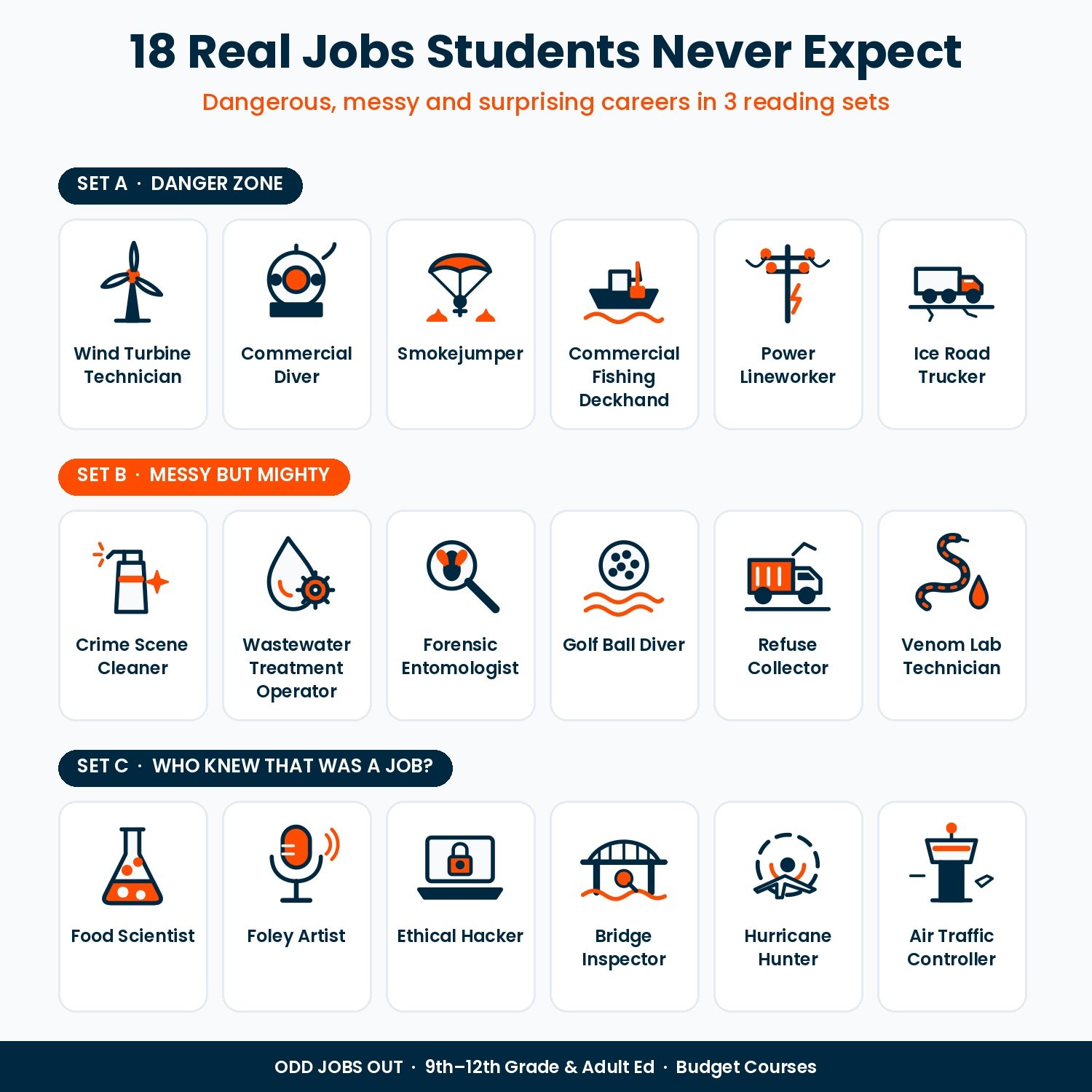
- 18 jobs, not a handful. Three themed sets of six: Danger Zone, Messy but Mighty, and Who Knew That Was a Job?
- Written for teens and adults. Each passage runs about 260 to 330 words with numbered paragraphs, so students can cite evidence by paragraph.
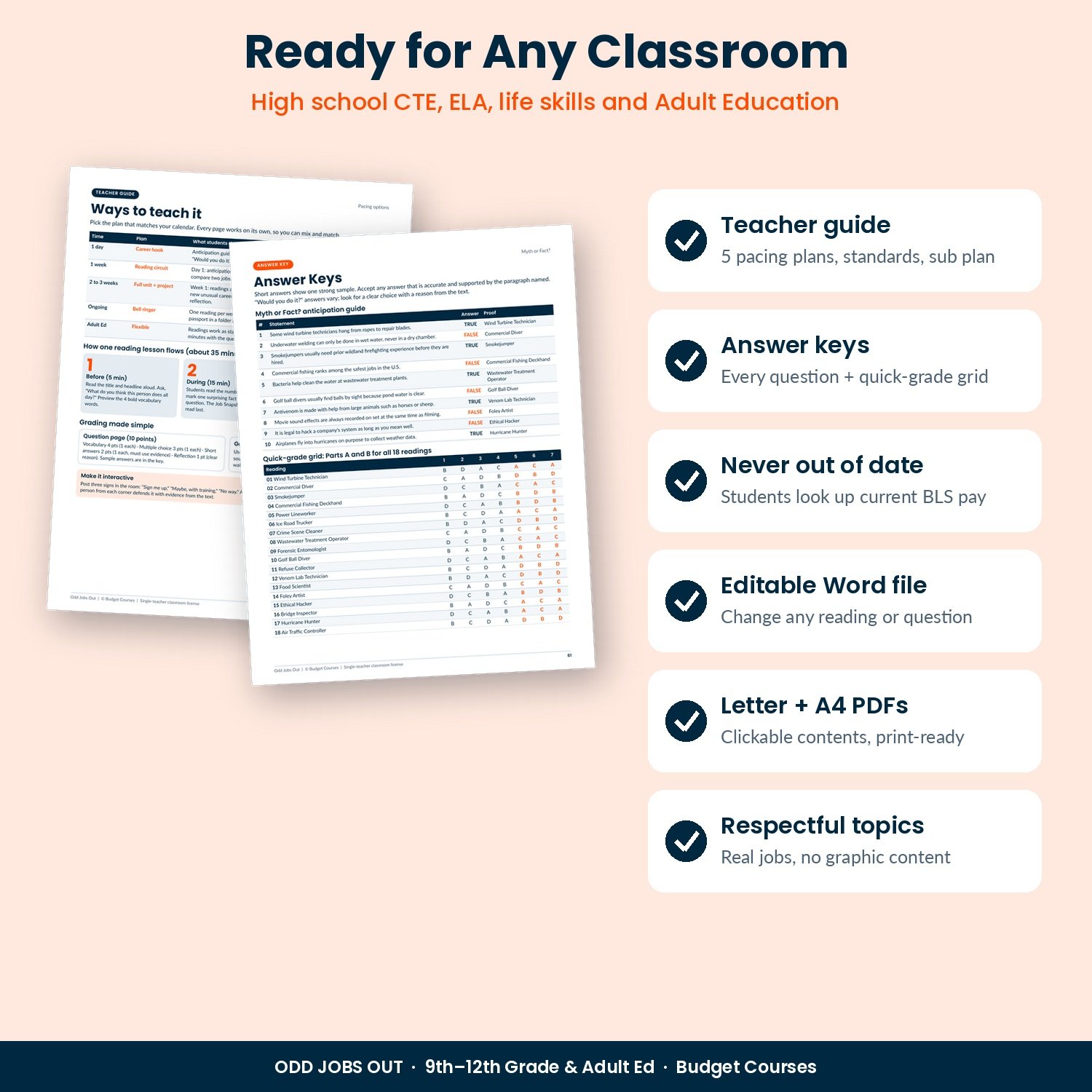
- Numbers that never go stale. Pay changes every year, so every reading names the matching U.S. Bureau of Labor Statistics Occupational Outlook Handbook profile. Students look up the current median pay and write it down with the year in the Pay Check box.
- Real thinking, not just recall. Every question page ends with “Would you do it?” Students choose Sign me up, Maybe with training, or No way, and back it up with the text.
- Respectful and classroom-safe. Crime scene cleaning and forensic entomology are covered calmly and without graphic detail, with the focus on safety, science and helping families.
The 18 unusual careers
Set A: Danger Zone
Wind turbine technician, commercial diver (underwater welding), smokejumper, commercial fishing deckhand, power lineworker and ice road trucker.
Set B: Messy but Mighty
Crime scene cleaner, wastewater treatment operator, forensic entomologist, golf ball diver, refuse collector and venom lab technician.
Set C: Who Knew That Was a Job?
Food scientist, Foley artist, ethical hacker, bridge inspector, hurricane hunter and air traffic controller.
What is included
- Cover and clickable contents page with PDF bookmarks
- Teacher guide (5 pages): quick start, five pacing plans, standards and differentiation, job map with career clusters and BLS profiles, jigsaw steps, discussion questions and a ready-to-use sub plan
- Myth or Fact? anticipation guide (10 statements) and an Odd Jobs passport tracker
- 3 set opener pages with a quick-write prompt
- 18 reading pages, each with a Job Snapshot sidebar (work setting, training path, key skills, career cluster), Danger, Mess and Surprise ratings, a Pay Check look-up box and note boxes
- 18 question pages: 4 vocabulary matches, 3 multiple-choice questions, 2 text-evidence questions and the “Would you do it?” reflection
- Job showdown ranking for all 18 jobs and a compare-two-jobs chart with Venn diagram
- 2-page job research organizer that works with any career
- 5-page gallery walk project: student directions with checkpoints, poster planner, feedback cards, viewer sheet and a 40-point rubric
- My Career Clues reflection that links students’ answers to their interests
- 72-word glossary
- Answer keys with sample short answers and a one-page quick-grade grid
- Editable Word version of every reading and question page
- User guide (DOCX)
How the career exploration lesson works
1. Hook. Students mark the Myth or Fact? guide before reading. Statements like “Movie sound effects are always recorded on set” spark instant debate.
2. Read. One reading and its question page take about 35 minutes. Short answers require a paragraph number, which builds the evidence habit for every subject.
3. Reflect. Students vote with their feet: one corner for Sign me up, one for Maybe, one for No way. The passport, job showdown and career clues pages turn those opinions into self-knowledge.
4. Go deeper. For a full unit, students research a brand-new unusual career with the organizer, design a poster and review classmates’ work in a gallery walk.
Who this unusual careers unit is for
- High school career and technical education (CTE), career readiness and advisory classes
- English and reading teachers who want high-interest informational text
- Adult Education, ESL, GED/HSE and career pathways instructors
- Life skills, transition and job-readiness programs
- Homeschool families and tutors working with teens or adults
Real classroom uses
- A one-day career exploration lesson: jigsaw six readings in groups of six
- A one-week reading circuit: one set per day, then a showdown and reflection
- A three-week project unit ending in a gallery walk
- Emergency sub plans: the sub plan page tells a substitute exactly what to copy
- Open-entry Adult Ed classes: every reading works as a stand-alone lesson
Skills and standards
The career exploration worksheets support Common Core informational reading standards for citing evidence, central idea and vocabulary in context (RI.9-10.1, RI.9-10.2, RI.9-10.4 and grade 11-12 equivalents), short research projects (W.9-10.7, W.9-10.8) and collaborative discussion (SL.9-10.1). They also fit the reading and writing goals of the College and Career Readiness Standards for Adult Education.
File formats and software
- PDF, US Letter (8.5 x 11 in) and PDF, A4: 65 pages each, fonts embedded, clickable contents. Opens in any PDF reader.
- Editable Word file (.docx): all readings, question pages, the anticipation guide and the research organizer as plain editable text with real heading styles. Tested in LibreOffice Writer; built for Microsoft Word.
- User guide (.docx): setup, feature tour, customizing tips, troubleshooting and FAQ.
Customizing
Open the Word version to shorten a passage for struggling readers, swap a question, add a local employer or enlarge the font. Change Heading 1, 2 and 3 once to restyle the whole document.
Digital download
This is a digital product. Nothing ships. You get instant access to all four files after checkout, with unlimited downloads from your account. The license covers one teacher for personal classroom use.
FAQ
What grade level are these career exploration activities for?
They are written for 9th–12th grade and Adult Education. Strong 8th grade readers can use them with support.
Do the readings include salary information?
Not as fixed numbers. Each reading names the official BLS Occupational Outlook Handbook profile, and students record the current median pay and the year of the data. Your packet stays accurate year after year.
Are the jobs real?
Yes. All 18 are real careers, and every reading was written from public information about the work, training and safety rules.
How long does each reading take?
About 30 to 40 minutes for one reading and its question page.
Are answer keys included?
Yes. Every vocabulary, multiple-choice and short-answer question has a key, plus a one-page quick-grade grid for all 18 readings.
Can I edit the readings?
Yes. The Word file has every reading and question page as editable text.
Is any content graphic or upsetting?
No. Two readings mention crime and death in a calm, factual way. The teacher guide flags them so you can preview or skip them.


Reviews
There are no reviews yet.